

Eight fields, five steps and three measures give the board one view of what is required and whether it was done.
A Kenyan institution answers to several authorities at once: its sector regulator, the Financial Reporting Centre, the Office of the Data Protection Commissioner, the revenue authority and, increasingly, its donors and counterparties. The requirements arrive as laws, circulars, licence conditions and contract clauses, and a compliance obligations register is the tool that brings them into one view.
They are rarely held in one place: each team tracks its own, so no one can show the board the full list, who owns each requirement or which were missed.
A compliance obligations register resolves this through eight fields, five steps and three measures that the board can read in a minute. ISO 37301:2021, the international standard for compliance management systems, devotes a clause to compliance obligations, and the register is how most organisations apply it. It is also the starting point for our compliance services in Kenya.
Obligations come from more sources than the sector regulator
A bank looks first to the Central Bank of Kenya, a SACCO to SASRA and an insurer to the Insurance Regulatory Authority. Yet the sector regulator is only one source, and the table shows the range a typical institution should consider, as a guide to sources and not a complete list.
| Source | Who it applies to | Typical obligations |
|---|---|---|
| Sector regulator (CBK, SASRA, IRA, CMA) | Licensed financial institutions and issuers | Returns, approvals, prudential limits, governance requirements |
| Financial Reporting Centre | Reporting institutions | Anti-money laundering reports, risk assessments, record keeping |
| Office of the Data Protection Commissioner | Data controllers and processors | Registration, breach notification, data subject rights |
| PBO Regulatory Authority | Public benefit organisations | Annual reports and governance requirements |
| Kenya Revenue Authority and other statutory bodies | All employers and taxpayers | Returns, remittances and filings |
| Contracts and grant agreements | Parties to the agreement | Reporting, audit and conduct clauses |
| Internal policies and voluntary codes | The institution itself | Commitments the board has adopted |
A compliance obligations register needs eight fields
- The obligation, stated in plain words that the owner can act on.
- The source, with the law, regulation, licence condition or contract clause it comes from.
- The owner, a named role that is accountable for meeting it.
- The frequency, such as monthly, quarterly, annual or on the occurrence of an event.
- The due date for the next instance.
- The evidence that will show the obligation was met, such as a filing receipt or a signed return.
- The consequence of missing it, so that effort follows severity.
- The status, kept current: met, due, overdue or not applicable.
The evidence field is the one most often left out. Without it, the register records that an obligation was met but cannot show it. A regulator, an auditor or a donor will ask for the proof, and the register should point to it.
Illustrative entries show the level of detail a compliance obligations register needs
The entries below are generic examples drawn from different sources, intended only to show how much detail each line needs so that an owner can act on it and a reviewer can test it.
| Obligation | Source | Owner | Frequency | Evidence |
|---|---|---|---|---|
| Notify the data protection regulator of a personal data breach within the statutory period | Data Protection Act 2019 | Data protection officer | On occurrence | Notification and acknowledgement |
| Hold the annual general meeting within the period set by law and the articles | Companies Act and articles of association | Company secretary | Annual | Notice, attendance record and minutes |
| Train relevant staff on anti-money laundering procedures | Proceeds of Crime and Anti-Money Laundering Act and regulations | Money laundering reporting officer | Annual | Training records and test results |
| Submit the quarterly financial report to the donor | Grant agreement | Finance manager | Quarterly | Submitted report and donor acknowledgement |
| Renew the operating licence before expiry | Licence conditions | Head of operations | Annual | Renewed licence and payment receipt |
Five steps build the register
- Identify. List the laws, regulations, licences, contracts and internal commitments that apply, with input from legal, finance, operations and the company secretary.
- Translate. Turn each legal text into specific obligations that state who does what and by when.
- Assign. Give each obligation an owner in the first line and a reviewer in the compliance function.
- Schedule. Convert recurring obligations into dated instances, so that each period has its own record and evidence.
- Maintain. Review the register when a law changes, a new product launches or a new contract is signed.
The fourth step is what separates a register from a list. A quarterly return is not one obligation but four dated events a year, each with a preparer, an approver and a receipt. Treating each instance separately is what allows the compliance function to report on time performance with confidence.
The board should see three measures
Our compliance work follows the model of Prevent, Detect, Respond. The compliance obligations register supports all three, and it yields three measures for the board: coverage, which is the share of obligations with a named owner and current status; timeliness, which is the share of dated instances met on or before the due date; and closure, which is the share of corrective actions completed by their agreed date.
These measures are simple, comparable from quarter to quarter and hard to misread. They also give the board early sight of pressure, well before a missed filing becomes a regulatory conversation.
Regulatory change monitoring keeps the register current
A compliance obligations register loses value quickly if it is not updated as laws change, so the compliance function should name the sources it monitors, such as the Kenya Gazette, regulator websites and circulars, the annual Finance Act, industry associations and donor policy updates, and review them on a fixed cycle.
Each change is then assessed for its effect on the institution, which may mean a new obligation, a changed deadline or an obligation that falls away, and the register, the owners and any affected policies are updated with a record of when and why the change was made.
Each obligation should map to the policy and control that meet it
An obligation is met through a policy that states the institution’s position and a control that ensures the work is done, and recording that link in the register allows the compliance function to test the control instead of relying on an owner’s confirmation that all is well.
The same link shows the effect of a failure, because a missed filing can be traced to the control that should have prevented it, and the corrective action can then address the cause instead of the single instance.
Evidence standards decide whether the register persuades a reviewer
- Evidence is created at the time the obligation is met, not assembled afterwards.
- It comes from an independent source where possible, such as a regulator’s acknowledgement or a system receipt, instead of a self-declaration.
- It carries a date and a reference, so that it can be retrieved on request.
- For obligations with the heaviest consequences, the compliance function reviews the evidence before the status is recorded as met.
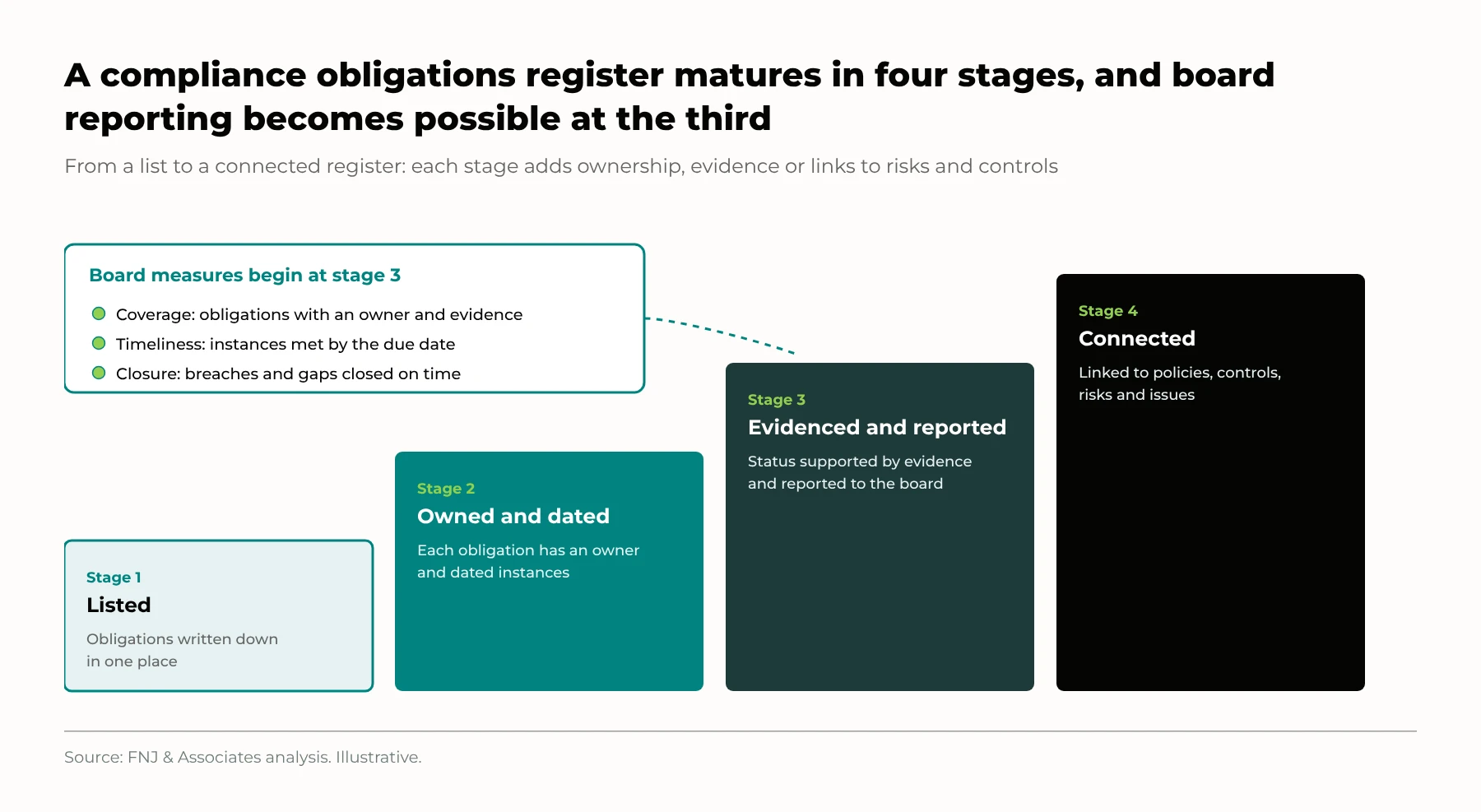
A compliance obligations register matures in four stages
| Stage | Description | Typical sign |
|---|---|---|
| 1. Listed | Obligations are written down in one place | A spreadsheet maintained by one person |
| 2. Owned and dated | Each obligation has an owner and dated instances | Owners receive reminders before due dates |
| 3. Evidenced and reported | Status is supported by evidence and reported to the board | Coverage, timeliness and closure are measured each quarter |
| 4. Connected | Obligations link to policies, controls, risks and issues | A missed obligation automatically prompts a corrective action and a review of the related risk |
A spreadsheet works until the register grows
A small organisation can keep its compliance obligations register in a spreadsheet. The approach strains as obligations multiply, owners change and evidence accumulates in email. At that point, reminders, approvals and evidence storage are better handled in a system built for the purpose. Trigarc Compliance, implemented by FNJ, manages obligations, dated compliance events, evidence and corrective actions in one place.
A compliance obligations register prepares the institution for inspections and audits
When a regulator, an external auditor or a donor’s reviewer asks how the institution manages its obligations, a well-kept register answers the question in one document, showing what applies, who is responsible, whether each instance was met and where the evidence sits.
The register also shortens the preparation for an inspection, because the compliance function can extract the history of the obligations within the inspector’s scope, identify any missed instances in advance and show the corrective action already taken, instead of assembling the picture under time pressure.
Groups need one register per entity and one consolidated view
A group with subsidiaries in several countries or sectors faces different obligations in each, so each entity should hold its own register under local ownership, while the group compliance function maintains a consolidated view that applies the same fields, scales and measures, allowing the group board to compare entities on a like-for-like basis.
Four pitfalls weaken a compliance obligations register
- Obligations copied from legal text without translation, which leaves owners unsure what action is expected of them.
- Owners named as departments instead of roles, so accountability is diffused across a team.
- Recurring obligations recorded once, which hides missed instances behind a single status.
- Status updated without evidence, which gives the board a figure it cannot rely on.
Smaller organisations can start with the obligations that matter most
A compliance obligations register does not need to be complete on its first day to be useful, and a smaller organisation can begin with the twenty or thirty obligations whose consequences are heaviest, such as licence renewals, regulatory returns, statutory filings and donor reports, before extending the register as the discipline becomes routine.
Three moves for the next quarter
- Name one owner for the register and list the sources. The compliance function or the company secretary holds the list; legal, finance and operations contribute.
- Enter the twenty obligations with the heaviest consequences first, as dated instances with the evidence required for each.
- Report coverage, timeliness and closure at the next committee meeting, even if the first figures are incomplete. The baseline is the point.
How we support your institution
FNJ & Associates builds and reviews compliance obligations registers for regulated institutions, NGOs and corporates. We identify the applicable requirements, translate them into obligations, agree owners with management and set up the reporting to the board. We also provide an outsourced or co-sourced compliance function where an institution needs one.
Questions about the compliance obligations register
What is a compliance obligations register?
A compliance obligations register is a single list of the legal, regulatory, contractual and internal requirements that apply to an organisation. Each entry has an owner, a frequency, a due date, the evidence required and a current status.
Who should own the compliance obligations register?
The compliance function, or the company secretary in a smaller organisation, maintains the register. Each obligation is owned by the manager whose team performs it, and the board or its committee oversees the result.
How often should the register be updated?
Status should be updated as each obligation falls due, and the content should be reviewed at least once a year and whenever a law changes, a new product is launched or a significant contract is signed.
Do NGOs need a compliance obligations register?
Yes, because an NGO has obligations to its regulator, to tax and employment authorities and to each donor under its grant agreements. A register is often the only place where these are seen together.
What is the difference between a compliance obligations register and a risk register?
A compliance obligations register lists what the institution must do, with owners, dates and evidence, while a risk register lists what could go wrong and how well it is controlled, and the two connect because each significant obligation carries a compliance risk that belongs in the risk register.
Should contractual and donor obligations be included?
Yes, because grant agreements, loan covenants, licence conditions and significant contracts impose requirements that carry real consequences when missed, and keeping them alongside statutory obligations gives the board one complete view.
Can FNJ & Associates build our register?
Yes, FNJ & Associates builds compliance obligations registers, sets up board reporting and implements Trigarc Compliance where a system is needed, and the firm can be reached through fnjassociates.co.ke to request a proposal.
Request a proposal for your compliance obligations register
FNJ & Associates helps boards and compliance teams across Kenya and East Africa identify what is required of them, assign ownership and report on performance.
About FNJ & Associates
FNJ & Associates is an ICPAK-registered CPA firm and a multidisciplinary team of 20+ professionals holding CPA(K), ACCA, CIA, CISA, CFE, CEH, CAMS and CIPP/E credentials, serving more than 100 organisations across Kenya and East Africa. The firm provides governance, risk and compliance advisory, including AML/CFT, anti-bribery and data protection, and implements Trigarc Compliance for obligation tracking, evidence and corrective actions. Visit fnjassociates.co.ke to learn more.