

The codes ask for an annual evaluation, but the return comes from five or six actions, each with an owner and a date, reviewed twice in the following year.
Board evaluation in Kenya is an established annual exercise: the Capital Markets Authority’s Code of Corporate Governance Practices for Issuers of Securities to the Public 2015, gazetted on 4 March 2016, asks boards to evaluate themselves, and the frameworks for banks, insurers and state corporations set similar expectations.
Completion is not the difficulty, since many evaluations end with a report that is noted and filed, and the same observations return the following year.
The evaluations that change a board share three features: they cover six areas, they combine three methods and they end in a short action plan that the board tracks. This article sets out what the codes expect and how to build each feature.
The Kenyan codes expect an annual evaluation
The Capital Markets Authority’s Code of Corporate Governance Practices for Issuers of Securities to the Public 2015 was gazetted on 4 March 2016. It asks the board to agree its annual evaluation process and to evaluate the board, its committees, the chief executive and the company secretary. The Code also provides for a governance audit at least once a year.
Other frameworks that shape board evaluation in Kenya point the same way. The Central Bank of Kenya’s Prudential Guideline on Corporate Governance provides for board evaluation in banks, and Mwongozo sets governance expectations for state corporations. Institutions should read the current text of the framework that applies to them, since several are under review.
A board evaluation in Kenya should cover six areas
| Area | What the evaluation asks |
|---|---|
| Composition and skills | Whether the board has the skills, independence and diversity its strategy needs |
| Agenda and information | Whether meeting time goes to the matters that count, and whether papers arrive early and support decisions |
| Committees | Whether each committee fulfils its terms of reference and reports clearly to the board |
| Strategy and risk oversight | Whether the board shapes strategy and understands the principal risks |
| Relationship with management | Whether challenge is constructive and the boundary between board and management is respected |
| Individual contribution and the chair | Whether each director prepares, attends and contributes, and whether the chair draws out all views |
The second area deserves particular attention, because directors can only oversee what they can see, and an evaluation that tests the quality and timing of board papers often produces the most practical improvements.
Three methods work best in combination
- Questionnaires give a consistent view across all directors and allow comparison from year to year.
- Confidential interviews bring out what a questionnaire cannot, such as dynamics in the room and concerns about succession.
- Review of documents and observation tests what directors report against agendas, minutes, papers and a live meeting.
Many boards run an internal evaluation in most years and commission an independent one periodically. An independent facilitator brings candour, comparison with other boards and a clear separation from the people being assessed. The company secretary remains central in either case, coordinating the process and holding the record.
Questionnaire themes should probe behaviour as well as structure
A questionnaire that asks only whether the board has a charter or meets four times a year will produce reassuring answers and little insight, so the most useful questions in a board evaluation in Kenya ask directors how the board actually behaves.
| Theme | Sample question |
|---|---|
| Skills and composition | Which skill will the board most need in the next three years, and does it have it today? |
| Board papers | Do papers arrive early enough, and do they state the decision required? |
| Use of time | Is enough meeting time spent on strategy and principal risks, compared with routine reporting? |
| Challenge | Do directors challenge management constructively, and is dissent recorded? |
| Committees | Does each committee report to the board in a way that lets the board rely on its work? |
| Risk oversight | Could the board name the institution’s five principal risks and the appetite for each? |
| Chair | Does the chair draw out the views of every director, including the quieter ones? |
| Succession | Is there a plan for the succession of the chair, the chief executive and key directors? |
Confidential interviews follow a short guide
Interviews add what a questionnaire cannot capture, and they work best when each director is asked the same small set of open questions, with the facilitator free to follow the answers.
- What has the board done particularly well in the past year?
- Which decision would the board approach differently with hindsight?
- What information do you need that you do not receive today?
- How well do the board and management work together, and where is the boundary unclear?
- What should the chair do more of, or less of?
- If you could change one thing about how the board works, what would it be?
A five-stage sequence fits within one board cycle
| Stage | Activity | Led by |
|---|---|---|
| 1. Scope | Agree the areas, methods and whether to use an independent facilitator | Chair and nominations committee |
| 2. Gather views | Issue questionnaires and hold confidential interviews | Facilitator or company secretary |
| 3. Review evidence | Review agendas, papers and minutes, and observe a meeting | Facilitator |
| 4. Discuss findings | Share the draft findings with the chair | Facilitator and chair |
| 5. Agree actions | Present findings to the board and agree the action plan | Chair with the full board |
The value lies in the action plan
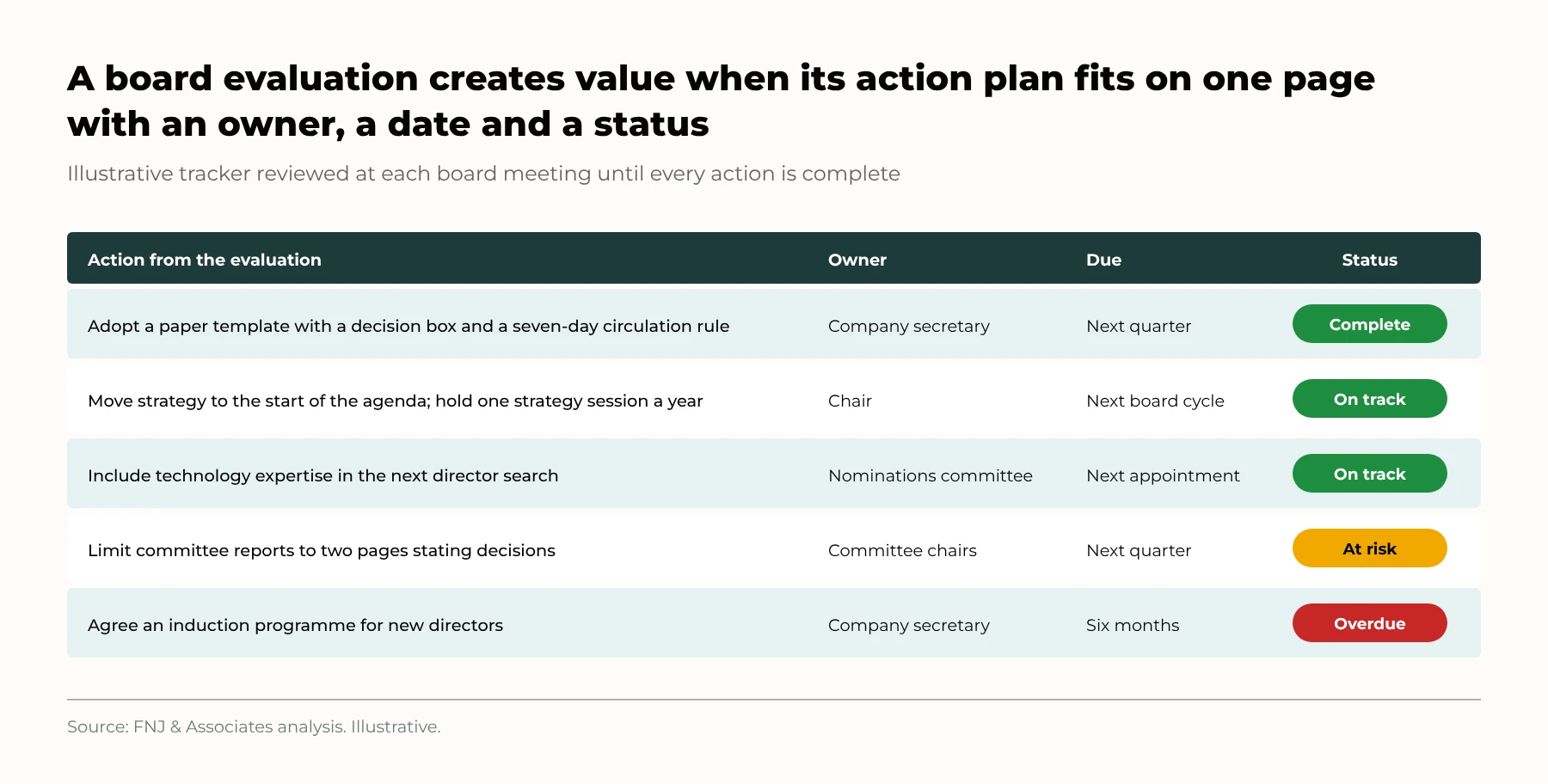
An evaluation report is a list of observations that becomes useful when the board converts it into a plan. A workable plan has no more than five or six actions, each with an owner, a date and a measure of completion. Examples include adding a skill through the next appointment, moving risk discussion earlier in the agenda or shortening papers to a standard format.
The plan should then appear on the board’s agenda at least twice in the following year. Progress is reported in the same way as any other board decision. This step turns board evaluation in Kenya from a compliance exercise into a tool for improvement, and it gives the next evaluation a baseline.
A worked action plan shows the level of precision boards need
The example below shows how four typical findings from a board evaluation in Kenya translate into actions that the board can track, each with an owner, a date and a measure that makes completion clear.
| Finding | Action | Owner | By | Measure of completion |
|---|---|---|---|---|
| Papers arrive late and lack a clear decision | Adopt a paper template with a decision box and a seven-day circulation rule | Company secretary | Next quarter | Share of papers circulated on time |
| Little time on strategy | Move strategy items to the start of the agenda and hold one strategy session a year | Chair | Next board cycle | Strategy session held and minuted |
| Gap in technology skills | Include technology expertise in the next director search | Nominations committee | Next appointment | Appointment made |
| Committee reports are long and descriptive | Limit committee reports to two pages stating decisions and matters for the board | Committee chairs | Next quarter | Reports in the new format |
Sector context shapes the evaluation
The six areas apply across sectors, but the emphasis differs. A bank board will weigh risk oversight and regulatory engagement heavily. An NGO board will look closely at donor accountability and the separation between governance and management. A state corporation board will consider its performance contract, and a SACCO board will consider the skills of elected directors and the support they receive. A good board evaluation in Kenya is tailored to these differences instead of applying one questionnaire to all.
Disclosure in the annual report should describe the process and the themes
Issuers report on their application of the Capital Markets Authority code, and the regulator’s frequently asked questions on the code give further guidance, so many boards summarise in the governance statement how the evaluation was conducted, who facilitated it, the main themes and the actions agreed, without disclosing individual ratings.
Evaluating individual directors and the chair needs particular care
Individual evaluation is the most sensitive part of the exercise, so feedback is best given privately, the chair’s own evaluation is usually led by the senior independent director or the deputy chair, and the results inform each director’s development plan and, where relevant, the board’s recommendation on re-election.
Committees deserve their own short evaluation
Much of a board’s work is done in its committees, so a board evaluation in Kenya should include a short assessment of each committee against its terms of reference, using questions that reflect the committee’s particular role.
| Committee | Questions that test its effectiveness |
|---|---|
| Audit | Does the committee meet the external and internal auditors without management, and does it follow up on overdue audit actions? |
| Risk | Does the committee review risks against appetite and challenge the assumptions behind the risk report? |
| Nominations and remuneration | Does the committee maintain a skills matrix and a succession plan, and link pay to agreed performance measures? |
| Investment or credit | Are decisions taken within delegated limits, and are exceptions reported to the board? |
Some moments call for an independent facilitator
An internal evaluation led by the chair and the company secretary serves most boards well in most years, yet certain circumstances make independent facilitation the better choice, because candour and an outside perspective matter more than familiarity.
- The board has a new chair or several new directors.
- The institution has been through a period of strain, a regulatory finding or a change of strategy.
- Several years have passed since the last independent evaluation.
- Directors have signalled concerns about board dynamics or the relationship with management.
- A regulator, investor or major funder has asked for evidence of an objective review.
Three moves for the next quarter
- Retrieve the last evaluation and count the actions closed. The ratio shows whether the exercise is producing change.
- Agree the scope and method of the next evaluation, including whether this is the year for an independent facilitator.
- Place the action plan on two board agendas in the coming year, with a named owner reporting on each action.
How we support your institution
FNJ & Associates facilitates board evaluation in Kenya and East Africa for listed and unlisted companies, financial institutions, state corporations and NGOs. We design the questionnaire, conduct confidential interviews, review board papers and minutes, and present findings to the board with a proposed action plan. We also deliver corporate governance training for directors, company secretaries and senior management.
Where a board wants its packs, actions and governance records in one place, we implement Trigarc Governance alongside the advisory work.
Questions about board evaluation in Kenya
Is board evaluation in Kenya mandatory?
For issuers of securities to the public, the Capital Markets Authority’s 2015 Code asks the board to carry out an annual evaluation. Banks, insurers and state corporations have their own governance frameworks. Each institution should check the framework that applies to it.
How often should a board be evaluated?
The codes that govern board evaluation in Kenya point to an annual exercise. Many boards carry out an internal evaluation in most years and an independent one periodically.
Who should conduct the board evaluation?
The chair and the company secretary usually lead an internal evaluation. An independent facilitator adds candour and comparison, and is useful when the board is new, has changed significantly or faces a difficult issue.
What is the difference between a board evaluation and a governance audit?
A board evaluation assesses how well the board performs, whereas a governance audit assesses whether the organisation complies with the governance code and sound practice. The two inform each other, although they answer different questions for the board and its regulators.
What should a board evaluation questionnaire include?
A questionnaire for board evaluation in Kenya should cover composition and skills, the quality and timing of board papers, the use of meeting time, committee effectiveness, strategy and risk oversight, the relationship with management, the chair’s leadership and succession, with questions that ask how the board behaves and not only whether a structure exists.
Who should see the results of a board evaluation?
The full board should see the collective findings and agree the action plan, while individual feedback is shared privately with each director and the chair’s feedback is usually handled by the senior independent director or deputy chair.
Can FNJ & Associates facilitate our board evaluation?
Yes, FNJ & Associates facilitates independent evaluations and helps boards turn the findings into an action plan, and the firm can be reached through fnjassociates.co.ke to request a proposal.
Request a proposal for an independent board evaluation
FNJ & Associates supports board evaluation in Kenya and East Africa, helping boards assess their effectiveness and act on the results, with confidential interviews, document review and a clear action plan.
About FNJ & Associates
FNJ & Associates is an ICPAK-registered CPA firm and a multidisciplinary team of 20+ professionals holding CPA(K), ACCA, CIA, CISA, CFE, CEH, CAMS and CIPP/E credentials, serving more than 100 organisations across Kenya and East Africa. The firm provides governance, risk and compliance advisory and corporate governance training, and implements Trigarc Governance for board reporting. Visit fnjassociates.co.ke to learn more.