
Tips detect more fraud than any other method, but they keep coming only when each report is acknowledged, assessed and answered on time.
Reports from staff, suppliers and communities detect more occupational fraud than any other method. The Association of Certified Fraud Examiners, in Occupational Fraud 2026: A Report to the Nations, attributes 43% of the cases it studied to tips. A whistleblowing procedure is therefore among the most productive controls a board oversees.
Its weak point is what happens after the report, because a reporter who hears nothing concludes that nothing was done, and colleagues draw the same conclusion. Kenya has no single statute in force that sets time limits for a response, so each organisation sets its own or sets none.
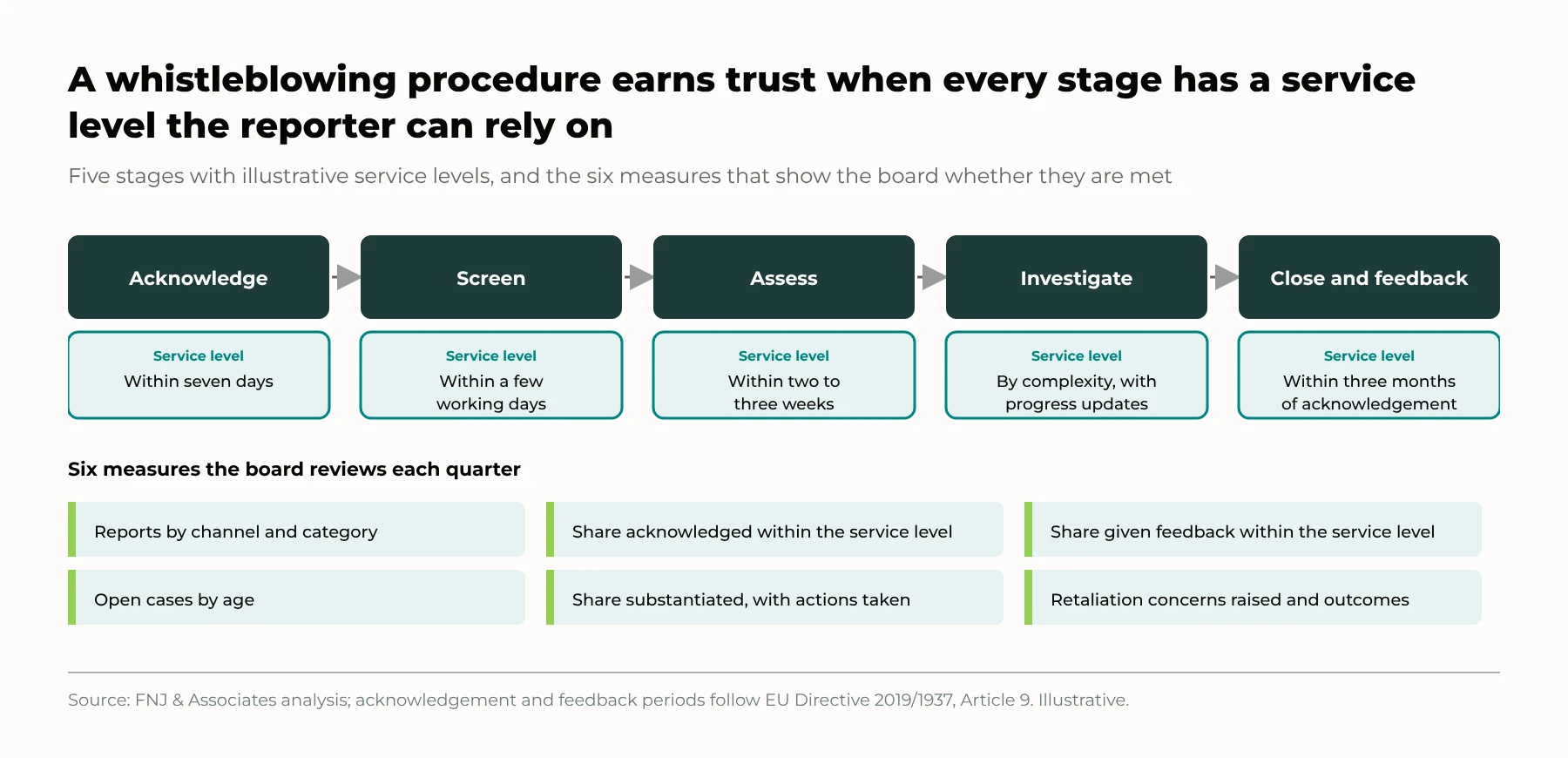
Five service levels, one for each stage of handling a report, close that gap, and six measures let the board see whether they are met. This article sets out both, builds on our earlier guidance on the whistleblower policy and complements our anti-fraud and forensic services.
International benchmarks set clear time limits
Kenya does not yet have a stand-alone whistleblower protection statute in force, although sector laws and the Bribery Act contain protections. In the absence of a single domestic standard, many institutions look to international practice. ISO 37002:2021 gives guidance on whistleblowing management systems, and the European Union’s Directive 2019/1937 goes further and sets two time limits for internal channels: receipt must be acknowledged within seven days, and feedback must be given within three months.
These limits do not bind Kenyan organisations, but they are useful as a reference point, particularly for subsidiaries of European groups and for NGOs funded by European donors.
A whistleblowing procedure has five stages, each with a service level
| Stage | What happens | Illustrative service level |
|---|---|---|
| Acknowledge | The reporter is told the report has been received and how to stay in contact | Within seven days, in line with the European benchmark |
| Screen | The report is checked for scope, urgency and conflicts of interest, and routed to the right handler | Within a few working days |
| Assess | The handler decides whether the report warrants an investigation, and on what terms | Within two to three weeks |
| Investigate | Evidence is gathered, findings are reached and actions are agreed | According to complexity, with progress updates to the reporter |
| Close and give feedback | The reporter is told, within the limits of confidentiality, what was done | Within three months of acknowledgement, in line with the European benchmark |
The service levels in the middle rows are illustrative, and each organisation should set its own, in proportion to its size and the volume of reports. What matters is that the levels are written into the whistleblowing procedure, measured and reported.
Each channel in a whistleblowing procedure suits a different reporter
No single channel suits every reporter, so most organisations offer several and route them all into one case record, which allows the same service levels to apply whichever route a person chooses.
| Channel | Strengths | Points to manage |
|---|---|---|
| Web portal | Available at all times, supports anonymous two-way contact and attachments | Must be easy to find and work on a mobile phone |
| Telephone line | Suits reporters who prefer to speak, and allows immediate follow-up questions | Calls must be logged into the case record promptly |
| Familiar and simple to use | Harder to keep anonymous, and messages can sit unread | |
| SMS or messaging | Reaches field staff and communities with limited internet access | Needs a clear process for logging and replying |
| In person or by letter | Suits reporters who trust a named individual | Depends on that individual recording the report correctly |
Anonymous reporters need a way to continue the conversation
Many reporters choose anonymity, and a channel that accepts an anonymous report but offers no way to ask a follow-up question often leaves the handler with too little to act on. A sound whistleblowing procedure gives the reporter a reference and a secure means to check for questions and updates without revealing identity. This two-way contact is frequently the difference between a report that is closed for lack of information and one that is resolved.
Triage criteria should be written down before the first report arrives
Screening decisions are made quickly and often under pressure, so the whistleblowing procedure should set out the questions the handler answers for every report, which keeps decisions consistent and makes them easy to explain later.
- Is the matter within the scope of the procedure, or does it belong in a grievance or customer complaint process?
- Is there an immediate risk to people, to assets or to evidence that requires action before assessment is complete?
- Does the report name senior management or anyone involved in handling reports?
- Does the matter require notification to a regulator, a donor or the police?
- Is there enough information to proceed, or should the handler ask the reporter follow-up questions?
Data protection law shapes how reports are handled in Kenya
A report contains personal data about the reporter, the people it names and any witnesses, so the Data Protection Act 2019 applies to the way it is collected, stored, shared and retained, and the procedure should restrict access to those handling the case, set a retention period and record the lawful basis for processing.
The rights of the person named in a report must be balanced against the needs of the investigation, which is why many organisations complete a data protection impact assessment before launching a new channel and agree with their data protection officer how requests from data subjects will be handled.
An investigation file should stand up to later review
- Terms of reference that state the allegation, the scope and the investigator.
- A record of evidence obtained, with the chain of custody for documents and devices.
- Notes of interviews, signed or acknowledged where possible.
- Findings that refer to the evidence on which each one rests.
- The decision taken, the actions agreed and the communications with the reporter.
Conflicts and retaliation are managed from the first day
Screening should confirm that no person named in a report can see or handle it. Where the report concerns senior management, the procedure should route it to the chair of the audit committee or another independent recipient.
Protection from retaliation is equally practical, and the procedure should name who monitors the reporter’s position after a report, for how long, and how a concern about retaliation is raised. A simple check at intervals after closure shows the reporter that the commitment was meant.
Retaliation monitoring needs a named owner and a schedule
Monitoring works best when it follows a simple schedule, with a named person checking the reporter’s position at set intervals after the report, for example at one, three and six months, and reviewing any change to their role, pay, performance rating or reporting line in that period.
The reporter should also know how to raise a concern about retaliation and who will receive it, and the procedure should treat a substantiated case of retaliation as a serious disciplinary matter in its own right.
The board should review six measures
- The number of reports received, by channel and category.
- The share acknowledged within the service level.
- The share given feedback within the service level.
- The number of open cases by age.
- The share of reports substantiated, with the actions taken.
- The number of retaliation concerns raised and their outcome.
A rising number of reports is usually a sign of confidence, not of deteriorating conduct. Boards that understand this encourage the channel instead of questioning the volume.
A one-page board report keeps the focus on trends
The six measures fit on a single page when they are shown as trends over four or more quarters, with a short commentary on what changed and why, and with any case that is overdue, involves senior management or carries regulatory implications listed separately for the committee’s attention.
Awareness determines whether the whistleblowing procedure is used
A channel that staff do not know about, or do not trust, will receive few reports regardless of its design, so the whistleblowing procedure should be supported by regular communication from leadership, a short explanation in induction training and visible information on the intranet, in workplaces and on the public website.
The message that matters most is that reports are welcome, that they are handled confidentially and that the organisation acts on them, and sharing anonymised examples of reports that led to change is often more persuasive than any policy statement.
Suppliers, partners and communities should be able to report too
Many concerns come from outside the workforce, from suppliers who are asked for a bribe, from partners who see funds misused or from community members affected by a programme, so the procedure should state that external reporters are welcome and the channel should be reachable without an employee login.
For NGOs, this is closely linked to safeguarding, since donors increasingly expect beneficiaries and communities to have a safe, accessible way to raise concerns, often in local languages and through channels that do not depend on internet access.
Five weaknesses recur in whistleblowing procedures
- Reports routed to a line manager who may be the subject of the concern.
- No acknowledgement or feedback, so reporters assume nothing was done.
- Anonymous reports closed because the handler had no way to ask a follow-up question.
- Investigations conducted by people without training in evidence or interviewing.
- Board reporting limited to the number of reports, with no view of timeliness or outcomes.
Case measures are best read alongside a periodic staff survey that asks whether people know how to raise a concern, whether they believe it would be acted on and whether they would fear consequences, since the gap between those answers and the volume of reports shows where the whistleblowing procedure needs more attention.
Three moves for the next quarter
- Measure the last twelve months. For each report, record the days to acknowledgement and to feedback. The result is the baseline.
- Write the five service levels into the procedure, and name an independent recipient for reports about senior management.
- Add the six measures to the audit committee pack, starting with the next meeting.
How we support your institution
FNJ & Associates reviews and designs whistleblowing procedures, trains report handlers and investigators, and conducts independent investigations led by Certified Fraud Examiners. We also provide awareness sessions for boards, for management and for staff at all levels.
Trigarc Ethics, implemented by FNJ, provides a speak-up portal, case intake, investigations and ethics registers, with reporting for the board and the audit committee.
Questions about the whistleblowing procedure
What should a whistleblowing procedure contain?
A whistleblowing procedure should state who can report, what can be reported, the channels available, how reports are handled at each stage, the service levels, how confidentiality is protected and how retaliation is prevented.
How quickly should a whistleblowing report be acknowledged?
The European Union’s Directive 2019/1937 sets seven days for acknowledgement and three months for feedback. These limits do not bind Kenyan organisations but are a widely used benchmark.
Can a report be made anonymously?
Yes, a sound procedure accepts anonymous reports and gives the reporter a secure way to receive questions and updates without revealing identity.
Who should receive whistleblowing reports?
Reports should go to a designated, impartial function such as ethics, compliance or internal audit. Reports about senior management should go to an independent recipient, such as the audit committee chair.
Does Kenya have a whistleblower protection law?
Kenya has no single whistleblower protection statute in force, although protections for people who report appear in specific laws such as the Bribery Act 2016, so many organisations rely on their own whistleblowing procedure and on international guidance such as ISO 37002 to set clear standards.
Should an external provider run the whistleblowing channel?
An external channel can increase trust and provide round-the-clock access, while an internal channel keeps knowledge of the organisation close to the handler, so many organisations combine an externally hosted intake channel with an internal team that assesses and investigates the reports.
Can FNJ & Associates help with our whistleblowing procedure?
Yes, FNJ & Associates reviews procedures, trains handlers, investigates reports and implements Trigarc Ethics, and the firm can be reached through fnjassociates.co.ke to request a proposal or a demo.
Book a Trigarc Ethics demo with FNJ
FNJ & Associates helps organisations across Kenya and East Africa design a whistleblowing procedure that people trust, from the policy and service levels to the reporting channel and investigations.
About FNJ & Associates
FNJ & Associates is an ICPAK-registered CPA firm and a multidisciplinary team of 20+ professionals holding CPA(K), ACCA, CIA, CISA, CFE, CEH, CAMS and CIPP/E credentials, serving more than 100 organisations across Kenya and East Africa. The firm provides forensic audit and investigation services and governance, risk and compliance advisory, and implements Trigarc Ethics for speak-up reporting, investigations and ethics registers. Visit fnjassociates.co.ke to learn more.