

Boards approve appetite once a year, yet the value lies in the thresholds, the warnings and the decisions that follow between approvals.
Boards of banks, SACCOs, insurers, fintechs, NGOs and large corporates across Kenya and East Africa now approve a risk appetite statement as part of their annual cycle, and supervisors increasingly expect to see one when they review how an institution governs risk.
Approval has not always produced use, because many statements describe appetite in broad words such as “low” or “moderate” that cannot be measured. As a result, lending, pricing, investment and expansion decisions are taken without reference to them and directors learn that appetite was exceeded only after a loss has been recorded.
Three design features close that gap: a statement built in three layers that run from the board’s intent down to operational limits, thresholds set in three zones that signal when a response is required, and a defined process that turns every breach into a recorded decision. This article sets out each feature, and it complements the wider work of our risk management services in Kenya.
Supervisors expect the board to set appetite and management to use it
The Financial Stability Board’s Principles for an Effective Risk Appetite Framework, published in November 2013, describe appetite as the aggregate level and types of risk an institution is willing to assume to achieve its strategy. They assign the board responsibility for approving it and holding management accountable for staying within it.
In Kenya, the Central Bank of Kenya’s draft Risk Management Guidelines, published for comment in 2026, point in the same direction for banks, and the expectation of a board-approved appetite has spread well beyond banking. As a result, insurers, SACCOs, development finance institutions and larger NGOs are now asked by regulators, rating agencies and donors to show how appetite is set and monitored.
An effective risk appetite statement is built in three layers
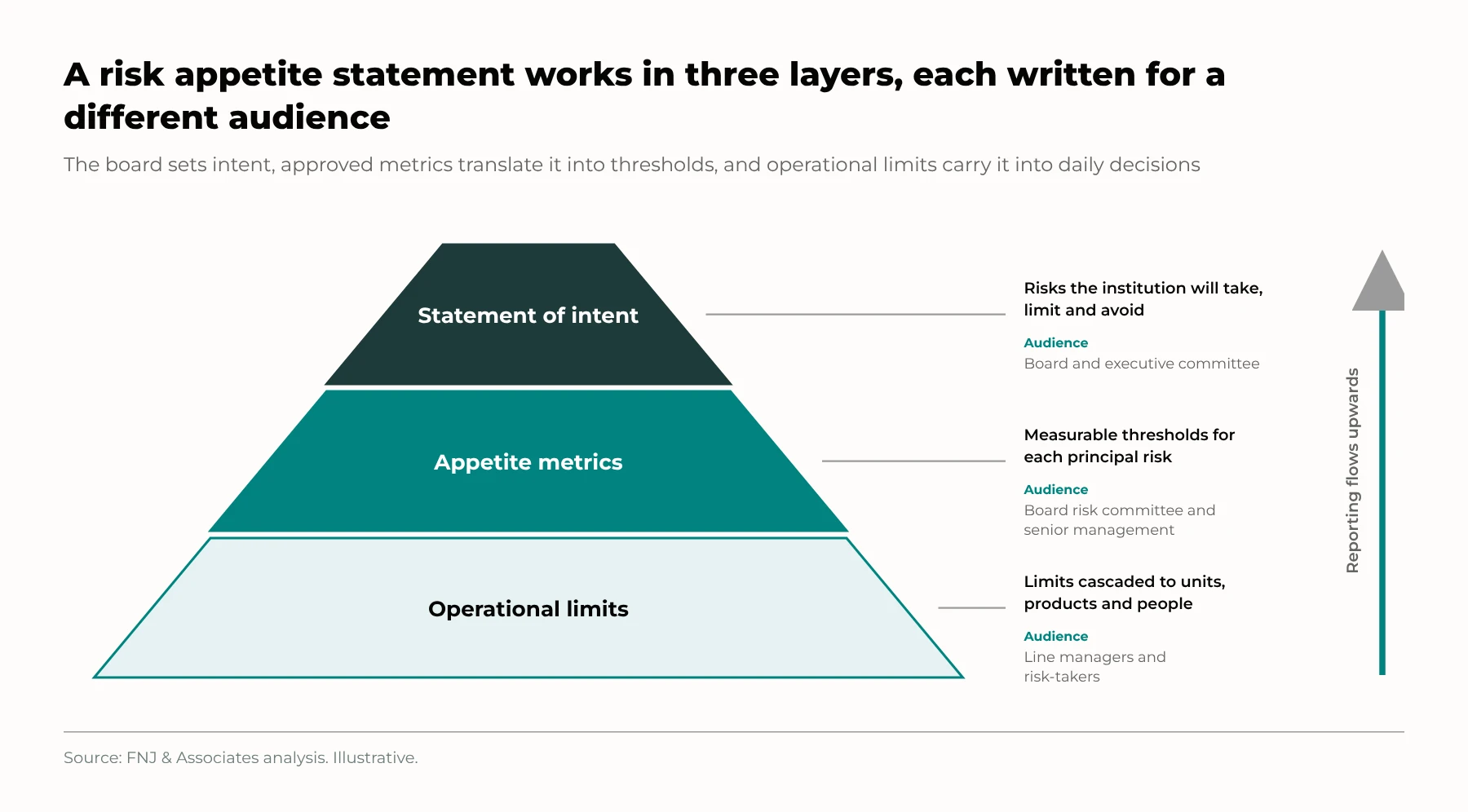
The most common weakness is a statement that stops at the first layer, so the board’s intent never reaches the people who take risk every day. The remedy is to build the statement in three connected layers that each audience can use.
| Layer | Content | Primary audience |
|---|---|---|
| Statement of intent | A short description of the risks the institution will take, will limit and will avoid, linked to strategy | Board and executive committee |
| Appetite metrics | Measurable indicators for each principal risk, with thresholds approved by the board | Board risk committee and senior management |
| Operational limits | Limits cascaded to business units, products, counterparties and individuals | Line managers and risk-takers |
Each layer should be traceable to the one above it, so that a branch lending limit can be explained by reference to a portfolio metric and the portfolio metric by reference to the board’s statement of intent, which is what allows the board to see that its decisions are being applied in practice.
Thresholds in three zones turn a risk appetite statement into an early warning
A single limit tells the board only that a line has been crossed, which is usually too late to act. As a result, effective statements set three zones for each metric, each with an agreed response that is written down before it is needed.
| Zone | Meaning | Agreed response |
|---|---|---|
| Within appetite | The metric sits where the board wants it to be | Routine monitoring and reporting |
| Early warning | The metric is approaching the edge of appetite | Management reviews the cause and reports a plan to the risk committee |
| Outside appetite | The metric has crossed the boundary the board approved | Immediate escalation and a board decision to act, accept for a limited period or revise appetite |
The early warning zone carries most of the value, because it gives management time to respond while the position is still within tolerance. Boards that set it with care receive fewer surprises and spend their meetings on decisions instead of explanations.
Qualitative appetite still needs measures that can be observed
Some of the most important statements concern reputation, conduct, compliance and safeguarding. They are often written as “no appetite” or “zero tolerance”, which conveys the board’s intent but cannot be monitored unless it is translated into measures that show whether the intent is being honoured.
A statement of no appetite for regulatory breaches, for example, can be monitored through the number of breaches reported, the age of open regulatory findings and the share of returns filed on time, while a statement on customer outcomes can be monitored through complaint volumes, the time taken to resolve complaints and the proportion upheld. A statement on safeguarding can be monitored through the number of concerns raised and the time taken to act on them.
Worked examples show how appetite metrics read in practice
The examples below show how three different institutions might express one appetite metric each, and the thresholds are illustrative only, since each board must set its own figures by reference to its strategy, capital, funding and regulatory requirements.
| Institution | Metric | Within appetite | Early warning | Outside appetite |
|---|---|---|---|---|
| Lender or SACCO | Non-performing loans as a share of gross loans | Below 6% | 6% to 8% | Above 8% |
| Insurer | Claims settled within the service standard | Above 90% | 85% to 90% | Below 85% |
| NGO | Expenditure questioned by donor auditors as a share of grant spend | Below 1% | 1% to 2% | Above 2% |
| Manufacturer | Share of a critical input bought from one supplier | Below 40% | 40% to 60% | Above 60% |
Each metric has a defined source, an owner and a reporting frequency. Each threshold has been set so that the early warning zone gives enough time for a response before the outer boundary is reached, which is the test a risk committee should apply when it reviews the figures each year.
Every breach of the risk appetite statement should end in a recorded decision
When a metric moves outside appetite, the board has three legitimate responses: it can direct management to act and bring the metric back within appetite, it can accept the position for a defined period and on stated conditions, or it can conclude that the appetite itself no longer fits the strategy and revise it.
What matters is that the decision is explicit, recorded in the minutes and revisited at an agreed date, because an unrecorded acceptance tends to become permanent. A pattern of unrecorded acceptances signals to the organisation that the risk appetite statement is advisory rather than binding.
Appetite should shape strategy, budgets and incentives
A risk appetite statement has its greatest effect when it is used before decisions are made. As a result, the strongest institutions test the strategic plan and the annual budget against appetite before approving them, and they ask management to show that new products, markets and major investments fit within it.
Incentives complete the link, because a remuneration scheme that rewards growth without regard to the risk taken can pull behaviour away from the board’s intent, while one that includes risk measures, such as the quality of the loan book or the closure of audit findings, reinforces it.
Sector context shapes which metrics matter most
Banks and SACCOs give most weight to credit, liquidity, capital and concentration, while insurers focus on underwriting, reserving, claims and reinsurance, and fintechs add technology, fraud and data protection to the core financial metrics.
NGOs typically express appetite for fraud, safeguarding, donor compliance and partner risk, manufacturers for supply continuity, product quality and workplace safety, and public bodies for service delivery, procurement integrity and the use of public funds, yet the three layers, the three zones and the discipline of recorded decisions apply in every case.
Reporting against the risk appetite statement should fit on one page
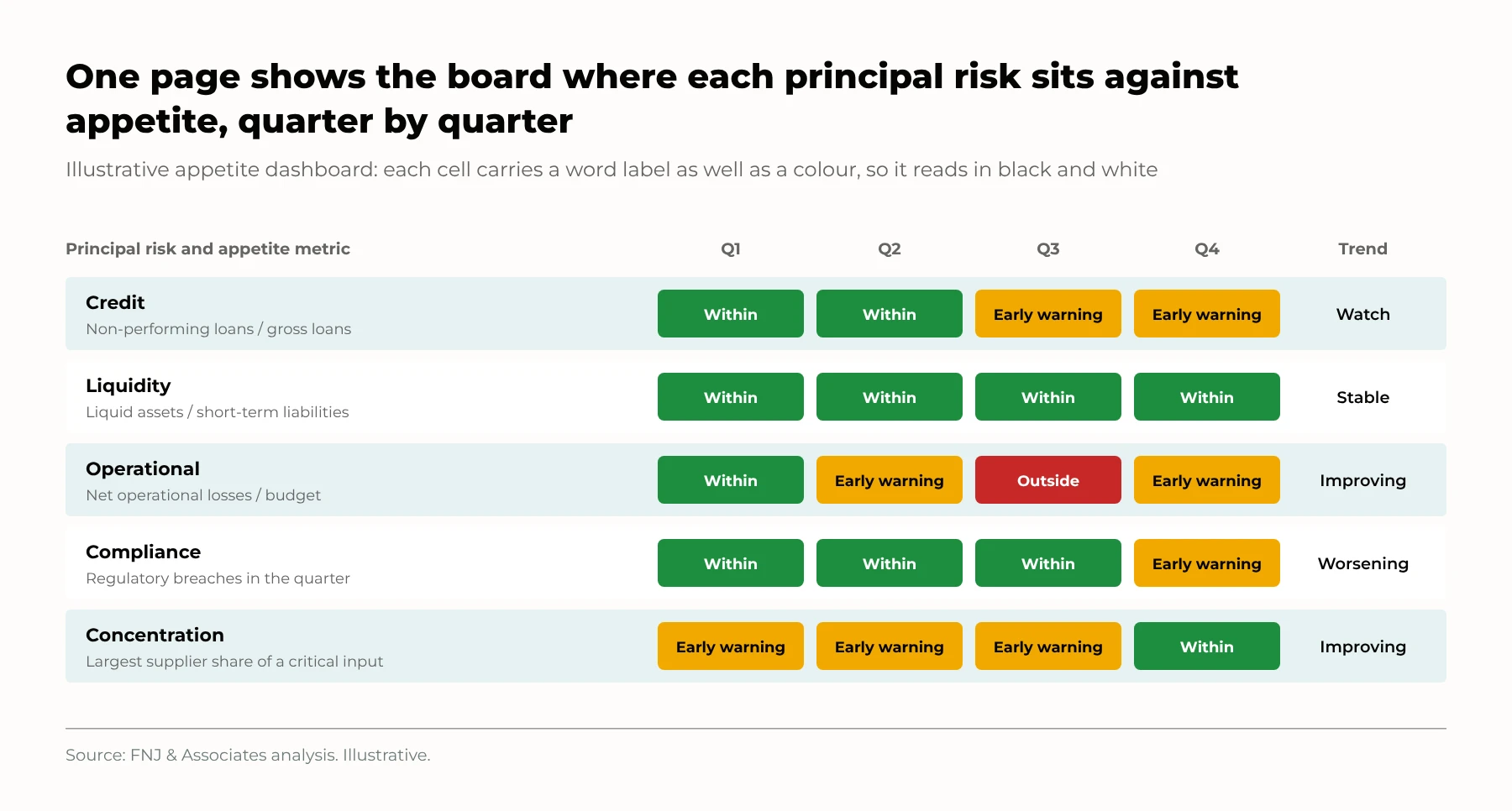
Directors absorb appetite reporting best when every metric appears on a single page, grouped by principal risk, with the current value, the trend over the last four quarters and the zone shown in colour together with a word label, so that the eye is drawn to the few metrics in the early warning or outside appetite zones.
Beneath the summary, a short commentary for each metric outside the routine zone explains the cause, the response under way and the decision required of the committee, while metrics within appetite need no commentary at all, which keeps the paper short and focuses the discussion where it adds value.
Five weaknesses recur in risk appetite statements
- Words without numbers, such as “low appetite for credit risk”, which cannot be monitored or breached.
- Metrics without owners, so that no one is accountable for explaining a movement or proposing a response.
- Thresholds set where the institution already is, which confirms the present position instead of expressing the board’s intent.
- No early warning zone, so the first signal the board receives is a breach that has already occurred.
- No link to operational limits, which leaves the risk appetite statement disconnected from the decisions taken every day.
Each weakness can be corrected within one annual cycle, and a review of the risk appetite statement against this list is a practical first step for a board that wants assurance that its appetite is being applied and not only approved.
Emerging and strategic risks need a qualitative appetite of their own
Some of the risks that matter most to a board, such as a new technology, a shift in regulation, climate effects on a loan book or a change in donor priorities, cannot yet be measured with confidence. As a result, the risk appetite statement should record the board’s stance on each in words, name the signals that management will watch and set a date by which the risk committee will consider whether a quantitative metric has become possible.
This keeps emerging risks within the governance cycle instead of leaving them to informal discussion. It gives the board a record of how its view developed as the risk became clearer, which is valuable evidence for regulators and auditors who ask how the institution anticipates change.
Three moves for the next quarter
- Test the current statement against the three layers. Identify any principal risk that has a statement of intent but no measurable metric, and any metric that has no operational limit beneath it.
- Add an early warning zone to the five most important metrics, with a written response for each zone approved by the risk committee.
- Review the last year’s breaches, confirm that each ended in a recorded decision and schedule a review of any acceptance that has no end date.
How we support your institution
FNJ & Associates designs and reviews risk appetite frameworks for banks, SACCOs, insurers, fintechs, NGOs and corporates, from facilitating the board discussion on intent to defining metrics, thresholds, operational limits and the reporting that brings them together for the risk committee.
Our risk work follows the model of Insight, Judgement, Execution, and the appetite framework links directly to the risk and control self-assessment, which tests whether controls keep residual risk within the thresholds the board has set. Where the institution needs a system to monitor appetite, Trigarc Risk, implemented by FNJ, records metrics against their thresholds and flags movements into the early warning and outside appetite zones.
Questions about the risk appetite statement
What is a risk appetite statement?
A risk appetite statement is a board-approved document that describes the types and amounts of risk an institution is willing to take in pursuit of its strategy, together with the metrics and thresholds used to monitor whether it is staying within that appetite.
What is the difference between risk appetite, risk tolerance and risk limits?
Risk appetite is the level of risk the board is willing to accept to achieve its objectives, risk tolerance is the acceptable variation around that level for a particular risk, and risk limits are the specific boundaries cascaded to business units and individuals to keep activity within both.
How often should the risk appetite statement be reviewed?
Most boards review the statement once a year alongside the strategy and budget, and they revisit it sooner when the strategy changes, a major acquisition is planned or the operating environment shifts materially.
Do NGOs and public bodies need a risk appetite statement?
They benefit from one, because a clear statement of the risks the organisation will and will not accept helps boards, donors and oversight bodies understand how decisions on programmes, partners and funds are made.
Who owns the risk appetite statement?
The board owns and approves the statement, the risk function proposes metrics and thresholds and reports against them, and management is accountable for operating within the limits that flow from it.
How many metrics should a risk appetite statement contain?
Most institutions find that two or three metrics for each principal risk, giving perhaps fifteen to twenty-five in total, are enough to monitor the board’s intent without overwhelming the risk committee, provided each metric has a clear source, owner and threshold.
Can FNJ & Associates help us design our risk appetite statement?
Yes, FNJ & Associates facilitates board workshops, defines metrics and thresholds, cascades limits and sets up risk committee reporting, and the firm can be reached through fnjassociates.co.ke to request a proposal.
Request a proposal for your risk appetite framework
FNJ & Associates helps boards and risk functions across Kenya and East Africa turn a risk appetite statement into measurable thresholds, timely warnings and recorded decisions.
About FNJ & Associates
FNJ & Associates is an ICPAK-registered CPA firm and a multidisciplinary team of 20+ professionals holding CPA(K), ACCA, CIA, CISA, CFE, CEH, CAMS and CIPP/E credentials, serving more than 100 organisations across Kenya and East Africa. The firm provides governance, risk and compliance advisory, and implements Trigarc Risk for risk identification, assessment and reporting. Visit fnjassociates.co.ke to learn more.