

Institutions accept risks every day, and the difference between sound practice and neglect lies in authority, records, time limits and review.
Risk acceptance is a normal part of managing an institution, because no bank, SACCO, insurer, NGO or company can reduce every risk to zero, and some controls would cost more than the losses they prevent. When a risk is accepted deliberately, by someone with the authority to do so and with a clear understanding of the consequences, it is a sound management decision.
In practice, many risks are accepted by default rather than by decision. An audit action passes its due date and is quietly dropped, a weakness identified in a self-assessment is noted and never revisited, or a policy exception granted for a month remains in place for years. As a result, the institution carries risks that no one with authority agreed to carry.
Five elements turn risk acceptance into a deliberate decision: an authority matrix, a complete record, a time limit, compensating controls where possible and regular review. This article sets out each element as part of our risk management services in Kenya.
Risk acceptance has a clear place in the risk framework
Every risk the institution identifies can be treated in one of four ways: avoided by stopping the activity, reduced through controls, transferred through insurance or contracts, or accepted. Acceptance is the right choice when the residual risk sits within appetite, when further controls would cost more than they save, or when a remedy is planned but cannot be implemented immediately.
Acceptance is not the right choice when the residual risk sits well outside the board’s risk appetite statement and no one with board-level authority has agreed to it, or when the decision is being used to avoid an inconvenient control rather than to manage a real trade-off.
An authority matrix decides who may accept which risks
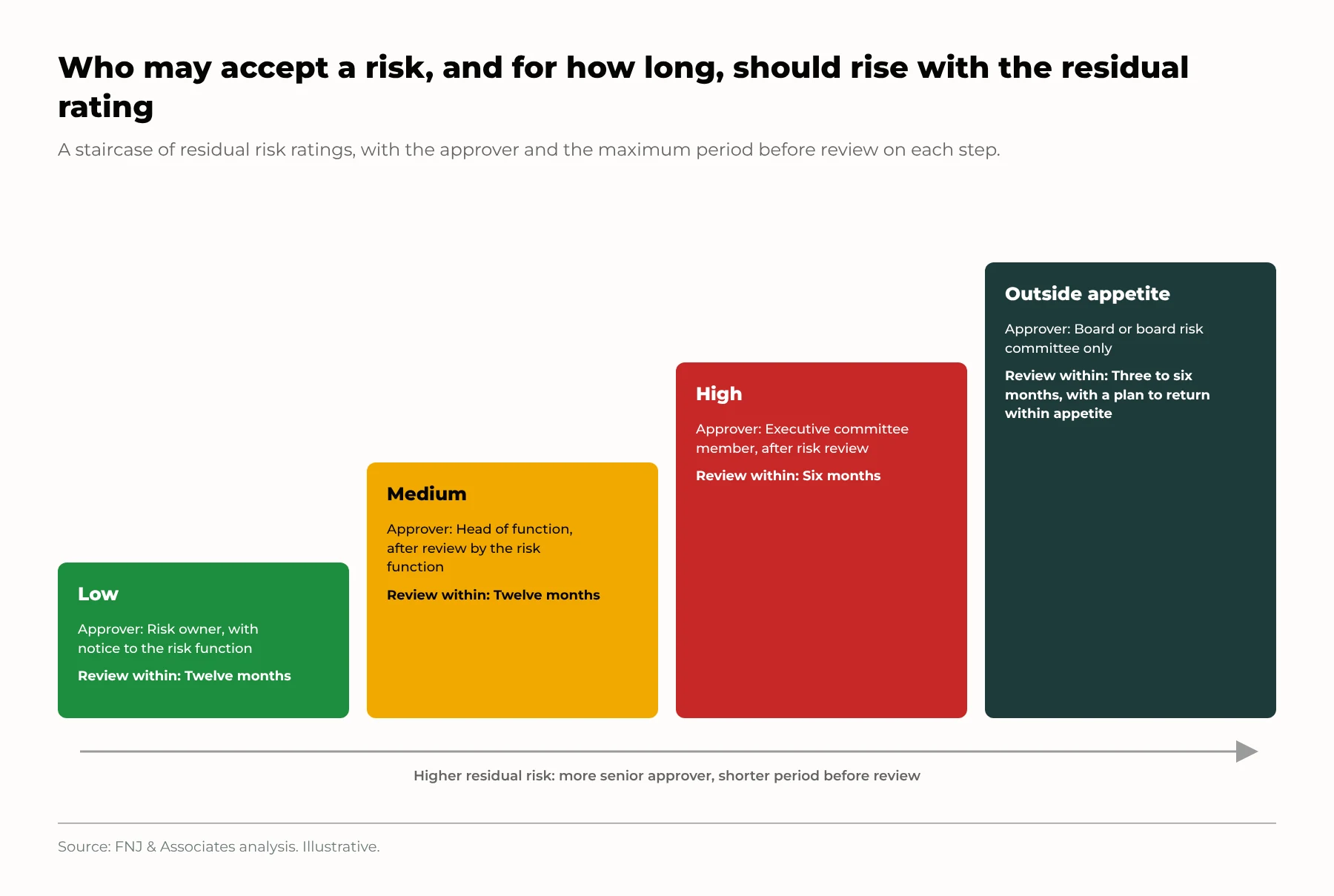
The authority to accept a risk should rise with the size of the residual risk, so that small risks can be accepted quickly by the people closest to them, while large risks reach senior executives or the board. An authority matrix written into the risk policy removes doubt about who may sign.
| Residual risk rating | Who may accept (illustrative) | Maximum period before review |
|---|---|---|
| Low | Risk owner, with notice to the risk function | Twelve months |
| Medium | Head of function, after review by the risk function | Twelve months |
| High | Executive committee member, after review by the risk function | Six months |
| Outside appetite | Board or board risk committee only | Three to six months, with a plan to return within appetite |
The risk function’s role is to review and challenge, not to accept on the business’s behalf. Keeping the decision with the accountable executive, and the challenge with the second line, preserves the separation between owning a risk and overseeing it.
A complete record makes risk acceptance defensible
When a regulator, an auditor or the board later asks why a risk was accepted, the answer should be on file. Each risk acceptance should record enough for a reader who was not involved to understand the decision and to judge whether it was reasonable at the time.
- The risk or finding being accepted, with its residual rating and the controls in place.
- The reason for acceptance, such as the cost of further controls or a planned remedy that is not yet possible.
- The potential consequence if the risk materialises, in financial and non-financial terms.
- Any compensating controls that reduce the exposure in the meantime.
- The approver, the date of approval and the expiry or review date.
- The review and challenge provided by the risk function.
Every risk acceptance needs an expiry date
An acceptance without an end date tends to become permanent, because there is no prompt to reconsider it. Setting an expiry date, with a reminder to the owner and the risk function before it falls due, forces a fresh decision: renew the acceptance with current reasons, implement the remedy, or escalate if circumstances have changed.
Renewal should not be automatic, because a risk accepted for six months because a system upgrade was planned should not simply be renewed when the upgrade slips, without asking why it slipped, whether the exposure has grown and whether a higher approver should now be involved.
Compensating controls reduce exposure while the risk is accepted
Where a preferred control cannot be implemented yet, a compensating control can often reduce the exposure in the meantime. A manual review of high-value transactions while an automated limit is built, or more frequent reconciliation while a system interface is fixed, are typical examples, and they should be recorded with the acceptance and tested like any other control.
Audit findings may also end in risk acceptance
Management sometimes decides not to implement an action agreed in response to an audit finding, because the cost has proved higher than expected or the business has changed. The Global Internal Audit Standards expect the chief audit executive to discuss such decisions with management and to communicate with the board where the accepted risk exceeds the organisation’s tolerance.
Recording these decisions as formal risk acceptances, with the same authority, record and expiry as any other, keeps the audit committee informed and prevents findings from being closed by silence. Our article on closing audit findings explains how accepted risks fit into the closure process.
Policy exceptions are a form of risk acceptance
A dispensation from a policy, a waiver of a requirement or a temporary breach that management chooses to tolerate are all forms of risk acceptance, even when they are not described that way. They should follow the same discipline, with an approver matched to the significance of the exception, a record of the reason and an expiry date, so that the institution can see at any time which policies are not being fully applied and why.
A risk acceptance register gives the board one view
All accepted risks, policy exceptions and audit findings closed through acceptance should sit in one register. The register shows the number of acceptances by rating and function, those approaching or past their expiry date, those renewed more than once and those outside appetite, which together tell the board how much risk the institution is carrying by choice.
A growing register is not necessarily a problem, since it may reflect more honest recording. What deserves attention is a pattern of repeated renewals, acceptances that have passed their expiry without review, or high-rated risks accepted below the level of authority the matrix requires.
Five weaknesses recur in risk acceptance
- Acceptances made by people without the authority the risk rating requires.
- No expiry date, so acceptances become permanent by default.
- Renewals granted without new reasons or a fresh look at the exposure.
- Policy exceptions and audit findings accepted outside the risk framework.
- No single register, so the board cannot see the total risk accepted.
Sector context shapes what is commonly accepted
Banks and SACCOs often accept risks relating to legacy systems awaiting replacement, manual processes in branches and concentration in particular sectors or customers, while insurers commonly accept risks in claims processing backlogs and distribution channels that are being redesigned.
NGOs may accept security risks in difficult locations or weaker controls at new partners while capacity is built, and manufacturers may accept supply concentration while alternative suppliers are qualified. In each case, the five elements of authority, record, expiry, compensating controls and review apply in the same way.
Risk acceptance should be quantified wherever possible
A statement that a risk is “accepted as low” says little about what the institution stands to lose. Wherever possible, the record should estimate the potential loss in a realistic adverse case, the likelihood of that case occurring during the acceptance period and any non-financial consequences, such as harm to customers or regulatory action, so that the approver knows what they are agreeing to.
Quantification also allows the board to see the total risk accepted across the institution. Ten acceptances that each appear small may together amount to an exposure the board would not have approved as a single decision, and only a quantified register reveals that pattern.
The risk function should challenge, not rubber-stamp
The second line adds value to risk acceptance by testing the reasons given, asking whether cheaper controls have been considered, checking that compensating controls exist and work, and confirming that the approver has the authority the matrix requires. Where the risk function disagrees with an acceptance, the disagreement should be recorded and, for significant risks, escalated to the risk committee.
A risk function that rarely challenges acceptances may be under-resourced or too close to the business, and the risk committee should ask how many acceptances were challenged, how many were changed as a result and how many disagreements were escalated.
Changes in circumstances should trigger an early review
Some events should prompt a review of a risk acceptance before its expiry date, such as a loss or incident linked to the accepted risk, a change in regulation, a significant change in the business or the failure of a compensating control. The acceptance record should name these triggers so that the owner and the risk function know when to revisit the decision without waiting for the calendar.
Smaller institutions can keep risk acceptance simple
A SACCO, a growing fintech or a mid-sized NGO does not need an elaborate system to apply these disciplines. A one-page acceptance form, an authority matrix in the risk policy, a single spreadsheet register with expiry dates and a standing item on the risk committee agenda deliver most of the value of formal risk acceptance at very little cost, and the approach can be extended as the institution grows.
Three moves for the next quarter
- Write an authority matrix into the risk policy, linking each residual rating to an approver and a maximum review period.
- Gather all current acceptances, exceptions and accepted audit findings into one register, and add an expiry date where none exists.
- Report to the risk committee the acceptances outside appetite, those past expiry and those renewed more than once.
How we support your institution
FNJ & Associates designs risk acceptance processes, authority matrices and registers, reviews existing acceptances for adequacy and helps boards and risk committees understand the risk the institution carries by choice. Our risk work follows the model of Insight, Judgement, Execution, and risk acceptance is where judgement is most visible.
Trigarc Risk, implemented by FNJ, records each risk acceptance with its approval route, compensating controls and expiry date, sends renewal reminders and reports the register to the risk committee.
Questions about risk acceptance
What is risk acceptance?
Risk acceptance is a deliberate decision by an authorised person to tolerate a risk at its current level, without further treatment for a defined period, with the reasons and consequences recorded.
Who should approve a risk acceptance?
The approver should depend on the residual risk rating, with risk owners accepting low risks, senior executives accepting high risks and the board or its risk committee accepting risks that sit outside appetite.
How long should a risk acceptance last?
Most institutions set a maximum of twelve months for low and medium risks and shorter periods for high risks or those outside appetite, after which the acceptance must be reviewed and renewed, remedied or escalated.
What is the difference between risk acceptance and a policy exception?
A policy exception is a specific form of risk acceptance in which a requirement of a policy is not applied, and it should follow the same discipline of authority, record, expiry and review.
Can management accept the risk instead of implementing an audit action?
Yes, if a person with the right authority makes and records the decision and agrees a review date, and the chief audit executive should inform the board if the accepted risk exceeds the organisation’s tolerance.
Should accepted risks be reported to the board?
Yes, the board or its risk committee should see a summary of the risk acceptance register, including acceptances outside appetite, those past expiry and those renewed repeatedly, so that it understands the risk the institution carries by choice.
What should a risk acceptance record contain?
A risk acceptance record should describe the risk and its residual rating, the reason for acceptance, the potential consequence, any compensating controls, the approver, the approval date, the expiry date and the review provided by the risk function.
Can FNJ & Associates design our risk acceptance process?
Yes, FNJ & Associates designs authority matrices, records and registers for risk acceptance and reviews existing acceptances, and the firm can be reached through fnjassociates.co.ke to request a proposal.
Request a proposal for your risk acceptance process
FNJ & Associates helps institutions across Kenya and East Africa make risk acceptance a deliberate, recorded and reviewed decision that the board can see.
About FNJ & Associates
FNJ & Associates is an ICPAK-registered CPA firm and a multidisciplinary team of 20+ professionals holding CPA(K), ACCA, CIA, CISA, CFE, CEH, CAMS and CIPP/E credentials, serving more than 100 organisations across Kenya and East Africa. The firm provides governance, risk and compliance advisory, and implements Trigarc Risk for risk identification, assessment and reporting. Visit fnjassociates.co.ke to learn more.