
Tiering suppliers and partners by exposure lets an institution concentrate due diligence, contract terms and monitoring where they matter.
Institutions across Kenya and East Africa rely on third parties for an expanding share of their operations, from cloud hosting and payment processing to claims handling, debt collection, agency banking and the delivery of donor-funded programmes, which makes a sound third-party risk assessment part of the core risk framework instead of a procurement formality.
Many organisations still apply one onboarding process to every supplier, so the provider that hosts the core system receives the same questionnaire as the stationery vendor, while the review of critical suppliers after the contract is signed is left to chance and concentration on a few providers grows unnoticed.
A tiered approach resolves this: clear criteria place each third party in a tier, the depth of due diligence, contract protection and monitoring rises with the tier, and a reassessment cycle keeps the picture current. This article sets out each element as part of our risk management services in Kenya.
Regulators and donors increasingly look through to third parties
The Central Bank of Kenya’s prudential guidelines include a guideline on outsourcing for banks, the Data Protection Act 2019 makes data controllers responsible for the processors they appoint. Donors expect NGOs to assess and monitor the implementing partners and sub-grantees through which their funds flow.
The common thread is that an institution can outsource an activity but not the accountability for it. As a result, the board needs to know which third parties the organisation depends on, what could go wrong with each and how the risk is being managed.
Five criteria place each supplier in a third-party risk assessment tier
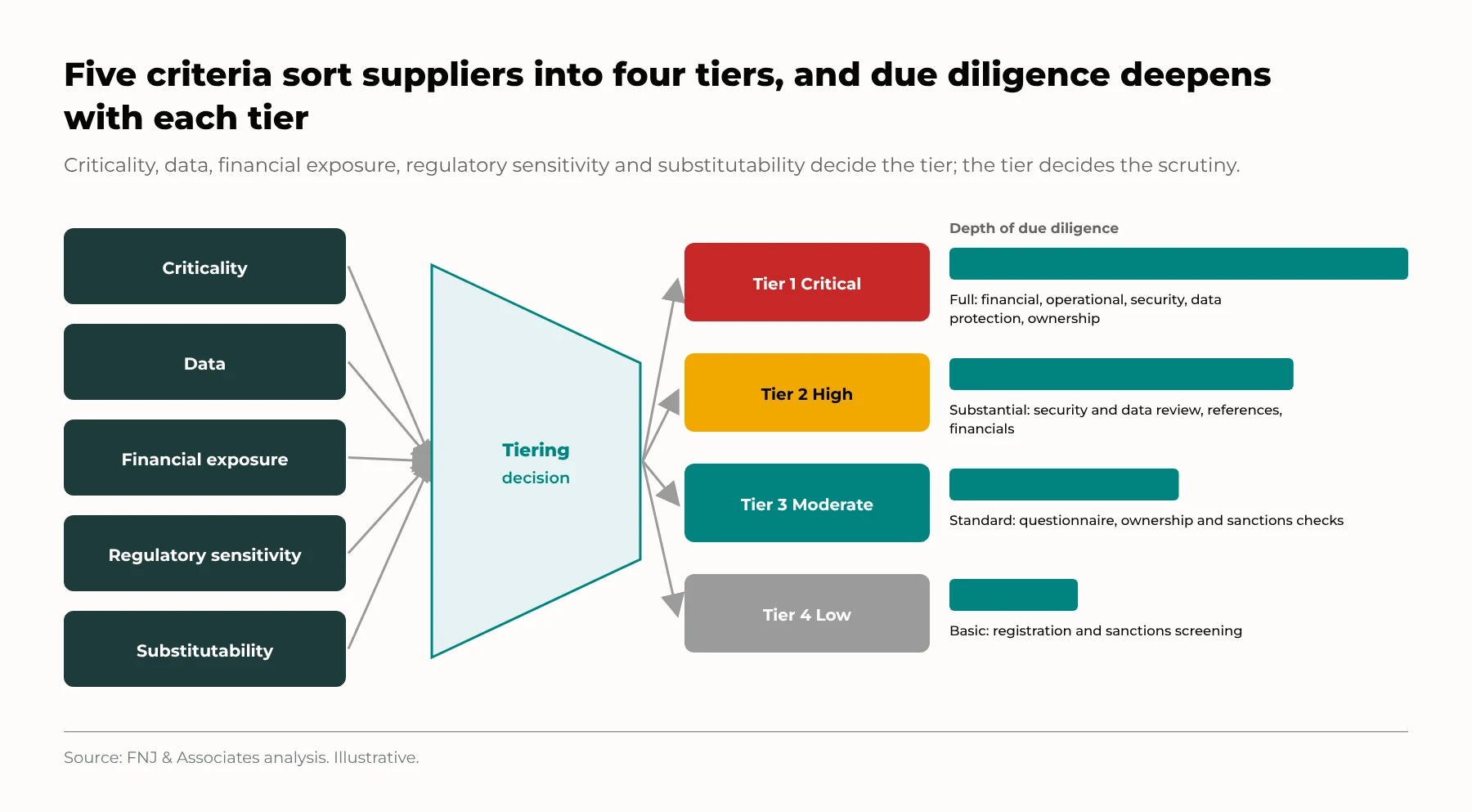
Tiering works when the criteria are few, clear and applied consistently, and five questions answered at onboarding are usually enough to decide how much attention a supplier or partner deserves.
- Criticality: would the failure of this third party disrupt a critical service to customers, members or beneficiaries?
- Data: will it hold, process or have access to personal or confidential data?
- Financial exposure: how large is the contract value or the amount of funds it will handle?
- Regulatory sensitivity: does the activity fall under a regulator’s outsourcing rules or a donor’s sub-award conditions?
- Substitutability: how quickly could the activity be moved to another provider or brought back in-house?
The answers combine into three or four tiers, and the table shows how the depth of work typically rises with the tier, with the detail adapted to each institution’s size and sector.
| Tier | Typical examples | Due diligence | Reassessment |
|---|---|---|---|
| 1. Critical | Core system host, payment processor, key implementing partner | Full: financial, operational, security, data protection, ownership and integrity checks | Annually, with continuous monitoring |
| 2. High | Claims administrator, collection agency, payroll provider | Substantial: security and data protection review, references, financial review | Every one to two years |
| 3. Moderate | Professional services, facilities management | Standard: questionnaire, ownership and sanctions checks | At renewal |
| 4. Low | Office supplies, catering | Basic: registration and sanctions screening | At renewal |
Due diligence for critical third parties goes beyond the questionnaire
For the suppliers and partners in the highest tier, a self-completed questionnaire is a starting point rather than an answer. As a result, the third-party risk assessment should test the responses against independent evidence such as audited financial statements, independent assurance reports on controls, certificates for information security management, results of penetration tests and the findings of a site visit.
Ownership and integrity checks matter as much as operational ones, because a supplier owned by a politically exposed person, a sanctioned party or a director of the institution creates a different kind of risk, and screening of beneficial owners and adverse media at onboarding and at renewal is now standard practice in financial services and among donor-funded organisations.
Contract terms should rise with the tier
The contract is where the institution secures the rights it will need if something goes wrong. As a result, agreements with critical and high-tier third parties should include service levels with consequences, rights of audit and access for the institution and its regulator, data protection obligations, notification of incidents within a defined time, requirements for business continuity and the right to terminate with an orderly exit.
Exit planning is the term most often missing, yet the ability to move a critical service to another provider without disruption is what limits the institution’s dependence on any single supplier. A short written exit plan for each critical third party is a practical test of whether that ability exists.
Monitoring after signing keeps the third-party risk assessment current
Risk changes after the contract is signed, as suppliers are acquired, lose key staff, suffer incidents or come under financial pressure. As a result, the institution should monitor critical third parties through service level reports, incident notifications, periodic attestations and, where the exposure justifies it, independent checks of financial standing and adverse news.
Concentration deserves particular attention at the portfolio level, because several business units may each rely on the same cloud provider, payment aggregator or implementing partner without any one of them seeing the combined dependence. A register that shows all third parties in one place is the simplest way to reveal it.
Sub-grantees and implementing partners are third parties too
For NGOs and development programmes, the most significant third parties are often the local partners that deliver activities and spend donor funds, and the same tiered logic applies: a partner managing a large grant in a high-risk location warrants a pre-award assessment of governance, financial management, safeguarding and anti-fraud controls, followed by monitoring visits and periodic financial reviews.
A proportionate approach also supports localisation, because smaller partners can be given a clear path to strengthen their systems instead of being excluded by a one-size-fits-all checklist that only large organisations can satisfy.
Sector context changes the emphasis
Banks and payment service providers concentrate on outsourcing of core systems, cloud services and agents, insurers on claims administrators, intermediaries and reinsurers, and fintechs on technology partners and the banks and mobile money providers on which their products depend.
Manufacturers give most weight to suppliers of critical inputs and logistics, public bodies to contractors delivering public services, and NGOs to implementing partners and the financial service providers that move funds to programme locations, yet in every case the five criteria, the tiers and the cycle of monitoring remain the same.
Fourth parties extend the chain beyond the contract
A critical supplier often relies on its own providers for hosting, software or staff, and a failure two links away can interrupt the institution’s service just as surely as a failure in the direct supplier. As a result, the third-party risk assessment for critical relationships should ask which subcontractors the supplier depends on and require notice before material subcontracting changes.
This matters most in technology, where several apparently independent providers may run on the same cloud platform, and in donor-funded programmes, where an implementing partner may pass funds and activities to smaller community organisations that the donor and the lead agency never assess directly.
Third-party incidents need a playbook prepared in advance
When a critical supplier suffers a data breach, an outage or a fraud, the institution has little time to decide how to protect customers, notify regulators and maintain service. As a result, the playbook for each critical relationship should set out who leads the response, how the institution will be informed, which notifications may be required and how the service can continue if the supplier cannot recover quickly.
Testing the playbook once a year with the supplier, even as a short desk exercise, reveals gaps in contact details, data access and fallback arrangements that are far easier to close before an incident than during one.
Five weaknesses recur in third-party risk assessment
- No single list of third parties, so the institution cannot say how many suppliers it relies on or which are critical.
- One questionnaire for every supplier, which overburdens low-risk vendors and under-examines critical ones.
- Due diligence only at onboarding, with no reassessment as the supplier or the relationship changes.
- Contracts without audit, incident or exit terms, which leaves the institution without leverage when problems arise.
- No view of concentration, so dependence on a single provider across several functions goes unreported.
The board needs a short view of third-party risk
A quarterly third-party risk assessment summary for the risk committee should show the number of third parties in each tier, the critical relationships with overdue reassessments or open issues, any incidents involving third parties in the period and the concentrations that the institution has chosen to accept, which together give directors a clear sense of how dependent the organisation is on others and how well that dependence is managed.
Data protection due diligence deserves its own questions
Where a third party will process personal data, the third-party risk assessment should confirm the lawful basis for sharing the data, the location where it will be stored and processed, the security measures in place, the supplier’s process for notifying breaches, its use of further processors and its arrangements for returning or deleting the data when the contract ends.
These questions apply as much to a payroll bureau or a marketing agency as to a cloud provider, and recording the answers alongside the contract gives the data protection officer a ready response when a data subject, the regulator or an auditor asks how the institution oversees the processors that handle personal data on its behalf.
Smaller institutions can scale the approach
A SACCO, a growing fintech or a mid-sized NGO does not need an elaborate programme to benefit from tiering. This is because a single list of suppliers, the five criteria applied in one sitting and full due diligence on the handful of critical relationships deliver most of the value of a third-party risk assessment at modest cost, with the rest of the programme added as the organisation grows.
Over time, the record built through each third-party risk assessment also strengthens negotiations. This is because an institution that knows which suppliers are critical, how they have performed and where alternatives exist can renew contracts on better terms and plan the transition away from a provider before dependence becomes a constraint.
Three moves for the next quarter
- Build one list of third parties from the accounts payable ledger and the contracts register, and apply the five criteria to place each in a tier.
- Confirm that every critical third party has current due diligence, a contract with audit, incident and exit terms, and a named relationship owner.
- Report concentration to the risk committee, showing the third parties on which several functions or critical services depend.
How we support your institution
FNJ & Associates designs third-party risk frameworks, performs due diligence on critical suppliers and implementing partners, reviews outsourcing arrangements against regulatory expectations and supports internal audit in reviewing third-party risk management.
Where the institution needs a single register with tiering, reassessment reminders and contract renewals, Trigarc Risk, implemented by FNJ, includes vendor risk assessment alongside the risk register, so that third-party risks are reported together with the institution’s other principal risks.
Questions about third-party risk assessment
What is a third-party risk assessment?
A third-party risk assessment evaluates the risks an organisation takes on when it relies on a supplier, service provider or partner, and it determines how much due diligence, contractual protection and monitoring that relationship requires.
How often should third parties be reassessed?
Reassessment should follow the tier, so critical third parties are reviewed at least annually with continuous monitoring in between, while lower-risk suppliers are reviewed at contract renewal.
Does the Data Protection Act 2019 affect supplier management?
Yes, because a data controller remains responsible for personal data processed on its behalf, so contracts with processors should set out data protection obligations and the controller should be able to show that it assessed the processor before appointing it.
Should NGOs apply third-party risk assessment to implementing partners?
Yes, since implementing partners and sub-grantees spend donor funds and work with beneficiaries, a proportionate pre-award assessment followed by monitoring is both good practice and a common donor expectation.
What is concentration risk in third-party management?
Concentration risk arises when several functions or critical services depend on the same third party, so that a single failure affects a large part of the organisation at once.
What is the difference between vendor risk and third-party risk?
Vendor risk usually refers to suppliers of goods and services under a commercial contract, while third-party risk is the wider term that also covers outsourced service providers, agents, intermediaries, implementing partners and sub-grantees, all of which can expose the organisation to operational, financial, legal and reputational harm.
Can FNJ & Associates assess our critical suppliers?
Yes, FNJ & Associates designs tiering frameworks, performs due diligence on critical suppliers and partners and reviews outsourcing arrangements, and the firm can be reached through fnjassociates.co.ke to request a proposal.
Request a proposal for a third-party risk review
FNJ & Associates helps institutions across Kenya and East Africa tier their suppliers and partners, strengthen due diligence and contracts, and monitor critical third parties after signing.
About FNJ & Associates
FNJ & Associates is an ICPAK-registered CPA firm and a multidisciplinary team of 20+ professionals holding CPA(K), ACCA, CIA, CISA, CFE, CEH, CAMS and CIPP/E credentials, serving more than 100 organisations across Kenya and East Africa. The firm provides governance, risk and compliance advisory, and implements Trigarc Risk for risk identification, assessment and reporting. Visit fnjassociates.co.ke to learn more.