
Three tests separate a recorded closure from a real one, and the audit committee can see the difference in three measures.
Closing audit findings is the point at which an audit delivers its value, since a finding that leads to a working control reduces risk and one that does not leaves the institution where it started. Audit committees in banks, SACCOs, insurers, NGOs, manufacturers and public bodies therefore follow closure closely.
Closure is often recorded on thin evidence, because management confirms by memo or email that the action is done, the finding is marked closed. The same weakness reappears at the next audit, which erodes the committee’s confidence in both the follow-up report and the audit process itself.
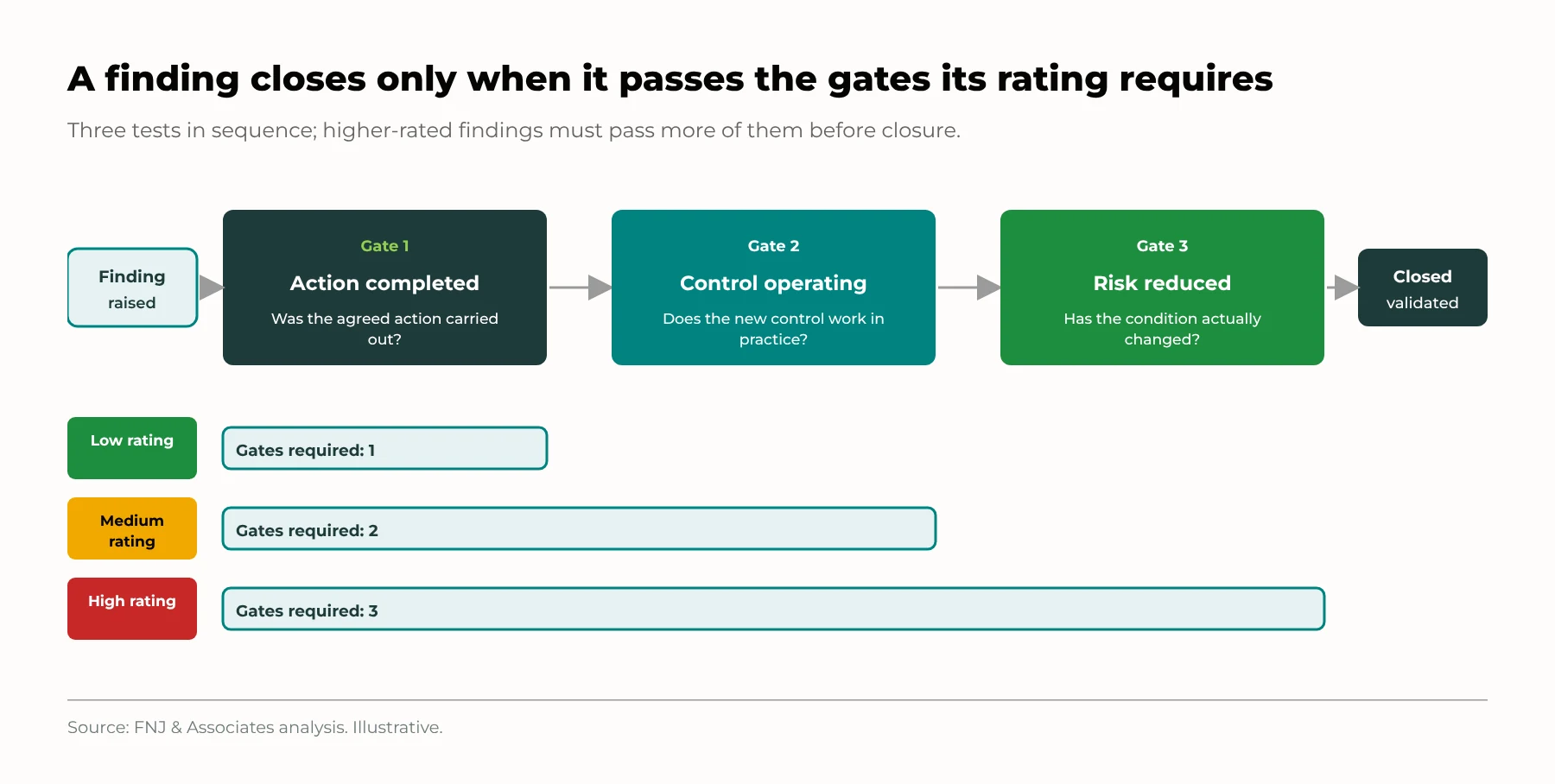
Three tests for closing audit findings resolve this: the agreed action was completed, the control now operates as intended, and the risk the finding described has fallen. This article sets out the evidence for each test, who should validate it and the measures the committee should see, as part of our internal audit services in Kenya and East Africa.
The Standards make confirming implementation part of internal audit’s work
The Global Internal Audit Standards issued by The Institute of Internal Auditors require the chief audit executive to establish a process for confirming that management has implemented agreed actions, or has accepted the risk of not acting. Follow-up is therefore part of the audit, not an administrative afterthought.
Sector regulators reinforce the point, since inspectors in banking, insurance and SACCO supervision routinely ask boards for the status of past audit and regulatory findings, and donors ask the same question of NGOs during grant monitoring.
Closing audit findings rests on three tests
| Test | Question it answers | Typical evidence |
|---|---|---|
| 1. Action completed | Was the agreed action carried out as described? | Approved policy, configured system change, issued procedure, training record |
| 2. Control operating | Does the new or improved control work in practice? | Sample of transactions processed under the new control, exception reports reviewed |
| 3. Risk reduced | Has the condition the finding described actually changed? | Data showing fewer exceptions, cleared backlog, reconciled balances, improved indicator |
Many follow-up processes stop at the first test: a new procedure has been issued, so the finding is closed, even though no one has checked whether staff follow it or whether the problem it addressed has gone away.
The second and third tests take more effort, so when closing audit findings they should be applied in proportion to the rating of the finding. A high-rated finding deserves all three, while a low-rated finding may be closed on the first test with a sample check later in the year.
Evidence standards differ by the kind of finding
What counts as sufficient evidence depends on the nature of the weakness. The table shows the evidence that typically satisfies the audit function for common kinds of finding, and it should be adapted to the institution’s own methodology.
| Kind of finding | Insufficient on its own | Sufficient evidence |
|---|---|---|
| Missing or outdated policy | Draft policy | Approved policy, communicated to staff, with evidence of the communication |
| Access and segregation of duties | Statement that access was reviewed | User access listing after the change, showing conflicting rights removed |
| Reconciliation not performed | One completed reconciliation | Reconciliations for consecutive periods, prepared and reviewed on time |
| Backlog or ageing items | Plan to clear the backlog | Ageing report showing the backlog cleared and held within the agreed level |
| System configuration weakness | Change request raised | Change implemented, tested and shown in the system settings |
| Training gap | Training scheduled | Attendance records and assessment results for the target population |
The principle behind the table is that evidence should show the control working over time, not a single instance, and it should come from the system or from a reviewer independent of the person who performed the action.
Who validates closure should depend on the rating
Management is responsible for implementing actions, and internal audit is responsible for confirming them. A practical division of work lets management self-certify closure of low-rated findings with supporting evidence, while internal audit validates medium-rated findings by desk review and high-rated findings by re-testing.
Risk and compliance functions can share part of the validation load. Where the second line already tests a control as part of its own monitoring, internal audit can place reliance on that work, provided it has assessed the quality of the testing.
Data analytics turns validation from a sample into a population
For findings that concern transactions, such as duplicate payments, unapproved changes to customer records or loans disbursed outside policy, a simple data query can test every transaction since the action was implemented. This gives far stronger evidence that the risk has fallen than a sample of twenty items, and the same query can be rerun each quarter as a continuing check.
Extensions and accepted risk need rules of their own
Some actions take longer than planned for good reasons, such as a system upgrade that depends on a vendor. A clear extension rule prevents due dates from drifting: management requests the extension before the due date, explains the reason and the interim control, and a senior executive approves it, with the history visible to the audit committee.
Sometimes management decides not to act because the cost outweighs the benefit. That is a legitimate decision when it is made by someone with authority to accept the risk, recorded with the reasoning and reviewed at an agreed date. The Standards expect the chief audit executive to raise the matter with the board if the accepted risk exceeds the institution’s tolerance.
Three measures show whether closing audit findings is real
- Closure rate on time: the share of actions closed by their original due date, shown separately for high, medium and low ratings.
- Ageing of overdue actions: the number of overdue actions by age band, with the oldest and highest-rated listed by owner.
- Reopened rate: the share of findings closed in the past two years that were raised again at a later audit, which is the clearest test of whether closure was real.
The third measure is rarely reported, yet it is the one that best reflects the quality of closure. In closing audit findings, a low closure rate tells the committee that actions are slow, while a high reopened rate tells it that actions are being closed without fixing the problem.
Recurring themes point to causes that individual actions miss
When similar findings appear in several audits, such as weak reconciliations in different branches or access reviews missed in different systems, the cause usually lies in something common to all of them. Training, system design, staffing or the tone set by management are typical candidates.
Internal audit adds most value when it reports these themes to the committee together with the root cause. Closing audit findings one at a time will not remove a cause that sits above all of them.
Sector context changes what the committee focuses on
In banks and SACCOs, committees give particular weight to findings from the regulator and the external auditor, because these carry supervisory consequences. In insurers the focus often falls on claims, underwriting authority and reinsurance recoveries.
NGOs track findings from donor audits and verification missions, since unresolved findings can affect future funding. Manufacturers concentrate on inventory, procurement and health and safety, and public bodies on findings from the supreme audit institution and on procurement compliance, yet the three tests apply in every case.
A clear lifecycle makes closing audit findings predictable
Each finding should move through the same stages, so that everyone involved knows what is expected of them and the audit committee can read the status at a glance. A typical lifecycle runs from finding raised and response agreed, through action in progress and evidence submitted, to validated and closed, with two further states for actions that have been extended or where the risk has been formally accepted.
| Stage | Who acts | What moves it to the next stage |
|---|---|---|
| Raised | Internal audit | Finding issued in the final report |
| Response agreed | Management | Action, owner and due date recorded |
| In progress | Action owner | Evidence submitted before the due date |
| Evidence submitted | Internal audit or second line | Evidence reviewed against the three tests |
| Validated and closed | Internal audit | Closure recorded and reported to the committee |
| Extended or risk accepted | Senior executive | Approved extension or recorded acceptance with a review date |
Reminders before each due date, and escalation to the accountable executive when a date passes, keep actions moving without relying on the audit team to chase every owner. The same lifecycle also gives the committee a consistent vocabulary, which avoids debates about whether an action that is “nearly done” counts as closed.
Common weaknesses make closing audit findings slower and less reliable
- Actions written in vague terms, such as “strengthen controls”, which cannot be tested when the owner claims completion.
- Owners named as departments rather than individuals, so no one feels accountable for the due date.
- Due dates set without the owner’s agreement, which leads to extensions as soon as the report is issued.
- Evidence held in email threads, so validation depends on the memory of the person who sent it.
- Closure reported as a single percentage, which hides the age and rating of the actions still open.
Each weakness is easy to correct at the point the finding is agreed. Writing actions as specific, testable outcomes, naming an individual owner and agreeing realistic dates during the closing meeting saves weeks of follow-up later and makes closing audit findings a routine step rather than a negotiation.
Regulators and external auditors also notice the difference, because an institution that can show a regulator not only that its findings were closed but how each closure was validated. That few findings have recurred, presents a far stronger picture of governance than one that reports only a closure percentage, and the evidence trail shortens the time an inspection team needs to reach its view.
Three moves for the next quarter
- Sample ten findings closed in the past year and test them against all three tests, to establish how often closure meets the standard.
- Agree the validation rule by rating with the audit committee, including who may self-certify and when internal audit re-tests.
- Add the reopened rate to the next committee report, with the themes that explain any recurrence.
How we support your institution
FNJ & Associates provides outsourced and co-sourced internal audit, including the validation of management actions, data analytics for follow-up and the design of committee reporting. We also review follow-up processes against the Global Internal Audit Standards as part of quality assessments.
Our earlier guidance on automating audit follow-up and on the internal audit report to the audit committee covers the reporting side in more depth. Trigarc Audit, implemented by FNJ, covers audit planning, execution, reporting and follow-up, so each finding carries its evidence, its extension history and its validation in one record.
Questions about closing audit findings
When can an audit finding be closed?
An audit finding can be closed when the agreed action has been completed and the evidence shows that the control now operates and the risk has fallen, with the depth of evidence matched to the rating of the finding.
Who is responsible for closing audit findings?
Management is responsible for implementing the agreed actions and providing evidence, while internal audit is responsible for confirming that the actions were implemented effectively and reporting the status to the audit committee.
Can management self-certify that an action is complete?
Many institutions allow management to self-certify low-rated findings with supporting evidence, while internal audit validates medium- and high-rated findings by review or re-testing.
What happens if management decides not to implement an action?
Management may accept the risk if a person with the right authority makes the decision, records the reasoning and agrees a review date. The chief audit executive should raise the matter with the board if the accepted risk exceeds tolerance.
What is a good closure rate for audit findings?
There is no universal benchmark, but committees should look at closure on time by rating, the ageing of overdue actions and the share of findings that reappear, since a high closure rate with frequent recurrence signals that closure is not effective.
How long should management have to implement audit actions?
Due dates should reflect the rating and the complexity of the action, with high-rated findings typically addressed within a few months and system changes allowed longer, provided an interim control reduces the risk in the meantime.
Can FNJ & Associates validate our audit actions?
Yes, FNJ & Associates validates management actions, applies data analytics to follow-up and implements Trigarc Audit, and the firm can be reached through fnjassociates.co.ke to request a proposal or a demo.
Book a Trigarc Audit demo with FNJ
FNJ & Associates helps audit committees and internal audit functions across Kenya and East Africa make closure real, from validation rules and data analytics to reporting that shows what has changed.
About FNJ & Associates
FNJ & Associates is an ICPAK-registered CPA firm and a multidisciplinary team of 20+ professionals holding CPA(K), ACCA, CIA, CISA, CFE, CEH, CAMS and CIPP/E credentials, serving more than 100 organisations across Kenya and East Africa. The firm provides audit and assurance, internal audit, and IT and cybersecurity audits, and implements Trigarc Audit for audit planning, execution, reporting and follow-up. Visit fnjassociates.co.ke to learn more.