
A consistent structure, sufficient evidence and timely review make the audit file defensible to quality assessors, regulators and audit committees.
Audit working papers are the record of the work internal auditors perform and the evidence on which their conclusions rest. In banks, SACCOs, insurers, NGOs, state corporations and corporates across Kenya and East Africa, they are what an external quality assessor, a regulator, an external auditor or a court will examine when the quality of an audit is questioned.
In many functions, working papers are organised differently by each auditor, prepared after the fieldwork rather than during it, and reviewed late or not at all. The result is an audit file that the auditor understands but no one else can follow, which weakens the function’s credibility and makes every external review more difficult than it needs to be.
A simple test, a consistent structure, a clear standard of evidence and timely review address these problems. This article sets out each, as part of our internal audit services in Kenya and East Africa.
Audit working papers must pass the experienced reviewer test
The test that good audit working papers must pass is whether an experienced auditor with no previous connection to the engagement could understand what was done, why it was done, what evidence was obtained and how the conclusion was reached, without asking the person who did the work. Every structural choice and every standard of evidence should serve that test.
The Global Internal Audit Standards reflect the same idea, since they expect internal auditors to document information that is sufficient, reliable and relevant to support engagement results. They expect engagements to be supervised so that the work is reviewed before conclusions are communicated.
A consistent structure makes every file easy to navigate
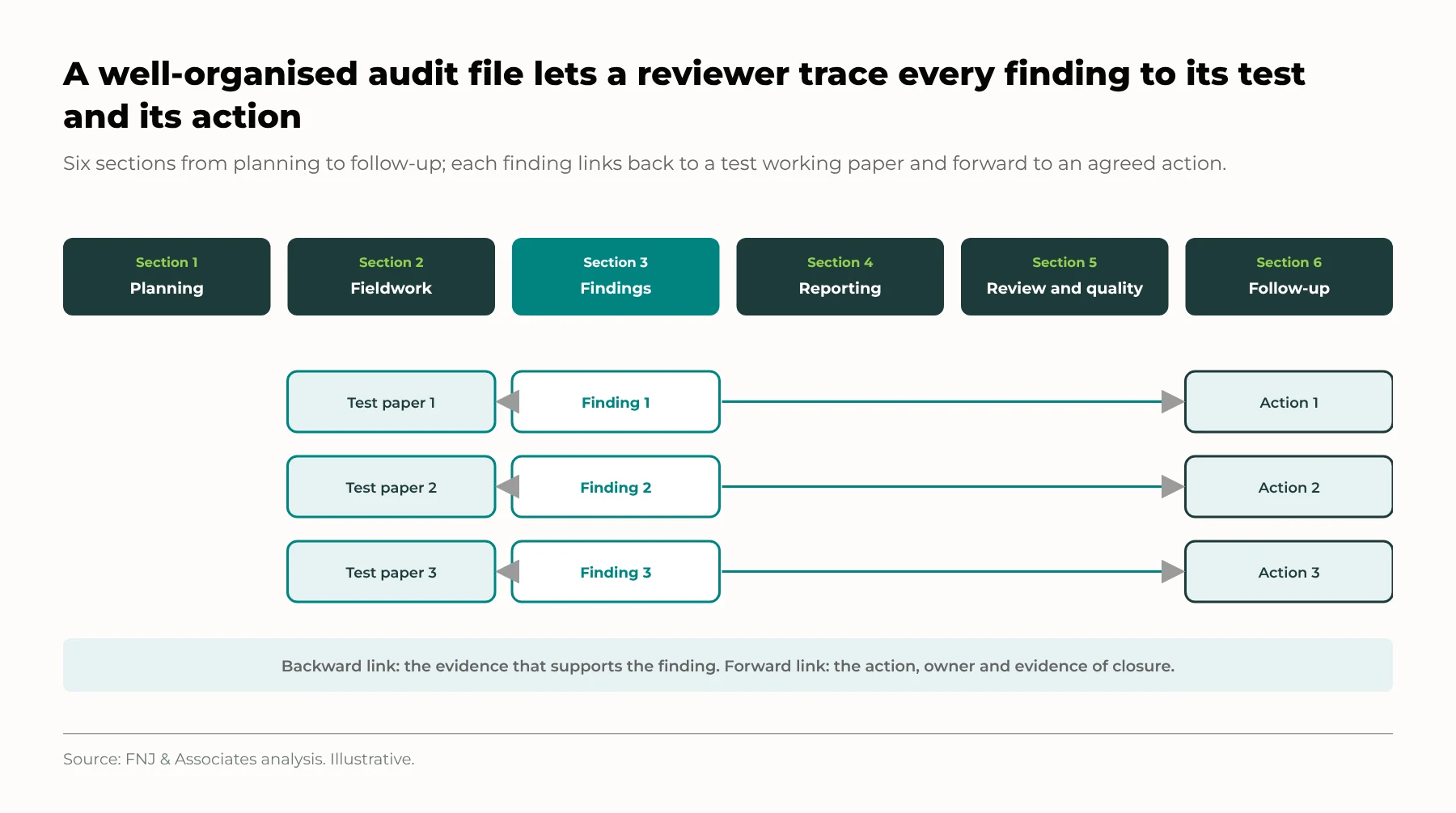
When every engagement file follows the same structure, reviewers can find what they need quickly and auditors moving between teams can pick up work without confusion. Most functions organise the file into a small number of sections that follow the engagement from planning to closure.
| Section | Typical contents |
|---|---|
| Planning | Engagement letter or notification, objectives and scope, risk assessment, audit programme, applicability of any topical requirements |
| Fieldwork | One working paper per test step, with the population, sample, procedure, results and conclusion |
| Findings | Each finding with its condition, criteria, cause, effect, recommendation and link to the supporting tests |
| Reporting | Draft and final reports, management responses and closing meeting notes |
| Review and quality | Review notes, clearance of comments and sign-offs |
| Follow-up | Agreed actions, evidence of implementation and validation of closure |
Each test working paper should tell a complete story
Within the fieldwork section, each test working paper should stand on its own. It should state the objective of the test, the control or process being tested, the population and how it was obtained, the sample size and selection method, the procedure performed, the results for each item tested, any exceptions, and the auditor’s conclusion on whether the control operated as intended.
- A clear heading with the engagement, the test reference and the preparer’s name and date.
- The objective of the test and the risk it addresses.
- The source and completeness of the population, and how the sample was selected.
- The procedure performed on each sample item, described clearly enough to be repeated.
- The results, exceptions and their follow-up.
- A conclusion that answers the objective.
Evidence must be sufficient, reliable and relevant
Sufficient evidence is enough to persuade a reasonable reviewer that the conclusion is correct. Reliable evidence comes from sources that are independent of the person whose work is being tested, or from the auditor’s own observation and re-performance, and relevant evidence relates directly to the objective of the test.
Enquiry alone is the weakest form of evidence available to an auditor. A manager’s confirmation that reconciliations are reviewed monthly does not show that they were, while signed and dated reconciliations for the sample months, with evidence that differences were investigated, do. Audit working papers that rely mainly on enquiry rarely survive an external quality assessment.
Findings should link back to the tests that produced them
Every finding in the report should be traceable to the test working papers that support it, and every exception in a test should either lead to a finding or carry a documented reason why it did not. This two-way link is one of the first things a quality assessor checks, because it shows whether the report reflects the work performed.
The finding itself should set out the condition found, the criteria it was measured against, the cause, the effect and the recommendation. Our article on the internal audit report for the audit committee explains how these elements carry through to the final report.
Review should happen during the engagement, not after it
Review is the quality control that turns individual work into the function’s work. The engagement manager should review test working papers as they are completed, raise review notes that the preparer clears in writing, and sign off each section before the report is drafted, so that weaknesses are corrected while the evidence is still available.
Review carried out after the report has been issued is too late to change the conclusion, and it often leaves review notes uncleared in the file. A quality assessor who finds open review notes in closed engagements will conclude that supervision is not working as the methodology describes.
Audit working papers need secure storage and a retention rule
Working papers often contain sensitive information about customers, staff, transactions and control weaknesses, so they should be stored with access restricted to the internal audit team and others with a legitimate need. Closed files should be locked against further editing, so that the record shows what the auditor relied on at the time.
The internal audit charter or methodology should set a retention period for engagement records, consistent with regulatory requirements, donor agreements and the organisation’s records policy, and should state who may grant access to auditors, regulators and others after the engagement closes.
Five weaknesses recur in audit working papers
- Different structures in every file, so reviewers cannot find the evidence.
- Populations and samples not documented, so the test cannot be repeated.
- Conclusions resting mainly on enquiry rather than inspection or re-performance.
- Findings that cannot be traced to tests, or exceptions that never became findings.
- Review notes raised after the report was issued and never cleared.
Sector context shapes the evidence that matters
Bank and SACCO audits draw heavily on system reports, loan files and transaction data, so the completeness of populations extracted from core systems deserves particular attention. Insurance audits examine policy and claims files, while public sector audits must often meet the documentation expectations of supreme audit institutions and parent ministries.
NGO audits rely on grant agreements, partner records and field documentation, sometimes gathered in locations with limited connectivity. The experienced reviewer test, the structure and the standard of evidence apply equally in each case.
Data analytics working papers need extra documentation
Internal audit functions increasingly test whole populations through data analytics rather than samples. These tests are powerful, but their audit working papers must show how the data was obtained, how its completeness was confirmed against the source system, what logic or script was applied and how exceptions were followed up, so that a reviewer can repeat the test and reach the same result.
Saving the script, the input data extract and the output with the working paper, together with a short narrative of each step, meets that standard. Without them, an analytics test that identified important exceptions may be impossible to defend later.
Reliance on others must be documented
Where internal audit relies on the work of the second line, an external specialist or the external auditor, the audit working papers should record the basis for that reliance, including the assessment of the provider’s independence and competence, the work reviewed and any re-performance carried out. A quality assessor will expect to see this, because reliance without documented evaluation is not reliance at all.
Electronic working papers change the practicalities, not the principles
Most functions now keep their audit working papers electronically, in an audit management system, a document library or both. Electronic files make review, sign-off and retention easier, but they also create risks of version confusion, scattered evidence and uncontrolled access if the structure is not agreed and enforced.
Whatever the system, the principles are the same: one engagement file, one version of each working paper relied on, review and sign-off recorded against each section, and access restricted to those who need it.
Good working papers make external quality assessment straightforward
An external quality assessment reviews a sample of engagement files against the Global Internal Audit Standards. Functions whose audit working papers follow a consistent structure, link findings to tests, document evidence properly and show timely review usually find that the assessment confirms their own view of their quality, while those with inconsistent files often face findings that are expensive and time-consuming to correct.
Training builds consistency across the team
Templates and methodology set the standard, but consistency comes from practice. Short sessions in which the team reviews anonymised examples of strong and weak audit working papers, discusses why one passes the experienced reviewer test and the other does not, and agrees how to improve the weaker example, build shared judgement faster than any manual and help new auditors reach the expected standard sooner.
Pairing a new auditor with an experienced reviewer for the first few engagements, with feedback given on each working paper rather than only at the end, reinforces the same habits and shortens the time it takes for the whole team to work to one standard.
Three moves for the next quarter
- Issue a standard audit file structure and test working paper template for all new engagements.
- Review a sample of recent audit working papers against the experienced reviewer test, and share the results with the team.
- Set a rule that review notes are cleared and sections signed off before the draft report is issued.
How we support your institution
FNJ & Associates reviews audit working papers and methodology, trains internal audit teams on documentation and evidence, and performs external quality assessments against the Global Internal Audit Standards. We also provide outsourced and co-sourced internal audit, with working papers prepared to the standard described here.
Trigarc Audit, implemented by FNJ, covers audit planning, execution, reporting and follow-up, linking each working paper to its test step, finding and review sign-off, so that the audit file can be followed from objective to conclusion.
Questions about audit working papers
What are audit working papers?
Audit working papers are the record of the work internal auditors perform and the evidence on which their conclusions rest, covering planning, testing, findings, reporting, review and follow-up.
What makes a good audit working paper?
A good working paper states the objective, the population and sample, the procedure, the results and the conclusion clearly enough that an experienced reviewer could follow the work without asking the auditor.
Is enquiry enough evidence for an audit conclusion?
Enquiry alone is the weakest form of evidence, and conclusions should usually rest on inspection of documents, observation or re-performance of the control.
When should working papers be reviewed?
Working papers should be reviewed during the engagement, with review notes cleared and sections signed off before the draft report is issued.
How long should audit working papers be kept?
The retention period should be set in the internal audit charter or methodology, consistent with regulatory requirements, donor agreements and the organisation’s records policy.
How should data analytics tests be documented?
The working paper should record how the data was obtained, how its completeness was confirmed, the logic or script applied, the output and the follow-up of exceptions, with the script and extracts saved so the test can be repeated.
Who should review internal audit working papers?
The engagement manager or another experienced auditor who did not prepare the work should review each working paper during the engagement, with the chief audit executive reviewing significant findings and conclusions before the report is issued.
Can FNJ & Associates review our working papers?
Yes, FNJ & Associates reviews working papers and methodology, trains audit teams and performs external quality assessments, and the firm can be reached through fnjassociates.co.ke to request a proposal.
Request a proposal for a working paper review
FNJ & Associates helps internal audit functions across Kenya and East Africa build audit files that quality assessors, regulators and audit committees can follow with confidence.
About FNJ & Associates
FNJ & Associates is an ICPAK-registered CPA firm and a multidisciplinary team of 20+ professionals holding CPA(K), ACCA, CIA, CISA, CFE, CEH, CAMS and CIPP/E credentials, serving more than 100 organisations across Kenya and East Africa. The firm provides audit and assurance, internal audit, and IT and cybersecurity audits, and implements Trigarc Audit for audit planning, execution, reporting and follow-up. Visit fnjassociates.co.ke to learn more.