
A single register of grant obligations, owned by named people and supported by evidence, lets an NGO meet every donor’s requirements without duplicating effort.
Donor compliance has become one of the defining capabilities of a well-run NGO in Kenya and East Africa. Organisations that manage several grants at once must meet each donor’s reporting calendar, eligible cost rules, procurement thresholds, audit requirements and conduct clauses, while also meeting their own regulator’s expectations under the public benefit organisations regime.
The obligations rarely sit in one place, because each grant agreement is negotiated and managed by a different programme team, and the finance, procurement and human resources functions each hold a part of the picture. When a donor audit or verification mission arrives, the organisation assembles the evidence under pressure, and findings such as ineligible costs or undocumented procurement follow.
A single obligations register, fed by every grant agreement and owned by named people, resolves this. This article sets out how to build it, how obligations flow down to implementing partners and how the organisation prepares for donor scrutiny, drawing on our compliance services in Kenya and our work with NGOs and donor-funded programmes.
The regulatory setting for NGOs has tightened
NGOs in Kenya now operate under the Public Benefit Organisations Act and its regulations, which set requirements for governance, annual reporting and the use of funds, with a transition period for existing organisations. At the same time, FATF Recommendation 8 asks countries to apply proportionate, risk-based measures to protect non-profit organisations from abuse for terrorist financing, which shapes the screening and due diligence that donors expect of their grantees.
Donors have also raised their expectations, and many now require evidence of anti-fraud, safeguarding and sanctions controls before signing a grant, and they apply those expectations through the whole delivery chain, including the local partners that receive sub-grants.
Grant agreements create obligations in ten recurring categories
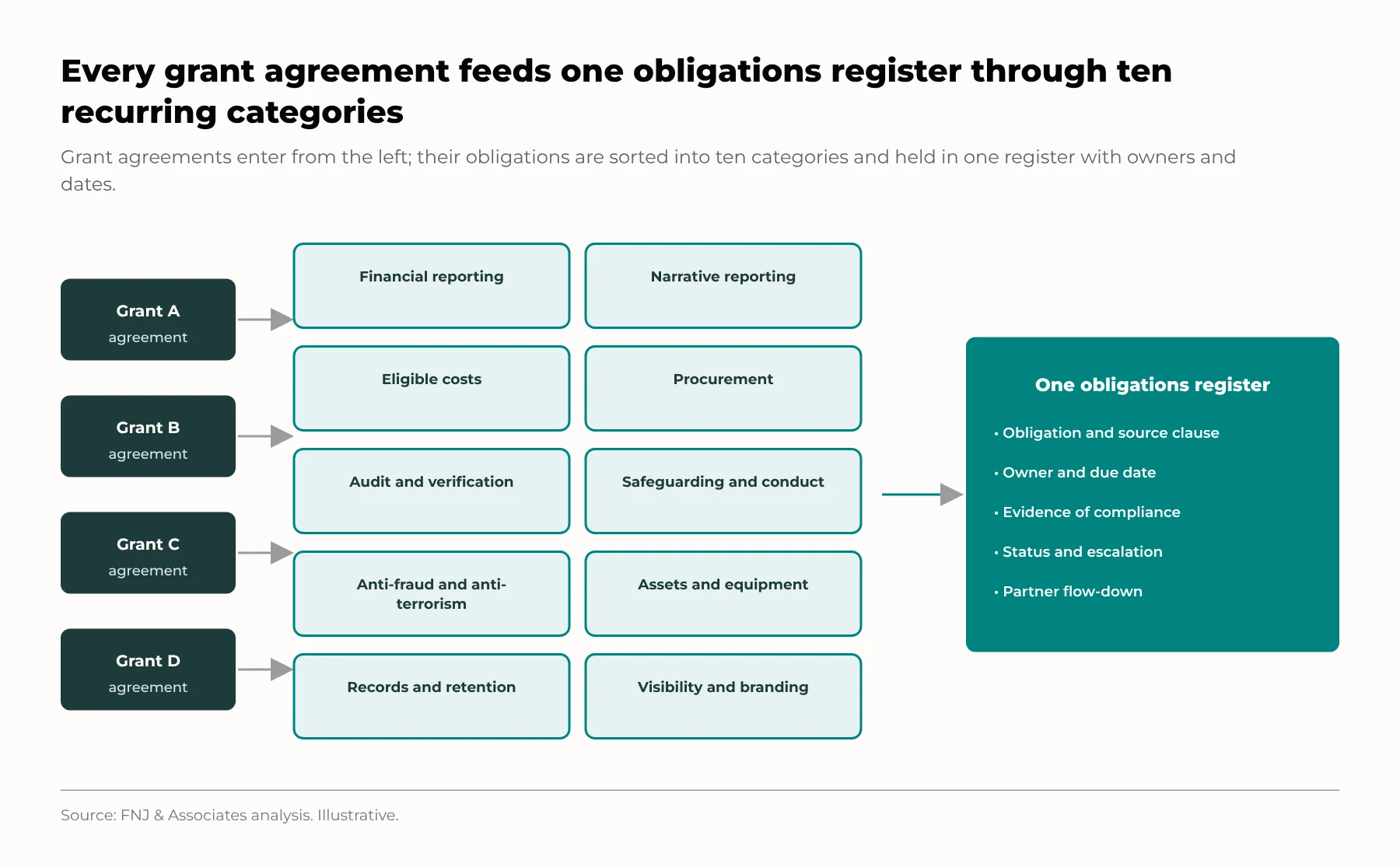
Although each donor writes its agreements differently, the obligations fall into a small number of categories that recur across almost every grant. Recognising these categories is the first step to managing donor compliance in one place instead of grant by grant.
| Category | Typical obligations |
|---|---|
| Financial reporting | Periodic financial reports in the donor’s format and currency, with budget-to-actual analysis |
| Narrative reporting | Progress reports against the results framework, with indicators and evidence |
| Eligible costs | Spending only on approved budget lines, within allowable cost rules and approved variances |
| Procurement | Thresholds for quotations and tenders, conflict of interest declarations, documentation standards |
| Audit and verification | Annual or end-of-grant audits, access for the donor’s auditors and monitoring visits |
| Safeguarding and conduct | Policies, training, reporting channels and notification of incidents within set periods |
| Anti-fraud and anti-terrorism | Screening of staff, partners and suppliers; notification of suspected fraud |
| Assets and equipment | Registers, tagging, insurance and disposal in line with donor rules |
| Records and retention | Keeping documents for the period the donor requires after the grant ends |
| Visibility and branding | Acknowledging the donor in materials and communications as specified |
One register turns donor compliance from memory into a managed process
The register lists each obligation from each grant agreement, with the clause it comes from, the owner, the due date or frequency, the evidence required and the current status. Recurring obligations, such as quarterly financial reports, appear as dated instances, so that the organisation can see at any time which reports are due in the next month and which are overdue.
The same structure as our guidance on the compliance obligations register applies, with two additions for NGOs. The first is a grant reference on every entry, so that obligations can be viewed by donor. The second is a flag for obligations that flow down to partners, so that the organisation can see what it must require of others.
Where several donors impose similar requirements, the register reveals the overlap. An organisation that knows it must screen suppliers against sanctions lists for four different donors can design one screening process that satisfies all four, instead of four processes run by four teams.
Eligible cost rules deserve particular attention
Ineligible costs are among the most frequent and most expensive findings in donor audits, because the organisation may have to refund the amount from unrestricted funds. Typical causes include spending outside the approved budget lines, exceeding the allowed variance without approval, charging costs that fall outside the grant period and allocating shared costs without a documented basis.
Preventing these findings depends on controls at the point of spending, not at the point of reporting. Budget holders need to know which costs each grant allows, finance needs to check eligibility before payment, and shared cost allocations need a written method approved in advance and applied consistently across donors.
Procurement rules are where documentation most often fails
Donors set thresholds above which quotations or tenders are required, and they expect a clear record of how each supplier was selected. Audit findings frequently arise not because the procurement was improper but because the file cannot show that it was proper, with missing quotations, unsigned evaluation sheets or no declaration of conflicts of interest.
A standard procurement file checklist, applied to every purchase above the lowest donor threshold, prevents most of these findings. Where donors set different thresholds, applying the strictest to all purchases above a certain value is often simpler than tracking each donor’s rule separately.
Obligations flow down to implementing partners
When an NGO passes funds to a local partner, most donor obligations pass with them, and the lead organisation remains accountable to the donor for the partner’s compliance. Sub-grant agreements should therefore reproduce the relevant obligations, and the lead organisation should assess each partner before the award and monitor it throughout.
A proportionate approach serves both donor compliance and localisation, because partners with strong systems can be monitored lightly, while partners with weaker systems receive capacity support, closer review of expenditure and more frequent visits, so that donor compliance is achieved without excluding the smaller organisations that are often closest to the communities served.
Donor audits are easier when the evidence is already in place
Preparation for a donor audit or verification mission should begin on the first day of the grant, not in the week before the auditors arrive. When each obligation in the register points to its evidence, the finance team can produce the documents the auditors request quickly, and the audit can focus on testing rather than on searching.
Our guidance on internal audit for NGOs in Kenya explains how an internal review in the months before a donor audit can identify and correct gaps while there is still time. Such a review typically samples transactions against the eligible cost rules, checks procurement files against the checklist and confirms that reports were submitted on time.
Common findings in donor audits follow a pattern
- Costs charged to the wrong grant or outside the grant period.
- Shared costs allocated without a documented and consistently applied method.
- Procurement files missing quotations, evaluations or conflict of interest declarations.
- Payments to partners without evidence of the partner’s own expenditure.
- Asset registers that do not match the equipment found on site.
- Exchange rate gains and losses treated inconsistently with the donor’s rules.
- Reports submitted late or with figures that do not agree with the accounting records.
Each of these findings can be prevented by a specific control, and an organisation that reviews its register against this list each year will find most of its gaps before the donor does.
The board should see donor compliance in one view
The board or its audit committee needs a short quarterly view of donor compliance: the number of active grants, reports due and submitted on time, open findings from donor audits with their age and status, any refunds or disallowed costs, and any safeguarding or fraud notifications made to donors. This view lets directors see whether the organisation’s funding relationships are secure and where attention is needed.
Under the public benefit organisations regime, boards also carry clearer responsibility for the use of funds. A donor compliance report that sits alongside the financial statements and the risk register gives the board the evidence it needs to discharge that responsibility.
Safeguarding and anti-fraud obligations carry the shortest deadlines
Most grant agreements now require the organisation to notify the donor of suspected fraud, safeguarding incidents and certain other events within a short period, sometimes within days of becoming aware. These notification obligations are easy to miss because they are triggered by events rather than by the calendar, and a late notification can damage the donor relationship more than the incident itself.
The register should therefore list each event-driven obligation with its trigger, its deadline and the person responsible for notifying the donor. Staff who receive concerns, including those in field offices and partner organisations, need to know that the clock starts when the organisation becomes aware of the matter, not when an investigation concludes.
Sanctions and counter-terrorism screening should be designed once
Most institutional donors require their grantees to check that funds do not reach designated individuals or entities, and many require screening of staff, partners, suppliers and sometimes beneficiaries against specified lists. Because the lists and the scope differ between donors, NGOs often end up running several screening processes for different grants.
A single screening procedure, designed to meet the strictest donor requirement and applied to all relevant parties, is simpler to run and easier to evidence. The procedure should record what was screened, against which lists, when and with what result, so that the organisation can demonstrate donor compliance on request.
Five weaknesses recur in donor compliance arrangements
- Grant obligations held only in the agreement documents, with no summary that programme and finance staff can use.
- Event-driven notification obligations that no one is responsible for tracking.
- Partner obligations assumed rather than written into sub-grant agreements.
- Evidence of compliance scattered across email, shared drives and paper files.
- Board reporting limited to financial results, with no view of grant obligations or donor audit findings.
Each weakness has a straightforward remedy, and most organisations can address all five within a single grant cycle by building the register, assigning owners and agreeing a short quarterly report to the board.
Three moves for the next quarter
- List every active grant agreement and extract its obligations into one register, using the ten categories as the structure.
- Review the last two donor audit reports and confirm that each finding has an owner, an action and evidence of closure.
- Apply a procurement file checklist to all purchases above the lowest donor threshold, starting this quarter.
How we support your institution
FNJ & Associates helps NGOs, PBOs and donor-funded programmes build donor compliance registers, review eligible cost and procurement controls, assess implementing partners and prepare for donor audits and verification missions. We also provide internal audit and forensic support where concerns about the use of funds arise.
Where an organisation manages many grants and partners, Trigarc Compliance, implemented by FNJ, holds grant obligations, dated reporting events, evidence and corrective actions in one place, with reporting to the board and audit committee.
Questions about donor compliance
What is donor compliance?
Donor compliance is the work an NGO does to meet the obligations in its grant agreements, including financial and narrative reporting, eligible cost rules, procurement requirements, audits, safeguarding, anti-fraud and record keeping.
How can an NGO manage different rules from several donors?
An NGO can extract the obligations from each grant agreement into one register with a common structure, identify where donors impose similar requirements and design single processes that satisfy all of them, while tracking any donor-specific rules separately.
Are NGOs responsible for their partners’ compliance?
Yes, a lead organisation usually remains accountable to the donor for funds passed to implementing partners, so it should flow the relevant obligations down through sub-grant agreements and assess and monitor each partner.
What are the most common donor audit findings?
Common findings include ineligible or misallocated costs, incomplete procurement files, unsupported payments to partners, inaccurate asset registers and late or inconsistent reports.
When should an NGO prepare for a donor audit?
Preparation should begin when the grant starts, by linking every obligation to its evidence, and an internal review a few months before the donor audit helps correct gaps while there is still time.
How does the PBO regime affect donor compliance?
The public benefit organisations regime sets governance, reporting and fund-use requirements that sit alongside donor obligations, so NGOs should include their regulatory obligations in the same register as their grant obligations and report on both to the board.
Can FNJ & Associates help with donor compliance?
Yes, FNJ & Associates builds donor compliance registers, reviews grant controls, assesses partners and prepares organisations for donor audits, and the firm can be reached through fnjassociates.co.ke to request a proposal.
Request a proposal for a donor compliance review
FNJ & Associates helps NGOs and donor-funded programmes across Kenya and East Africa bring every grant obligation into one register and meet each donor’s requirements with confidence.
About FNJ & Associates
FNJ & Associates is an ICPAK-registered CPA firm and a multidisciplinary team of 20+ professionals holding CPA(K), ACCA, CIA, CISA, CFE, CEH, CAMS and CIPP/E credentials, serving more than 100 organisations across Kenya and East Africa. The firm provides governance, risk and compliance advisory, including AML/CFT, anti-bribery and data protection, and implements Trigarc Compliance for obligation tracking, evidence and corrective actions. Visit fnjassociates.co.ke to learn more.