
Seven areas, a few sharp questions for each and the signals that call for a follow-up give a committee the means to test what it is told.
The audit committee is the board’s principal means of overseeing financial reporting, internal control and the assurance the institution receives. In listed companies, banks, SACCOs, insurers, state corporations and NGOs across Kenya and East Africa, the committee meets several times a year and receives reports from internal audit, external audit, risk, compliance and management.
Volume is rarely the difficulty, since most committees receive more material than they can read in depth. The difficulty is knowing which questions will reveal whether the assurance behind the reports is sound, so committees can spend their time noting reports rather than testing them.
A short set of questions for each of seven areas helps an audit committee test what it is told. This article sets out the questions and the signals that call for a follow-up, drawing on our internal audit services in Kenya and East Africa and our governance advisory work.
Governance codes expect the audit committee to challenge, not only to receive
Governance frameworks in Kenya give the audit committee responsibility for overseeing internal and external audit, financial reporting and internal control, and the Capital Markets Authority’s guidance on its governance code is one statement of that expectation. Banking, insurance and public sector frameworks set similar responsibilities, and the Global Internal Audit Standards place specific expectations on the board in relation to internal audit.
The common thread is that the committee is expected to form its own view. Receiving a report and noting it does not discharge that responsibility, while asking questions that test the report, and recording the answers, does.
Internal audit: is the function independent, adequately resourced and focused on the right risks?
- Does the audit plan cover the institution’s principal risks, and which high risks are not covered this year?
- Has any limitation of scope, access or resources affected the plan?
- How many findings closed in the past two years have reappeared at a later audit?
- When did the function last have an external quality assessment, and what did it find?
- Does the chief audit executive meet the committee without management present at least once a year?
The question about reappearing findings is often the most revealing. A function with a high closure rate but frequent recurrence is closing findings without fixing them, as our article on closing audit findings explains.
External audit: is the auditor independent and is the audit focused where judgement is greatest?
- What are the key audit matters, and why did the auditor select them?
- Which accounting estimates and judgements did the auditor challenge most, and what changed as a result?
- What non-audit services does the audit firm provide, and how is independence protected?
- What did the auditor find about internal control, and has management addressed the points raised last year?
- How does the committee assess the quality of the external audit each year?
Financial reporting: are the numbers right and are the judgements reasonable?
- Which areas of the financial statements involve the most judgement, and what range of outcomes was considered?
- Have any accounting policies changed, and why?
- Are there unadjusted differences identified by the auditor, and why were they not corrected?
- How does management gain comfort that the figures in the management accounts and the financial statements agree?
For banks, SACCOs and lenders, expected credit loss provisioning is usually the area of greatest judgement, and the audit committee should understand the assumptions behind it. For insurers, the measurement of insurance contract liabilities plays the same role, and for NGOs the treatment of restricted funds and grant income often deserves attention.
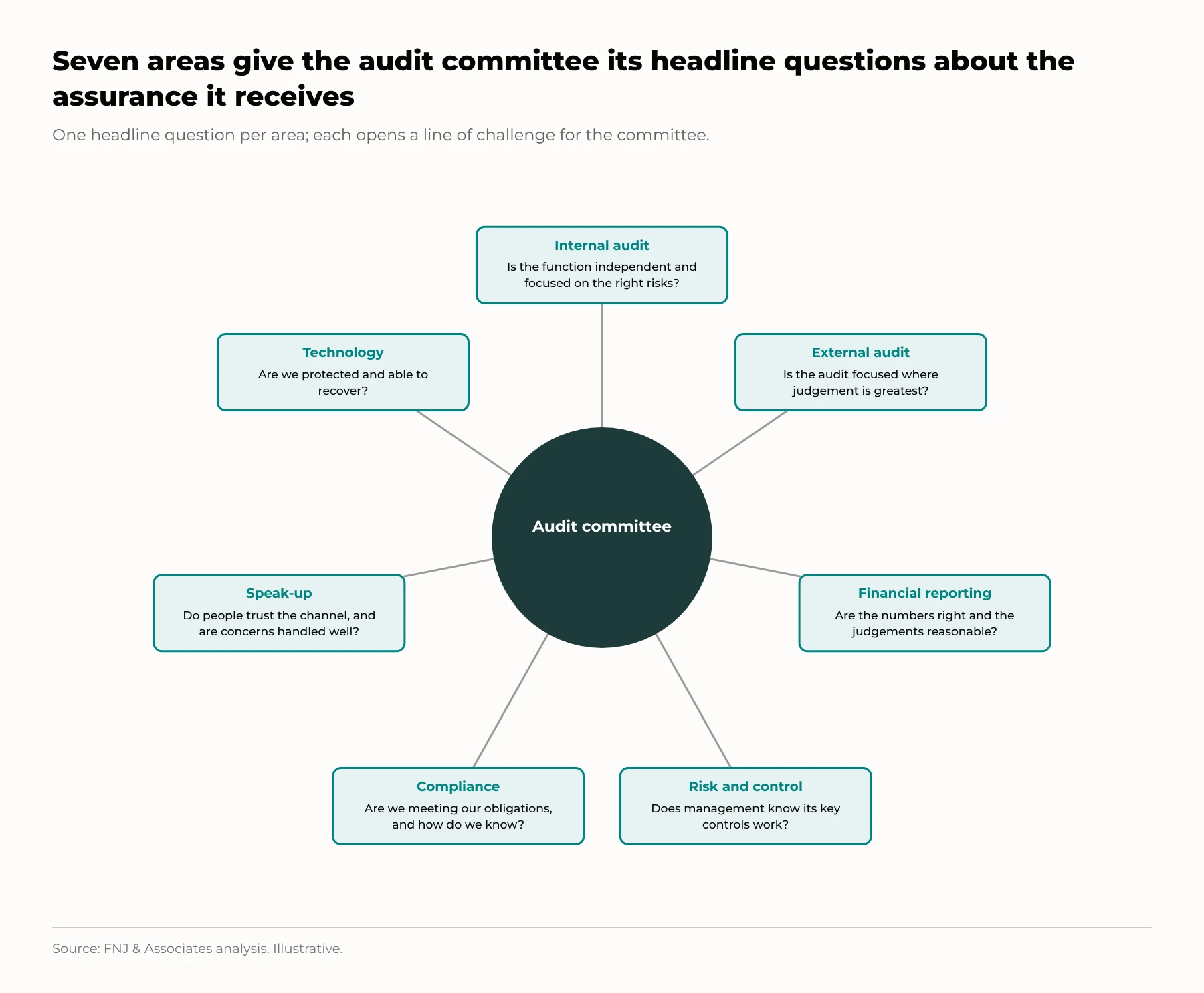
Risk and internal control: does management know whether its key controls work?
- Which principal risks sit outside appetite, and what is being done about them?
- How does management test its key controls between audits?
- Which control failures in the past year led to losses, and what changed afterwards?
- How are third-party and outsourcing risks monitored?
Where the institution has a separate risk committee, the audit committee should agree with it how responsibilities are divided, so that internal control is not overlooked because each committee assumes the other is covering it.
Compliance: is the institution meeting its obligations, and how do we know?
- Does the institution have a complete register of its obligations, with owners and due dates?
- What share of high-risk obligations was tested by the compliance function this year?
- What regulatory findings are open, and how old are they?
- Were any breaches reported to a regulator, and were the notifications made on time?
Speak-up: do people trust the channel, and are concerns handled well?
- How many concerns were raised, through which channels, and how does the number compare with previous years?
- What share of reports were acknowledged and given feedback within the service levels?
- How many concerns were substantiated, and what actions followed?
- Were any concerns about retaliation raised, and how were they resolved?
Our article on the whistleblowing procedure sets out the measures behind these questions. A low number of reports is not necessarily reassuring, since it may signal a lack of trust in the channel rather than an absence of misconduct.
Technology and cyber security: is the institution protected and able to recover?
- What were the most significant cyber security incidents in the period, and what was learned?
- When were critical systems last tested for recovery from a disruption, and did the test succeed?
- What share of critical vulnerabilities was fixed within the target time?
- What assurance has the committee received over the institution’s key technology suppliers?
Some signals call for a follow-up question
Certain patterns in reports suggest that the audit committee should probe further. Repeated extensions to the same action, a fall in the number of findings without an obvious reason, figures that differ between reports, a report that describes activity without stating conclusions, or a sudden change in the tone of a function’s reporting all deserve a follow-up question.
The committee should also notice what is missing, since a risk report that never mentions a known issue, an internal audit plan that omits a major change programme, or a compliance report that is silent on a new regulation may each indicate a gap that no one has raised.
Private sessions give the committee a candid view
Meeting the chief audit executive, the external audit partner and, where appropriate, the heads of risk and compliance without management present gives each the opportunity to raise concerns they might not raise in front of executives. A brief private session at each meeting, or at least annually for each, is a simple practice that many committees adopt.
The audit committee should evaluate its own effectiveness
An annual self-assessment, covering the committee’s composition, skills, information, meetings and relationships with the functions it oversees, helps the committee improve. Our article on board evaluation in Kenya sets out an approach that applies equally to committees, and an independent review every few years adds an outside perspective.
Fraud risk: would the institution detect fraud early, and does management take it seriously?
- When was the fraud risk assessment last updated, and which schemes does it rank highest?
- Which anti-fraud controls have been tested, and what did the tests find?
- How many frauds were detected in the period, how were they found and what was recovered?
- How quickly were suspected frauds investigated, and by whom?
The answer to how frauds were found is particularly telling. If most were found by accident or through external parties rather than through controls or reports from staff, the audit committee has reason to ask whether detection controls are working as intended.
Year-end: is the institution ready for the audit and the annual report?
- Is management’s timetable for the year-end close and the audit realistic, and what could delay it?
- Has management assessed going concern, and what assumptions support the assessment?
- Are there any significant transactions, disputes or regulatory matters that require disclosure?
- Has the governance statement in the annual report been reviewed against the applicable code?
Sector context adds questions of its own
Bank and SACCO audit committees should ask about expected credit losses, liquidity, capital adequacy and the status of regulatory inspection findings, while insurance committees should ask about the valuation of insurance liabilities, reinsurance arrangements and claims reserves. These areas carry the greatest judgement and the greatest supervisory attention in their sectors.
NGO audit committees should ask about donor audit findings, restricted funds, partner oversight and safeguarding, and public sector committees should ask about budget execution, procurement compliance and the status of findings from the supreme audit institution. The audit committee in each sector should add three or four questions of this kind to the seven areas above.
Minutes should record the questions as well as the answers
Regulators and auditors judge an audit committee partly by what its minutes show. Minutes that record only that reports were “noted” suggest a passive committee, while minutes that record the questions asked, the answers given and any follow-up agreed show a committee that tested what it was told.
A simple discipline helps: for each significant report, the minutes record the main questions raised, the conclusion reached and any action required, with an owner and a date. The action log then carries those actions forward to the next meeting, so that nothing raised by the audit committee is lost.
Good answers share three features
An audit committee can judge the answers it receives as well as the questions it asks. Strong answers are specific, citing figures, dates and owners rather than general reassurance; they are consistent with what other functions report on the same subject; and they acknowledge uncertainty where it exists instead of presenting every matter as resolved.
Answers that rely on phrases such as “we are working on it” or “this is under control”, without figures or dates, deserve a follow-up request for a short written update at the next meeting, which turns a general assurance into a commitment that can be checked.
Three moves before the next meeting
- Choose two questions from each of the seven areas and add them to the agenda for the relevant report.
- Schedule private sessions with the chief audit executive and the external audit partner.
- Ask internal audit to report the reopened rate for findings closed in the past two years.
How we support your institution
FNJ & Associates supports audit committees through internal audit, external quality assessments, audit committee effectiveness reviews and training for committee members. We also help committees redesign the reports they receive so that the questions in this article can be answered from the papers.
Trigarc Audit, implemented by FNJ, covers audit planning, execution, reporting and follow-up, and gives the audit committee a consistent view of findings, actions and closure from one record.
Questions about the audit committee
What are the main responsibilities of an audit committee?
An audit committee oversees financial reporting, internal control, internal audit and external audit, and in many institutions also compliance, whistleblowing and technology risk, on behalf of the board.
How often should an audit committee meet?
Most audit committees meet at least four times a year, aligned with the financial reporting cycle, with additional meetings when significant matters arise.
Should the audit committee meet auditors without management?
Yes, private sessions with the chief audit executive and the external audit partner give them the opportunity to raise concerns candidly, and many committees hold one at each meeting or at least annually.
What is the difference between the audit committee and the risk committee?
The audit committee focuses on financial reporting, internal control and audit, while the risk committee focuses on the institution’s risk profile and appetite, and the two should agree how responsibilities for internal control are divided.
How can an audit committee assess its own effectiveness?
An annual self-assessment covering composition, skills, information, meetings and relationships, supplemented by an independent review every few years, helps the committee identify improvements.
What questions should an audit committee ask internal audit?
An audit committee should ask whether the plan covers the principal risks, whether scope or resources were limited, how many closed findings have reappeared, when the last external quality assessment took place and whether the chief audit executive meets the committee privately.
What should an audit committee do when it receives a vague answer?
The audit committee should ask for a short written update with figures, dates and owners at the next meeting and record the request in the action log, so that a general assurance becomes a commitment that can be checked.
Can FNJ & Associates review our audit committee’s effectiveness?
Yes, FNJ & Associates carries out audit committee effectiveness reviews, provides internal audit and trains committee members, and the firm can be reached through fnjassociates.co.ke to request a proposal.
Request a proposal for an audit committee effectiveness review
FNJ & Associates helps audit committees across Kenya and East Africa ask sharper questions, receive better reports and gain confidence in the assurance they rely on.
About FNJ & Associates
FNJ & Associates is an ICPAK-registered CPA firm and a multidisciplinary team of 20+ professionals holding CPA(K), ACCA, CIA, CISA, CFE, CEH, CAMS and CIPP/E credentials, serving more than 100 organisations across Kenya and East Africa. The firm provides audit and assurance, internal audit, and IT and cybersecurity audits, and implements Trigarc Audit for audit planning, execution, reporting and follow-up. Visit fnjassociates.co.ke to learn more.