
Regulators, donors and communities now ask what an NGO board actually does, and the answer lies in its decisions, its oversight and its records.
NGO board governance in Kenya has moved from a formality to a subject of active scrutiny. The public benefit organisations regime sets clearer expectations for board composition, reporting and the use of funds, and donors, partners and communities increasingly ask what the board does to oversee the organisation it governs.
Many NGO boards were formed around a founder or a small group of supporters, and in practice the line between governance and management can blur. Board members may approve operational decisions, executive directors may set the board’s agenda without challenge, and the records needed to show that the board exercised oversight are often incomplete.
Effective NGO board governance rests on separating oversight from management and keeping clear evidence of both. This article sets out what that means in practice and complements our guide to the PBO Regulations 2026, which covers the regulatory requirements in detail.
The PBO regime sets clearer expectations for boards
The Public Benefit Organisations Regulations 2026, in force since 18 March 2026, set requirements that touch the board directly, including the filing of audited accounts within six months of the year-end, disclosure of funding sources and a requirement that at least one third of directors are resident in Kenya. Existing NGOs have until 14 May 2027 to complete their transition, and our guide sets out the steps.
Beyond the specific requirements, the regime reinforces a broader principle: the board is accountable for the organisation’s use of public benefit funds. That accountability can only be discharged through deliberate NGO board governance, not through occasional meetings that approve what management proposes.
Governance and management have different jobs
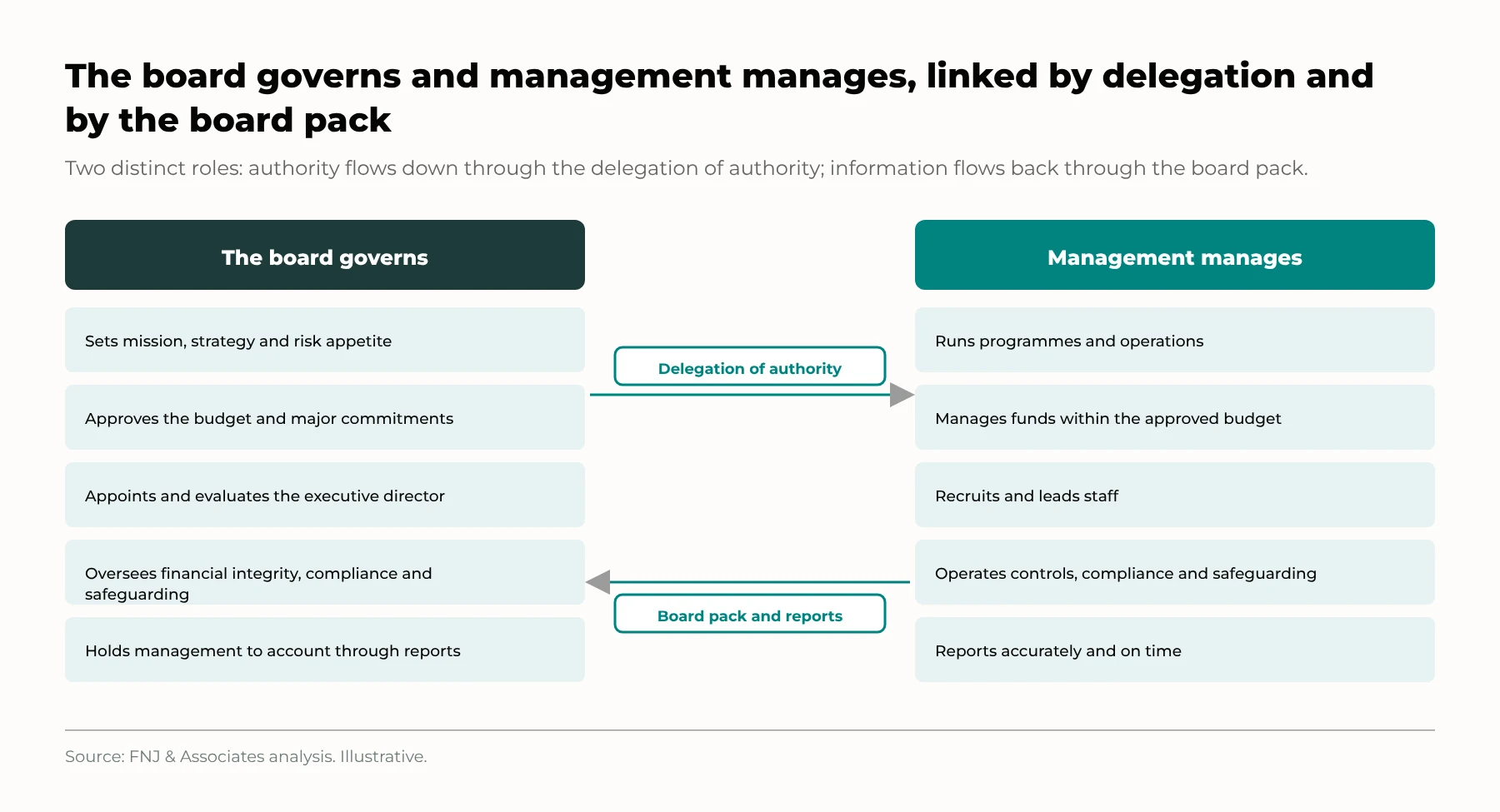
| The board governs | Management manages |
|---|---|
| Sets mission, strategy and risk appetite | Develops plans and delivers programmes |
| Approves the budget and major commitments | Spends within the approved budget and authority |
| Appoints, supports and evaluates the executive director | Recruits, manages and develops staff |
| Oversees financial integrity, compliance and safeguarding | Operates the controls that achieve them |
| Holds management to account through reports and questions | Reports accurately and on time to the board |
A written delegation of authority, approved by the board, makes the division concrete by stating which decisions the board reserves to itself and which it delegates to the executive director and others. Without it, board members may be drawn into operational decisions while strategic matters receive too little attention.
Oversight of funds is the board’s first responsibility
Donors and regulators look first at how the board oversees the money. The board should approve the annual budget, review management accounts against it at every meeting, receive the audited financial statements and the auditor’s management letter, and follow up on any weaknesses the auditor identifies.
The board should also see a view of donor compliance, including reports due and submitted, open donor audit findings and any disallowed costs. Our article on donor compliance sets out how organisations bring these obligations into one register, which gives the board a ready source for this oversight.
Partners and sub-grantees extend the board’s oversight
Many NGOs deliver much of their work through local partners, and the board remains accountable for funds passed to them. The board should understand how partners are selected and assessed, how their expenditure is verified and what happens when concerns arise, and it should receive a periodic summary of partner risks and findings.
Safeguarding needs a named board lead
Safeguarding the people the organisation serves, especially children and vulnerable adults, is a responsibility that donors and communities expect the board to own. Many NGOs appoint a board member as safeguarding lead, who receives regular reports on concerns raised, investigations and actions, and who ensures that policies, training and reporting channels are in place.
The board should also see aggregate safeguarding information at each meeting, protecting the identities of those involved. Sound NGO board governance treats safeguarding with the same seriousness as financial integrity, because the harm from a safeguarding failure can be far greater.
Risk and internal audit give the board independent insight
A risk register reviewed by the board, covering fraud, safeguarding, donor compliance, security and funding risks, gives the board a structured view of what could go wrong. Larger NGOs benefit from an internal audit function or an outsourced provider reporting to a board audit committee, and our article on internal audit for NGOs in Kenya explains how to scale this to the organisation’s size.
Speak-up channels connect the board to what is happening
Staff, partners and beneficiaries often know about problems long before management reports them. A confidential speak-up channel, with reports about senior management routed directly to the board chair or audit committee chair, gives the board early warning and demonstrates to donors that concerns can be raised safely.
The board’s own composition deserves regular review
Effective NGO board governance depends on having the right mix of skills, including finance, programme expertise, safeguarding, legal and fundraising experience, as well as the independence to challenge the executive director. A skills matrix, reviewed annually, shows where the board is strong and where a new appointment would add most.
Term limits and a planned rotation help keep the board fresh while preserving continuity. Founders who remain on the board can contribute valuable knowledge, but the board should ensure that no individual’s influence prevents it from exercising independent oversight.
Conflicts of interest need clear handling
Board members of NGOs often have links to suppliers, partners or other organisations in the sector. A register of interests, updated annually and whenever circumstances change, together with a rule that conflicted members do not take part in related decisions, protects both the organisation and the individuals concerned.
Evidence of NGO board governance should be ready on request
When a regulator, donor or auditor asks how the board governs, the answer lies in its records. Board packs, minutes that record decisions and dissent, a register of interests, the delegation of authority, the risk register and the reports the board receives together form the evidence of NGO board governance in action.
- Approved governing documents and a current delegation of authority.
- Minutes of board and committee meetings, recording decisions and follow-up.
- A register of directors’ interests and how conflicts were handled.
- Budgets, management accounts and audited financial statements reviewed by the board.
- Reports on donor compliance, partners, safeguarding and speak-up.
- The results of the board’s own evaluation and the actions that followed.
Appointing and evaluating the executive director is a core board task
The relationship between the board and the executive director is the hinge of NGO board governance. The board should appoint the executive director through a structured process, agree clear objectives each year, evaluate performance against them and plan for succession, so that the organisation is not left exposed if the executive director leaves suddenly.
Regular, structured conversations between the chair and the executive director help both sides. The executive director gains support and a sounding board, while the chair gains early sight of emerging issues and can bring them to the board before they become problems.
Fundraising, reputation and terrorist financing risks reach the board
How the organisation raises funds, and from whom, affects its reputation and its relationships with donors and regulators. The board should approve the fundraising strategy, set limits on the kinds of funding the organisation will accept and ensure that the sources of funds are known and documented, which the PBO regime now requires the organisation to disclose.
NGOs also face the risk of being misused for terrorist financing, which is the subject of FATF Recommendation 8 and of donor screening requirements. The board should confirm that the organisation screens partners, suppliers and, where required, beneficiaries, and that it can show the results of that screening.
A regular meeting rhythm supports good NGO board governance
Most NGO boards meet at least four times a year, with an annual calendar that sets out when the budget, the audited accounts, the risk register, the board evaluation and the executive director’s objectives will be considered. A calendar of this kind ensures that each responsibility receives attention at the right time, rather than only when a problem arises.
Smaller NGOs can scale the approach
A community-based organisation with a small board and a modest budget does not need committees and extensive reporting, but it still benefits from the core elements: a short delegation of authority, a budget reviewed at each meeting, a register of interests, a named safeguarding lead and minutes that record decisions. These elements cost little to put in place and give donors and the regulator confidence that the board is exercising real oversight.
Induction and training equip board members for their role
Many NGO board members bring valuable programme or community experience but have little background in finance, risk or governance. A structured induction, covering the organisation’s governing documents, finances, donor obligations, safeguarding arrangements and the board’s responsibilities under the PBO regime, helps new members contribute quickly and confidently.
Ongoing training, even a short session each year on a topic such as reading financial statements, overseeing fraud risk or responding to a safeguarding concern, keeps the board’s knowledge current. Donors increasingly see an investment in board development as a sign of strong NGO board governance, and some will support the cost through grant budgets.
Board members should also understand their personal responsibilities, including their duties of care and loyalty to the organisation, the importance of declaring conflicts and the risks of acting outside the authority the governing documents give them. A short briefing on these duties at induction, refreshed when the law or the organisation’s structure changes, protects both the members and the organisation.
Taken together, these practices give the board a clear answer when a donor, a partner or the regulator asks how the organisation is governed. They give the executive director a board that supports the organisation’s work rather than one that simply approves it.
Three moves for the next quarter
- Review the delegation of authority and confirm which decisions the board reserves to itself.
- Appoint a board safeguarding lead if the board does not have one, and agree the reports they will receive.
- Add a donor compliance and partner risk summary to the standing agenda for every board meeting.
How we support your institution
FNJ & Associates helps NGOs and PBOs strengthen NGO board governance through governance reviews, board evaluations, delegation of authority frameworks, internal audit and safeguarding and speak-up arrangements. We also prepare organisations for the PBO transition and for donor due diligence.
Trigarc Governance, implemented by FNJ, assembles board packs from the organisation’s records and keeps a secure archive, while Trigarc Ethics supports safeguarding and speak-up reporting to the board.
Questions about NGO board governance
What does an NGO board do?
An NGO board sets the mission, strategy and risk appetite, approves the budget, appoints and oversees the executive director, and oversees financial integrity, compliance, partners and safeguarding, while management runs day-to-day operations.
What do the PBO Regulations 2026 require of NGO boards?
The regulations include requirements on audited accounts, funding disclosure and the residency of directors, and existing NGOs have until 14 May 2027 to complete their transition, as set out in our PBO Regulations guide.
Should an NGO board have committees?
Larger NGOs benefit from an audit and risk committee and sometimes a programmes or fundraising committee, while smaller boards may handle these matters at full board meetings with a clear agenda.
How can an NGO board oversee safeguarding?
The board can appoint a safeguarding lead, receive regular aggregate reports on concerns and investigations, and ensure that policies, training and confidential reporting channels are in place.
What records show good NGO board governance?
Approved governing documents, a delegation of authority, minutes recording decisions, a register of interests, financial and compliance reports reviewed by the board and the results of board evaluations together show governance in action.
How often should an NGO board meet?
Most NGO boards meet at least four times a year, following an annual calendar that schedules the budget, audited accounts, risk register, board evaluation and executive director objectives at the right points in the year.
Can founders sit on an NGO board?
Founders can sit on the board and often bring valuable knowledge, but sound NGO board governance requires that the board as a whole can exercise independent oversight, that conflicts are declared and that no single individual dominates its decisions.
Can FNJ & Associates review our NGO board governance?
Yes, FNJ & Associates carries out governance reviews and board evaluations for NGOs and PBOs, and the firm can be reached through fnjassociates.co.ke to request a proposal.
Request a proposal for an NGO governance review
FNJ & Associates helps NGO and PBO boards across Kenya and East Africa separate governance from management, strengthen oversight and keep the evidence that regulators and donors expect.
About FNJ & Associates
FNJ & Associates is an ICPAK-registered CPA firm and a multidisciplinary team of 20+ professionals holding CPA(K), ACCA, CIA, CISA, CFE, CEH, CAMS and CIPP/E credentials, serving more than 100 organisations across Kenya and East Africa. The firm provides governance, risk and compliance advisory and corporate governance training, and implements Trigarc Governance for board reporting. Visit fnjassociates.co.ke to learn more.