
Consistent capture, sound classification and root cause analysis turn loss events into the most reliable evidence of where controls need strengthening.
An operational loss is a loss arising from inadequate or failed internal processes, people and systems, or from external events. Banks, SACCOs, insurers, fintechs, NGOs and corporates across Kenya and East Africa experience such losses every year, through fraud, processing errors, system failures, regulatory penalties and damage to assets.
Many institutions record only the losses large enough to reach the finance team, and they record them as accounting entries rather than risk events. Smaller losses, recoveries and near misses go unrecorded, causes are rarely analysed, and the same weakness produces the same loss again, sometimes in several branches or programmes before anyone notices the pattern.
A loss event process with clear definitions, consistent capture, root cause analysis and links to the risk register changes this. This article sets out how to build one, as part of our risk management services in Kenya.
Supervisors expect institutions to collect and use loss data
The Basel Committee’s principles for the sound management of operational risk expect banks to collect internal loss data and use it to identify and assess operational risk. The Central Bank of Kenya’s prudential framework reflects the same expectation, and insurance, SACCO and capital markets supervisors increasingly ask how institutions learn from incidents.
Outside financial services, donors expect NGOs to report losses of funds and assets promptly and to show what they have done to prevent recurrence, while corporate boards and lenders want to understand the cost of operational failures. A disciplined approach to operational loss data serves all of these audiences.
A clear definition decides what is captured
The loss event policy should define what counts as an event, so that every business unit records the same things. Most institutions capture three kinds of event: actual losses, where money or value has been lost; near misses, where a loss was avoided by chance or late detection; and events with gains or no financial effect that still reveal a control failure.
| Event type | Example | Why it matters |
|---|---|---|
| Actual operational loss | A fraudulent supplier payment that is not recovered | Measures the cost of control failure |
| Recovered loss | An erroneous transfer reversed after three days | Shows the gross exposure before recovery |
| Near miss | A duplicate payment stopped by the bank before release | Reveals a weakness before it costs money |
| Non-financial event | A data breach with no direct cost but regulatory exposure | Captures reputational and compliance effects |
Near misses are often the most valuable records, because they reveal weaknesses at no cost. An institution that records ten near misses for every actual loss has a far better view of its control environment than one that records losses alone.
Thresholds keep capture practical
Capturing every minor event can overwhelm business units, so most institutions set a reporting threshold for actual losses, below which events are recorded in aggregate or not at all. The threshold should be low enough to capture meaningful patterns, and near misses and events involving fraud, customers or regulators should be recorded regardless of value.
Each operational loss record needs consistent fields
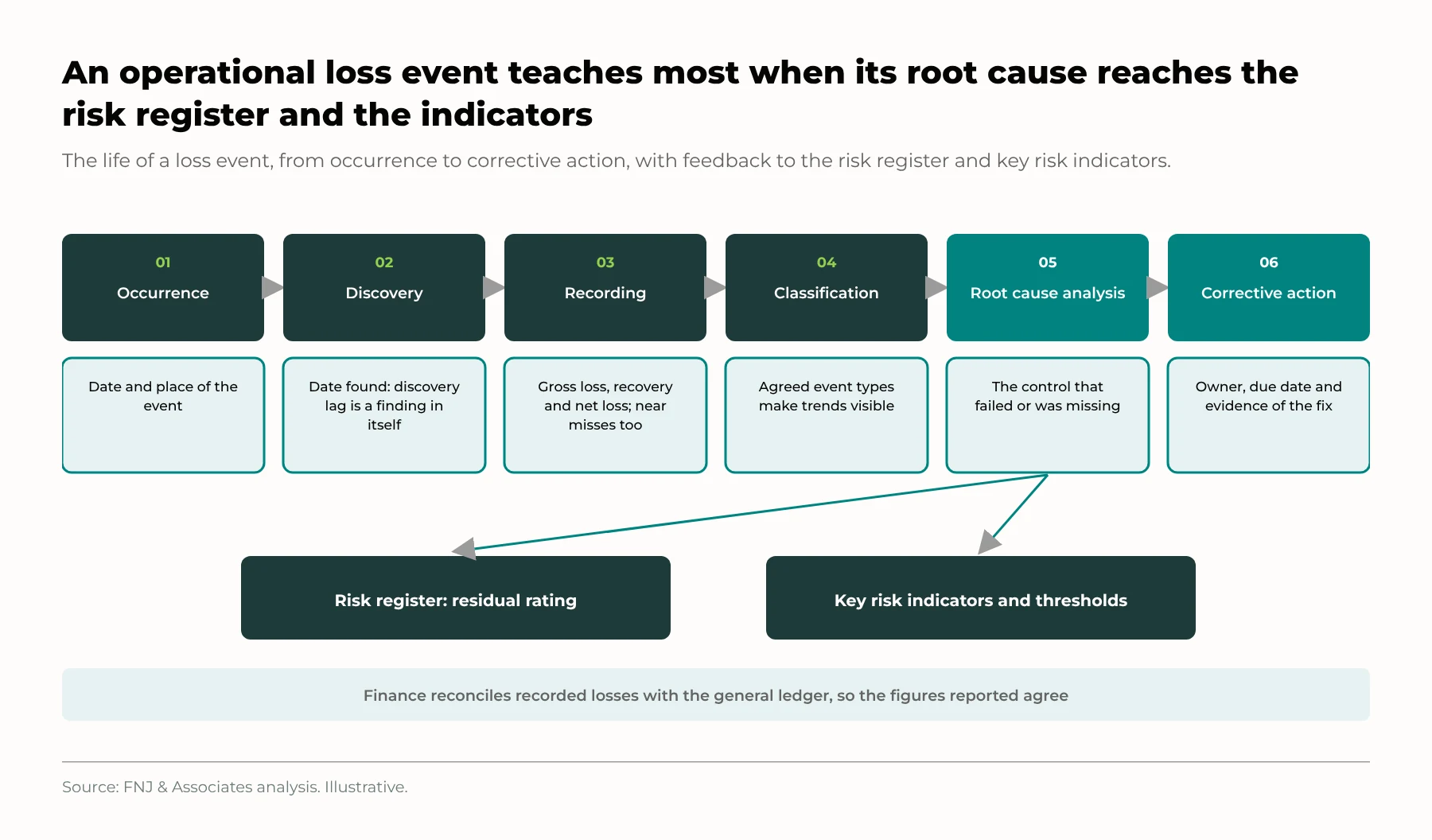
- The date the event occurred, the date it was discovered and the date it was recorded.
- The business unit, process and location where it occurred.
- A description of what happened, in plain language.
- The gross loss, any recovery and the net loss, with the basis of each figure.
- The event type, using an agreed classification.
- The root cause and the control that failed or was missing.
- The actions agreed to prevent recurrence, with owners and dates.
A common classification makes trends visible
Classifying each event by type allows the institution to see where losses concentrate. Many institutions use the seven Basel event types, which are internal fraud, external fraud, employment practices and workplace safety, clients, products and business practices, damage to physical assets, business disruption and system failures, and execution, delivery and process management.
The same classification can be applied outside banking with minor adaptation, and using it consistently across the institution allows losses to be compared over time and between business units, branches or programmes.
Root cause analysis is where the learning happens
Recording an operational loss without asking why it occurred captures the cost but misses the lesson. For each significant event, the owner should identify the immediate cause and the underlying cause, such as a missing segregation of duties, a manual workaround, inadequate training or a system limitation, and link it to the control that failed.
Root cause analysis also reveals common causes behind apparently different events. Three losses in different branches may share a single cause in the way a process was designed, and fixing that cause once is far more effective than responding to each event separately.
Loss data should feed the risk register and indicators
Loss events provide evidence for the ratings in the risk register. A risk rated as unlikely that has produced several losses in a year probably needs reassessment, and a control rated as effective that has failed repeatedly needs testing. Our article on risk and control self-assessment explains how loss data should challenge self-assessed ratings.
Loss trends also make useful key risk indicators, because the number and value of losses by type, the time taken to discover events and the share of events found by controls rather than by chance all tell the risk committee how well operational risk is being managed.
Finance and risk should reconcile operational loss figures
Losses recorded in the risk system should be reconciled periodically with write-offs, provisions and expense accounts in the general ledger. The reconciliation often reveals losses that were written off without being reported as risk events, and it gives the board confidence that the loss data is complete.
Five weaknesses recur in loss event processes
- Only large losses recorded, with near misses and recoveries ignored.
- Events recorded long after discovery, so details and evidence are lost.
- No root cause recorded, so the same weakness causes repeated losses.
- Loss data held separately from the risk register and never used to challenge ratings.
- No reconciliation with the general ledger, so the record is incomplete.
Sector context shapes where losses arise
Banks, SACCOs and fintechs see most losses from external fraud, processing errors and system failures, with digital channels and mobile money creating new patterns. Insurers see losses from claims fraud and processing errors, and corporates experience losses from supply chain disruption, inventory shrinkage and procurement fraud.
NGOs face losses of cash and assets in field operations, partner fraud and security incidents, and donors often require reporting within days of discovery. The definitions, fields, classification and root cause analysis described here apply in every case.
A culture of reporting determines the quality of loss data
Loss data is only as complete as people’s willingness to report. Where staff fear blame, small errors and near misses are hidden, corrected quietly or written off without explanation, and the institution loses exactly the information that would help it prevent larger failures later.
Senior management sets the tone for reporting across the institution. When executives respond to reported events by asking what the institution can learn rather than who is to blame, and when the risk committee praises business units that report near misses promptly, reporting rises and the picture becomes more accurate. A rise in recorded events after a new policy is introduced is usually a sign of better reporting, not of worse control.
Discovery time is as revealing as the loss itself
The gap between the date an event occurred and the date it was discovered says a great deal about the institution’s controls. An operational loss found by a daily reconciliation within a day suggests that detective controls are working, while one found months later by an auditor, a customer complaint or a regulator suggests that they are not.
Tracking the average discovery time by event type, and the share of events detected by the institution’s own controls, gives the risk committee a measure of control effectiveness that is hard to obtain any other way.
Significant events deserve a structured review
For any operational loss above a set value, any event involving customers or regulators, and any repeated pattern, the institution should hold a structured review led by the risk function with the business owner. The review should establish the sequence of events, the controls that should have prevented or detected the loss, why they did not, and what will change, and it should be completed within an agreed period of discovery.
The findings of each review should be shared with other business units that run the same process, because a weakness found in one branch, region or programme is often present elsewhere.
External loss data adds perspective
Internal loss data shows what has happened to the institution, but it rarely captures rare and severe events. Industry reports, regulatory publications and news of losses at peer institutions help the risk function test whether similar events could occur, and scenario analysis based on those events gives the board a view of exposures that internal data alone would miss.
Smaller institutions can start with a simple log
A SACCO, a growing fintech or a mid-sized NGO does not need specialist software to begin. A shared log with the fields described here, a monthly review by the risk officer, a quarterly trend report to the risk committee and a structured review of significant events deliver most of the value of an operational loss process, and the log can move into a GRC platform as volumes grow.
Starting simply also builds the habit of reporting, which is harder to establish than any system and matters far more to the quality of the data.
Three moves for the next quarter
- Agree a loss event policy that defines actual losses, recoveries, near misses and the reporting threshold.
- Record the root cause and the failed control for every operational loss above the threshold in the past year.
- Reconcile recorded losses with the general ledger and report the first trend analysis to the risk committee.
How we support your institution
FNJ & Associates designs loss event policies and classifications, facilitates root cause analysis for significant events, reconciles loss data with financial records and builds loss reporting for risk committees. Our risk work follows the model of Insight, Judgement, Execution, and loss data is often the clearest source of insight an institution has.
Trigarc Risk, implemented by FNJ, records incidents and loss events with their causes, links them to risks and controls, tracks corrective actions and reports trends to the risk committee.
Questions about operational loss
What is an operational loss?
An operational loss is a loss arising from inadequate or failed internal processes, people and systems, or from external events, such as fraud, processing errors, system failures, regulatory penalties or damage to assets.
Why should near misses be recorded?
Near misses reveal control weaknesses before they cause a loss, so recording them gives the institution early warning at no cost and a fuller view of its control environment.
What should a loss event record contain?
It should record the dates of occurrence and discovery, the business unit, a description, the gross loss, recovery and net loss, the event type, the root cause, the failed control and the corrective actions.
How should loss data be used?
Loss data should challenge risk and control ratings, feed key risk indicators, reveal common root causes and be reported to the risk committee as trends rather than isolated incidents.
Should loss data be reconciled with the accounts?
Yes, periodic reconciliation with write-offs, provisions and expense accounts reveals losses that were not reported as risk events and confirms that the loss record is complete.
What is a reporting threshold for loss events?
A reporting threshold is the value below which actual losses are recorded in aggregate or not at all, set low enough to capture patterns, while near misses and events involving fraud, customers or regulators are recorded regardless of value.
How should operational loss trends be reported to the board?
The risk committee should receive the number and value of losses by event type and business unit, the trend over several quarters, discovery times, significant events with their root causes and the status of corrective actions.
Can FNJ & Associates help us set up loss event reporting?
Yes, FNJ & Associates designs loss event policies, facilitates root cause analysis and builds loss reporting for risk committees, and the firm can be reached through fnjassociates.co.ke to request a proposal.
Request a proposal for loss event capture and reporting
FNJ & Associates helps institutions across Kenya and East Africa turn every operational loss and near miss into evidence of where controls need strengthening.
About FNJ & Associates
FNJ & Associates is an ICPAK-registered CPA firm and a multidisciplinary team of 20+ professionals holding CPA(K), ACCA, CIA, CISA, CFE, CEH, CAMS and CIPP/E credentials, serving more than 100 organisations across Kenya and East Africa. The firm provides governance, risk and compliance advisory, and implements Trigarc Risk for risk identification, assessment and reporting. Visit fnjassociates.co.ke to learn more.