

Six outcome areas, each with a few measures, give a board a quarterly view of whether customers are treated fairly.
Conduct risk, the risk that an institution’s behaviour leads to poor outcomes for customers or harms the integrity of the market, has moved to the centre of supervision in Kenya’s financial sector. Banks, insurers, SACCOs, microfinance institutions and digital lenders all face regulators who now ask how customers are treated, not only whether the institution is solvent.
Most boards have approved the building blocks: a code of conduct, a complaints procedure, a product approval process and a treating customers fairly policy. The reports they receive, however, usually describe these policies and the activities around them, so directors still cannot say with confidence whether customers are receiving fair outcomes.
Measuring outcomes closes the gap, because six outcome areas, each with a small number of indicators drawn from data the institution already holds, give the board a quarterly conduct profile and point to where action is needed. This article sets out the areas, the measures and the reporting, as part of our compliance services in Kenya.
Kenyan regulators have made conduct risk a supervisory priority
The Central Bank of Kenya’s prudential guidelines include a guideline on consumer protection for banks, and the draft revisions published for comment in 2026 are reported to strengthen consumer protection further. The Insurance Regulatory Authority and SASRA give similar attention to how products are sold and how complaints and claims are handled.
The direction of travel is consistent across sectors, and supervisors expect boards to know how customers are treated and to be able to show it, which requires measurement rather than assurance in general terms.
Six outcome areas cover the customer journey
Conduct risk arises at every stage of the relationship with a customer, from the design of a product to the way a debt is collected or a claim is settled. Grouping the journey into six outcome areas gives the board a complete view without an unmanageable number of measures.
| Outcome area | The outcome customers should experience |
|---|---|
| 1. Product design | Products meet the needs of the customers they are sold to, and offer fair value |
| 2. Sales and advice | Customers receive suitable products and understand what they are buying |
| 3. Pricing and disclosure | Charges are clear before purchase and match what is applied |
| 4. Service and after-sales | Customers can use the product, change it and leave it without unreasonable barriers |
| 5. Complaints, claims and collections | Problems are resolved fairly and promptly, and customers in difficulty are treated with care |
| 6. Data and privacy | Customer data is used lawfully and only as customers would reasonably expect |
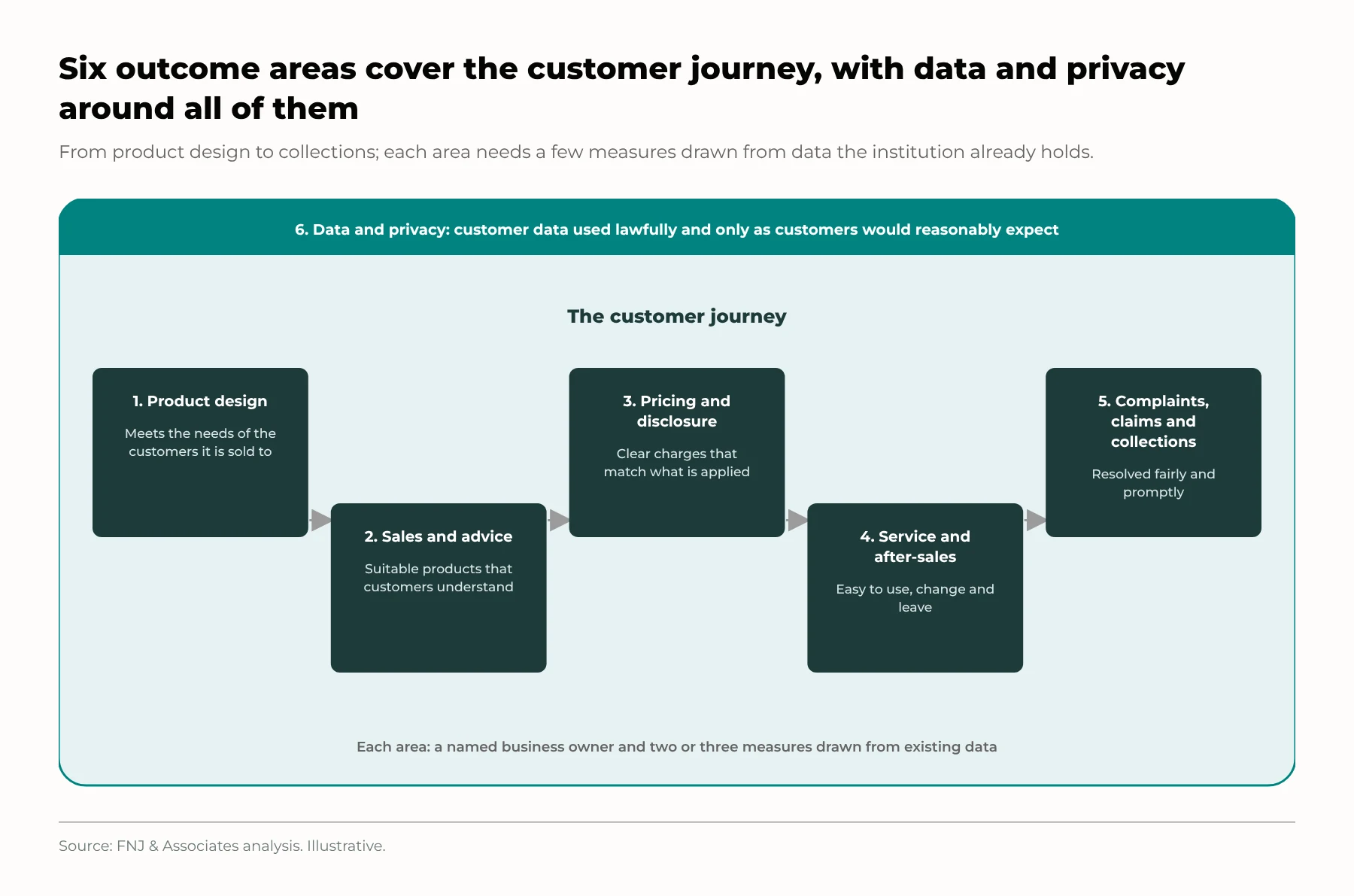
Each outcome area needs a few measures drawn from existing data
The measures below are illustrative and should be selected to fit each institution’s products and data. The principle is to choose two or three per area that move when outcomes change, and to report them consistently over time.
| Outcome area | Illustrative measures |
|---|---|
| Product design | Share of products reviewed for fair value in the year; take-up and early cancellation rates by product |
| Sales and advice | Cancellations within the cooling-off period; complaints about mis-selling; sales concentration by staff member |
| Pricing and disclosure | Complaints about unexpected charges; refunds of incorrectly applied fees |
| Service and after-sales | Time to process changes and closures; complaints about access to accounts or policies |
| Complaints, claims and collections | Time to resolve complaints; share upheld; claims settled within the service standard; collection complaints |
| Data and privacy | Data subject requests and their timeliness; privacy complaints; data incidents affecting customers |
Complaints data is the richest source of conduct risk insight
Complaints show where customers believe outcomes have failed, so they deserve more than a count. Analysing complaints by product, channel, branch and cause reveals patterns that point to a product feature, a sales practice or a process that is causing harm.
Root-cause analysis should feed back into the business, so a rise in complaints about a fee, for example, should prompt a review of how the fee is disclosed and whether it represents fair value, not only refunds to the customers who complained.
Incentives are a leading indicator of conduct risk
How staff and agents are rewarded shapes how they treat customers. Sales targets without quality measures, commissions that favour higher-margin products and collection incentives tied only to recovery amounts can all pull behaviour away from fair outcomes.
A conduct review should therefore examine incentive schemes alongside outcome data. Institutions that balance volume measures with quality indicators, such as cancellations, complaints and file reviews, tend to see better outcomes and fewer conduct issues.
Customers in vulnerable circumstances need particular care
Bereavement, illness, financial distress, limited literacy and limited familiarity with digital channels all make customers more susceptible to harm. An institution that identifies these circumstances, trains staff to respond and adapts its processes, for example in collections or claims, reduces conduct risk and builds trust with the customers who need it most.
Digital channels change how conduct risk arises
Mobile lending, digital insurance and app-based savings bring products to customers who may never visit a branch. Conduct then depends on screen design, default settings, the clarity of disclosures on a small screen and the conduct of automated collection messages.
These features should be tested with real customers before launch and monitored afterwards. Measures such as completion rates for disclosures, repeat borrowing patterns and complaints about collection messages show whether digital journeys produce fair outcomes.
A quarterly conduct profile gives the board a clear view
The board needs a short conduct risk profile each quarter: an overall assessment, a rating and trend for each outcome area, the three most significant issues and the actions under way, and any emerging risks such as a new product or channel. This fits on two pages and allows directors to focus on the areas that are moving in the wrong direction.
Many institutions support the profile with a quarterly self-assessment, in which business units rate their own performance against each outcome area and compliance reviews the ratings. The self-assessment gives ownership to the first line while the compliance function provides challenge.
The principles extend beyond financial services
Conduct risk is most developed in banking and insurance, but the same thinking applies to telecommunications providers, utilities and NGOs that serve beneficiaries. In each case the question is whether the people the organisation serves receive fair treatment, and the six outcome areas can be adapted to answer it.
Product governance prevents conduct risk at the source
Many conduct issues can be traced to a product that was designed without enough thought for the customers who would buy it. A product governance process asks, before launch, who the target customers are, whether the product meets their needs, whether its price represents fair value and how it will be sold, and it repeats those questions at regular reviews after launch.
Products that have been on sale for many years deserve the same scrutiny, because customer needs and market conditions change. A legacy savings product with a low rate, or an insurance cover that rarely pays claims, may now deliver poor value even though it was reasonable when launched.
Collections and claims are where conduct risk is most visible
Customers judge an institution most sharply when they are in difficulty, whether they have fallen behind on a loan or are making a claim after a loss. Collection practices that rely on excessive calls, public shaming or contact with family and friends cause real harm and attract regulatory attention, as do claims processes that delay settlement or reject claims on technical grounds.
Clear standards for collections and claims, monitored through complaint data and file reviews, protect customers and the institution’s reputation at the same time. Third parties such as collection agencies and loss adjusters should be held to the same standards through their contracts and through regular reviews of their work.
Five weaknesses recur in conduct risk frameworks
- Reports that describe policies and training completed instead of the outcomes customers experience.
- Complaints counted but not analysed by cause, product or channel.
- Incentive schemes reviewed by human resources without input from compliance.
- Third parties such as agents and collectors left outside the monitoring.
- No clear owner in the business for each outcome area.
Addressing these weaknesses does not require a large new programme. It requires the conduct risk framework to be connected to the data the institution already holds and to the people who make product, sales and service decisions every day.
Conduct risk links closely to culture and governance
Outcome measures show what is happening, while culture explains why. Staff surveys, exit interviews and the volume of internal concerns raised through the speak-up channel give the board a view of whether staff feel able to put customers first when targets pull in another direction.
Boards set the tone by asking about customer outcomes as often as they ask about growth, by reviewing incentive schemes and by holding senior management accountable for the conduct profile. Where the board shows that conduct matters, the rest of the organisation tends to follow.
Agents and intermediaries carry conduct risk on the institution’s behalf
Much of the selling in Kenyan financial services happens through agents, brokers, bancassurance partners and digital platforms rather than through employees. Customers rarely distinguish between the institution and the intermediary, so poor conduct by an agent damages the institution’s reputation and can expose it to regulatory action.
Contracts with intermediaries should therefore set conduct standards, require training and give the institution the right to review sales files and complaints. Monitoring the same outcome measures by intermediary, such as cancellations, complaints and claims declined, shows quickly where an agent’s practices differ from the rest of the network and need attention.
Three moves for the next quarter
- Select two or three measures for each outcome area from data the institution already holds, and agree a baseline for the current quarter.
- Analyse the last twelve months of complaints by cause, and identify the three causes that account for the largest share.
- Present a two-page conduct risk profile to the board committee, with an overall rating, the trend for each area and the actions under way.
How we support your institution
FNJ & Associates designs conduct risk frameworks, selects outcome measures, reviews incentive schemes and complaints processes, and prepares board reporting for banks, insurers, SACCOs and lenders. We also train boards, senior management and customer-facing staff on conduct expectations and on the measures that show whether they are being met.
Where conduct measures sit alongside wider compliance obligations, the compliance obligations register provides the foundation. Trigarc Compliance, implemented by FNJ, supports quarterly conduct self-assessments with compliance sign-off and reports the results to the board.
Questions about conduct risk
What is conduct risk?
Conduct risk is the risk that the behaviour of an institution, its staff or its agents leads to unfair outcomes for customers or harms the integrity of the market, through poor product design, mis-selling, unclear pricing, poor service or unfair handling of complaints, claims and collections.
Is conduct risk only relevant to banks?
No, conduct risk applies to insurers, SACCOs, microfinance institutions, digital lenders and investment firms, and the same principles extend to other organisations that serve customers or beneficiaries.
How is conduct risk measured?
Conduct risk is measured through indicators of customer outcomes, such as complaints by cause, cancellations, refunds, claims settlement times and collection complaints, grouped into outcome areas and reported over time.
Who owns conduct risk in an institution?
Business units own conduct risk because they design, sell and service products, while the compliance function sets standards, monitors outcomes and challenges the first line, and the board oversees the overall profile.
How often should the board review conduct risk?
Most boards review a conduct risk profile quarterly through a committee, with immediate escalation of significant issues such as widespread mis-selling or a pattern of unfair collections.
What is the difference between conduct risk and compliance risk?
Compliance risk is the risk of breaching laws, regulations or internal rules, while conduct risk focuses on the fairness of outcomes for customers and markets, which can be poor even when every rule has technically been followed.
How does conduct risk apply to digital lenders?
Digital lenders face conduct risk in how loans are offered on mobile screens, how costs are disclosed, how repeat borrowing is encouraged and how overdue customers are contacted. As a result, they should monitor outcome measures for each of these stages and review collection messages with particular care.
Can FNJ & Associates review our conduct risk framework?
Yes, FNJ & Associates reviews conduct frameworks, outcome measures, incentives and complaints handling, and the firm can be reached through fnjassociates.co.ke to request a proposal.
Request a proposal for a conduct risk review
FNJ & Associates helps banks, insurers, SACCOs and lenders across Kenya and East Africa measure customer outcomes and give their boards a clear view of conduct risk.
About FNJ & Associates
FNJ & Associates is an ICPAK-registered CPA firm and a multidisciplinary team of 20+ professionals holding CPA(K), ACCA, CIA, CISA, CFE, CEH, CAMS and CIPP/E credentials, serving more than 100 organisations across Kenya and East Africa. The firm provides governance, risk and compliance advisory, including AML/CFT, anti-bribery and data protection, and implements Trigarc Compliance for obligation tracking, evidence and corrective actions. Visit fnjassociates.co.ke to learn more.