

One calendar of recurring obligations, with named owners, early reminders and evidence of submission, turns scattered deadlines into a managed process.
A statutory compliance calendar lists every recurring filing, payment, return, renewal and report an organisation must make to government agencies and regulators, with its due date, owner and status. Banks, SACCOs, insurers, fintechs, NGOs and corporates in Kenya and East Africa face dozens of such deadlines each year, covering tax, payroll deductions, company filings, sector regulation, permits and data protection.
In many organisations, these deadlines are tracked in the heads of a few experienced staff, in personal diaries or in separate spreadsheets kept by finance, human resources and the company secretary. When one of those people is on leave or leaves the organisation, a filing is missed. The consequences range from penalties and interest to regulatory findings, suspension of a licence or the loss of a tax compliance certificate that a tender or a donor depends on.
A single statutory compliance calendar, with named owners and backups, early reminders, evidence of submission and regular reporting, removes that dependence on memory. This article sets out how to build one, as part of our compliance services in Kenya.
Statutory deadlines come from many authorities
Few organisations appreciate how many bodies they report to until they list them. A typical Kenyan organisation deals with the Kenya Revenue Authority for taxes and payroll deductions, the social security and health contribution bodies, the housing levy, the Business Registration Service for company filings, county governments for business permits and the Office of the Data Protection Commissioner for registration, before any sector regulator is considered.
| Category | Typical obligations (illustrative) | Usual frequency |
|---|---|---|
| Payroll deductions | Income tax on employment, social security, health contributions, housing levy, training levy | Monthly |
| Indirect and withholding taxes | Value added tax, withholding tax, excise duty where applicable | Monthly |
| Corporate income tax | Instalment tax and the annual return | Quarterly and annually |
| Company filings | Annual returns, changes in directors, beneficial ownership updates | Annually and on change |
| Licences and permits | County business permits, sector licences, professional registrations | Annually or as set |
| Data protection | Registration as controller or processor and its renewal | As set by the regulator |
| Sector regulators | Prudential, statistical and conduct returns for banks, SACCOs, insurers, pension schemes and capital markets firms | Monthly, quarterly or annually |
| NGO-specific | Annual returns and accounts to the PBO regulator, donor reports | Annually and as agreed |
Due dates and requirements change, so the calendar should be checked against each authority’s current guidance at least once a year and whenever a law or regulation changes. The compliance obligations register is the natural source for this information, since it records the legal basis of each obligation.
The statutory compliance calendar needs one owner for every deadline
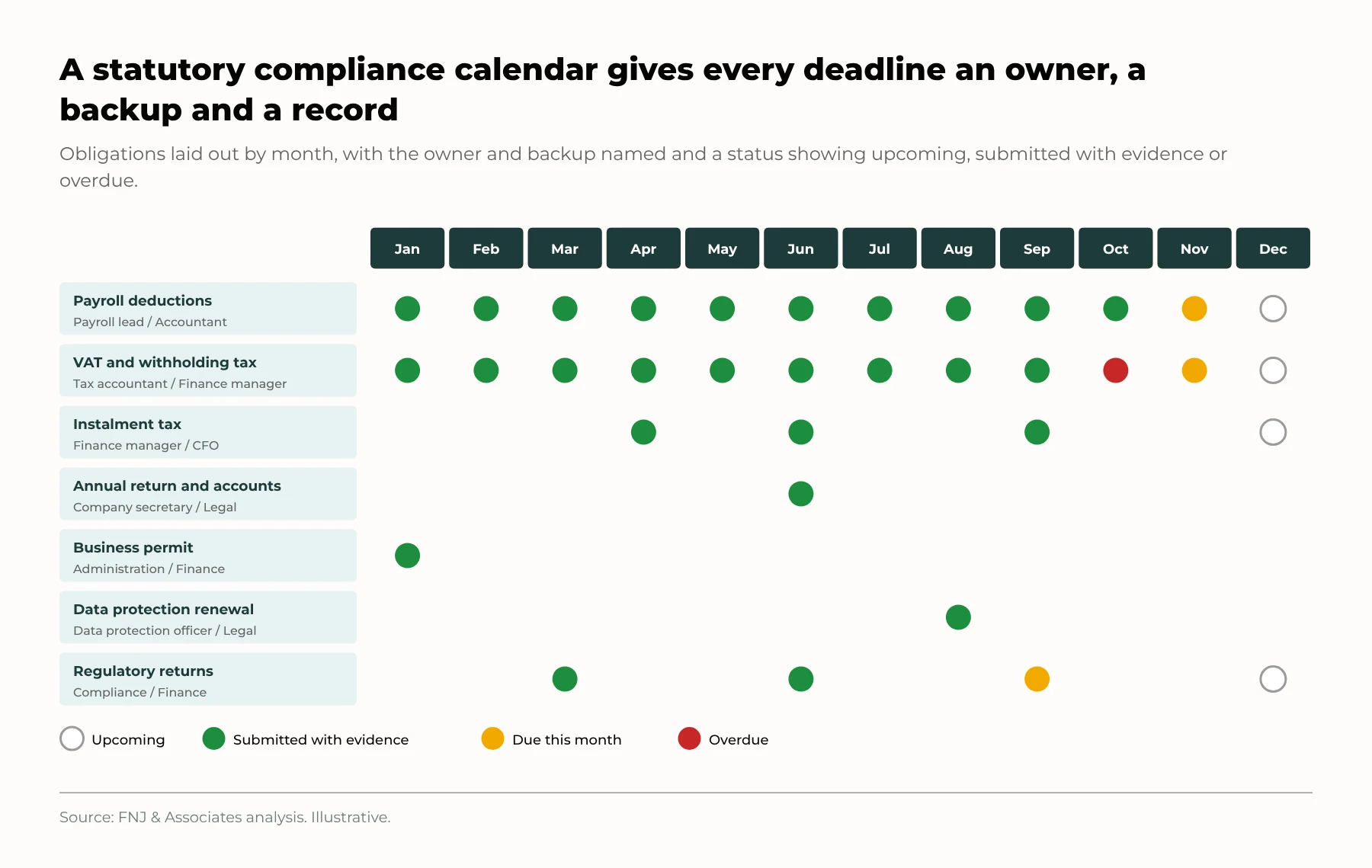
Each obligation in the calendar should have a named owner responsible for preparing and submitting it on time, and a named backup who can do so if the owner is absent. Owners are usually in finance, human resources, the company secretary’s office or compliance, but the calendar should be maintained by one function, which monitors progress across all of them.
A backup is not a formality, because the backup should know where the data comes from, have access to the relevant portal and have prepared the return at least once, so that a filing can be made without delay if the owner is unavailable on the due date.
Reminders should arrive well before the due date
A reminder on the due date is too late for anything that requires data from other teams, review or approval. The calendar should send reminders to the owner and the backup at set intervals before each deadline, typically two weeks and then a few days before, and escalate to the owner’s manager and the calendar coordinator if the item is not marked as submitted by the due date.
Lead times should reflect the work involved, since a monthly payroll return may need only a few days’ notice, while an annual sector return that depends on audited figures and board approval needs a much earlier start, and the reminder schedule should be set for each item accordingly.
Evidence of submission completes each entry
Marking an obligation as done in the statutory compliance calendar is not enough. The owner should attach evidence of submission, such as the acknowledgement receipt from the tax portal, the payment confirmation, the regulator’s submission reference or the stamped copy of a filing, so that the organisation can prove the filing was made on time if it is later questioned.
Evidence also allows the calendar to answer questions from auditors, regulators, lenders and tender evaluators quickly. When a tax compliance certificate or a regulator’s confirmation of good standing is needed for a bid, the organisation can show its record immediately rather than searching through email.
Approval steps should be built into the timetable
Some returns require review by a senior manager, sign-off by a director or approval by the board before submission. The calendar should show these steps as separate milestones with their own dates, so that board meetings are scheduled in time to approve annual returns and financial statements, and so that the reviewer receives the return early enough to check it properly.
Status reporting keeps management and the board informed
The calendar coordinator should report monthly to senior management on obligations submitted on time, submitted late and outstanding, with the reasons for any delay and any penalties incurred. A quarterly summary for the audit committee, showing the same information over the period, tells directors whether the organisation meets its statutory obligations consistently.
Penalties and interest should be recorded and reported even when they are small. A pattern of small late-filing penalties often points to a process weakness that could eventually cause a much more serious failure, such as the loss of a licence or a tax compliance certificate.
Groups and multi-country operations need a consolidated view
Organisations with subsidiaries, branches or country offices across East Africa face separate obligations in each jurisdiction, with different authorities, deadlines and languages. A consolidated statutory compliance calendar, with each entity’s obligations shown separately but reported together, gives group management and the board one view of compliance across the group.
Five weaknesses recur in statutory compliance tracking
- Deadlines held in the memory of a few individuals, with no single calendar.
- No backup for each filing, so absences lead to missed dates.
- Reminders sent on or after the due date rather than well before it.
- Items marked complete without evidence of submission.
- Small penalties paid without being reported or their causes addressed.
Sector context adds to the calendar
Banks, SACCOs, insurers, pension schemes and capital markets firms carry a heavy schedule of prudential, statistical and conduct returns, some due within days of each month end, alongside their general obligations. Fintechs licensed as payment service providers or digital credit providers add their own regulatory returns.
NGOs add annual returns to the PBO regulator and reporting deadlines set by each donor, which are contractual rather than statutory but carry similar consequences if missed. Corporates add sector licences, environmental and safety permits and, for listed companies, disclosure obligations to the capital markets regulator and the securities exchange.
Changes in law should update the calendar immediately
Finance Acts, new regulations and changes in the requirements of sector regulators regularly add, remove or alter filing obligations, and new contribution schemes or levies may begin with little notice. The compliance function should monitor these changes, update the statutory compliance calendar as soon as a change is confirmed, and tell the owners concerned, rather than waiting for the annual review.
Each change should be recorded with its effective date and source, so that the organisation can show when it became aware of a new obligation and how quickly it responded, which matters if a filing under the new rule is later questioned.
Portal access and credentials need their own control
Most statutory filings are now made through online portals, and access to those portals is itself a risk. Credentials held by a single person who then leaves, passwords shared informally among staff, or portal accounts registered to a personal email address can all prevent the organisation from filing on time, and they create a risk of unauthorised submissions.
The statutory compliance calendar should therefore record, for each portal, who holds access, how credentials are protected and how access is transferred when staff change. Information technology or finance should review this list periodically, in the same way as access to other critical systems.
Tax compliance certificates and good standing need forward planning
Many organisations need a current tax compliance certificate, a regulator’s confirmation of good standing or a valid business permit to bid for contracts, open bank accounts, receive donor funds or renew licences. Adding the expiry date of each such certificate to the calendar, with a reminder well before it lapses, prevents the loss of a tender or a payment simply because a document expired the week before it was needed.
Smaller organisations can start with a shared calendar
A SACCO, a small NGO or a growing business does not need specialist software to begin. A shared calendar or spreadsheet listing each obligation, its owner and backup, reminder dates and a column for the submission reference, reviewed by the finance head each month, prevents most missed filings. It can move into a compliance platform as the number of entities and obligations grows.
What matters most is that the statutory compliance calendar is the single, shared source of deadlines, rather than one of several personal lists, and that someone checks it every month.
Internal audit can add assurance by testing a sample of filings each year against the calendar, confirming that each was submitted by its due date, that evidence was retained and that any penalties were reported, which gives the audit committee independent confirmation that the process works as described.
Three moves for the next quarter
- List every recurring obligation with its authority, due date, frequency and legal basis, drawing on the obligations register.
- Assign an owner and a trained backup to each item, and set reminders at two weeks and a few days before each date.
- Require evidence of submission for every item, and report the first monthly status summary to senior management.
How we support your institution
FNJ & Associates builds statutory compliance calendars, maps obligations to owners and evidence, reviews compliance with filing deadlines and supports organisations with tax, payroll and company secretarial compliance. Our compliance work follows the model of Prevent, Detect, Respond, and a reliable calendar is one of the simplest preventive controls an organisation can have.
Trigarc Compliance, implemented by FNJ, holds obligations with their due dates, owners and evidence, sends reminders and escalations, and reports filing status to management and the audit committee.
Questions about the statutory compliance calendar
What is a statutory compliance calendar?
A statutory compliance calendar lists every recurring filing, payment, return, renewal and report an organisation must make to government agencies and regulators, with its due date, owner, backup and status.
Which obligations should the calendar include?
It should include payroll deductions, tax returns and payments, company filings, licences and permits, data protection registration, sector regulatory returns and, for NGOs, PBO and donor reporting.
How far ahead should reminders be sent?
Reminders should be sent well before each deadline, typically two weeks and a few days before, with longer lead times for returns that need data from other teams or board approval.
Why keep evidence of submission?
Evidence such as portal acknowledgements and payment confirmations proves that filings were made on time and allows the organisation to answer auditors, regulators and tender evaluators quickly.
How should the board monitor statutory compliance?
The audit committee should receive a quarterly summary of obligations submitted on time, late and outstanding, with the reasons for delays and any penalties incurred.
How should changes in law be reflected in the calendar?
The compliance function should monitor legal and regulatory changes, update the calendar as soon as a change is confirmed, record the effective date and source, and inform the owners concerned.
Who should maintain the statutory compliance calendar?
One function, usually compliance, finance or the company secretary, should maintain the calendar and monitor progress, while named owners in each function prepare and submit their filings.
Can FNJ & Associates build our compliance calendar?
Yes, FNJ & Associates builds statutory compliance calendars, assigns owners and evidence requirements and reviews filing compliance, and the firm can be reached through fnjassociates.co.ke to request a proposal.
Request a proposal for a statutory compliance calendar
FNJ & Associates helps organisations across Kenya and East Africa track every statutory deadline with named owners, early reminders and evidence of submission.
About FNJ & Associates
FNJ & Associates is an ICPAK-registered CPA firm and a multidisciplinary team of 20+ professionals holding CPA(K), ACCA, CIA, CISA, CFE, CEH, CAMS and CIPP/E credentials, serving more than 100 organisations across Kenya and East Africa. The firm provides governance, risk and compliance advisory, including AML/CFT, anti-bribery and data protection, and implements Trigarc Compliance for obligation tracking, evidence and corrective actions. Visit fnjassociates.co.ke to learn more.