

Regular rescreening, event triggers, disciplined match handling and periodic review keep politically exposed status current across the customer base.
PEP screening is the process of checking whether a customer, a beneficial owner or a close associate is a politically exposed person, meaning someone who holds or has held a prominent public function, or a family member or close associate of such a person. Banks, SACCOs, insurers, fintechs, capital markets firms and designated non-financial businesses in Kenya and East Africa must apply enhanced measures to these relationships. This is because the influence that comes with public office creates a higher risk of corruption and of laundering its proceeds.
Most institutions screen customers when they open an account, and many do so well. The weakness lies afterwards, because a customer who was an ordinary business owner at onboarding may become a county executive, a member of parliament, a senior civil servant, a military officer or the spouse of one several years later. Institutions often discover the change only when a large transaction, a regulatory inspection or a news report prompts a closer look.
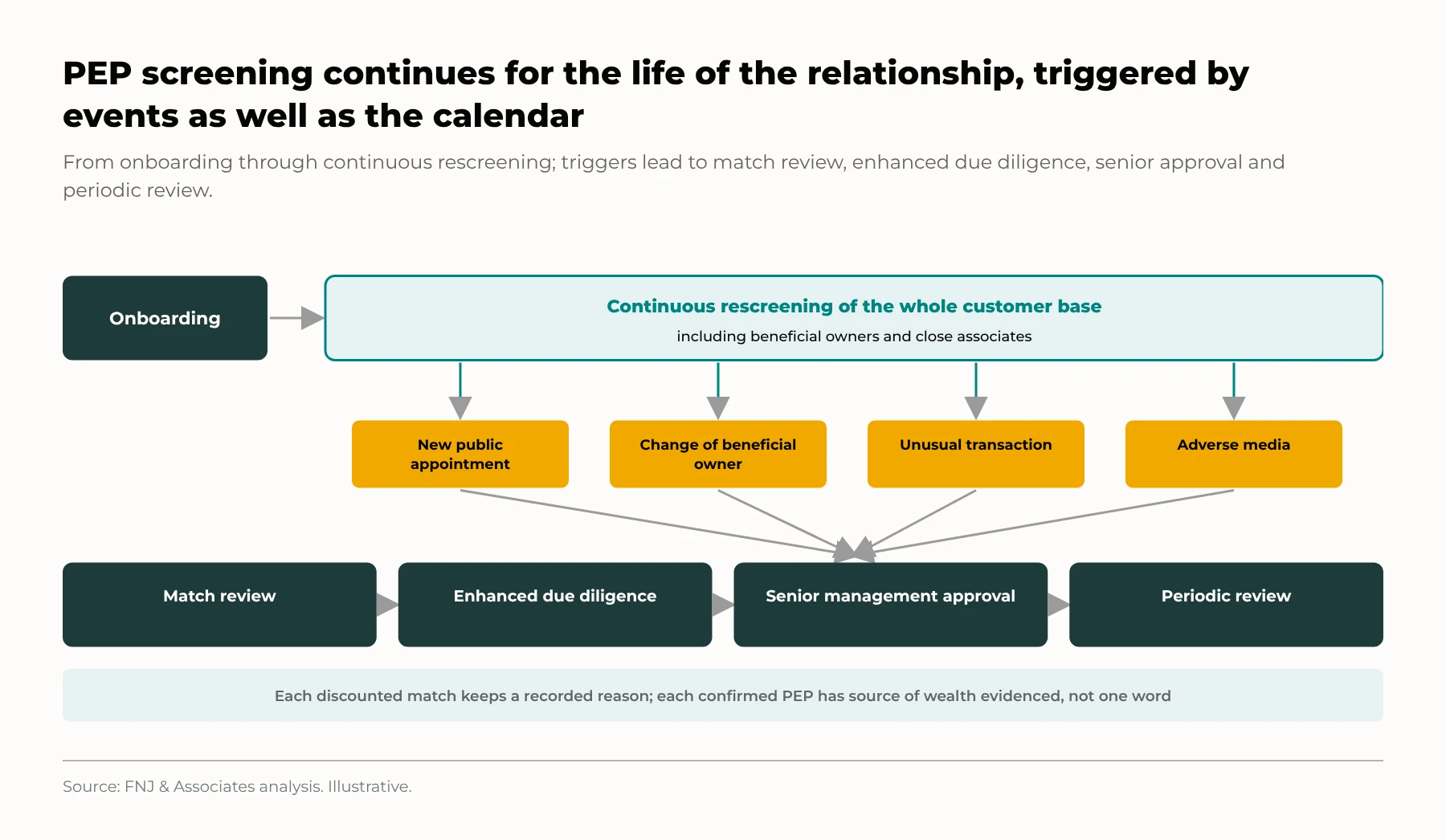
PEP screening that continues after onboarding, through regular rescreening, event triggers, disciplined match handling, enhanced due diligence, senior approval and periodic review, closes that gap. This article sets out each element, as part of our compliance services in Kenya.
The law requires ongoing measures, not a one-time check
Kenya’s anti-money laundering framework, under the Proceeds of Crime and Anti-Money Laundering Act and its regulations, requires reporting institutions to determine whether a customer or beneficial owner is a politically exposed person, to obtain senior management approval for such relationships, to establish the source of wealth and funds and to conduct enhanced ongoing monitoring. The Financial Reporting Centre and sector supervisors expect these measures to operate throughout the relationship, consistent with the international standard set by the Financial Action Task Force.
A one-time check at onboarding cannot meet that expectation, because the institution must be able to show that it would identify a customer who became politically exposed during the relationship and that it applied enhanced measures from that point.
Who counts as a politically exposed person
The definition covers domestic, foreign and international organisation PEPs, together with their family members and close associates. Institutions should set out in policy which positions they treat as prominent public functions in each category, how long a person remains a PEP after leaving office, and how family members and close associates are identified.
| Category (illustrative) | Examples |
|---|---|
| Domestic PEP | Senior government officials, members of parliament and county assemblies, governors and county executives, senior judges, senior military and police officers, heads of state corporations, senior political party officials |
| Foreign PEP | Persons holding equivalent functions in another country |
| International organisation PEP | Senior management of international and regional bodies |
| Family members | Spouses, partners, children and their spouses, parents and siblings, as defined in policy |
| Close associates | Persons with joint ownership of entities or close business relationships with a PEP |
Regular rescreening of the whole customer base
The foundation of PEP screening after onboarding is regular rescreening of every customer and beneficial owner against an up-to-date PEP database. Many institutions rescreen daily or whenever the database provider issues updates, which means that a customer newly appointed to a prominent position is flagged soon after the appointment is published.
Where automated rescreening is not yet possible, the institution should at least rescreen the whole base at a frequency set by its risk assessment, and screen higher-risk segments, such as large corporate customers, high-value individuals and customers in sectors linked to public procurement, more often.
Customer events should trigger a fresh check
Some events should prompt PEP screening immediately, whatever the regular schedule. These include a change in a corporate customer’s directors or beneficial owners, a significant change in transaction patterns, a request for a large loan or an unusual product, adverse media reports linking the customer to public office and elections or appointments that bring new people into prominent positions.
Elections deserve particular attention in Kenya, since they bring a large number of new office holders at national and county level at the same time. Institutions should plan a focused review of their customer base after each general election and after major public appointments.
Matches must be reviewed carefully and consistently
Screening produces potential matches, many of which are false positives arising from common names. Each potential match should be reviewed against identifying information such as date of birth, national identity number and address, the decision to confirm or discount the match should be recorded with its reasons. A second reviewer should check a sample of discounted matches to confirm that true matches are not being dismissed.
Matching rules should be tuned over time, since too strict a rule misses true PEPs whose names are spelled differently, while too loose a rule produces so many alerts that reviewers stop examining them carefully, and both problems weaken PEP screening.
A confirmed PEP needs enhanced due diligence and senior approval
When a customer is confirmed as a PEP, the institution should apply enhanced due diligence. That means establishing the source of the customer’s wealth and the source of the funds in the relationship, assessing whether these are consistent with the customer’s known position and income, and documenting the assessment, often with supporting evidence such as declarations, payslips, business records or public asset declarations where available.
Continuing the relationship requires approval by senior management, as the law expects. The approver should consider the risk assessment, the enhanced due diligence results and the institution’s appetite for PEP relationships, and should record the decision with any conditions, such as transaction limits or more frequent review.
Enhanced ongoing monitoring follows approval
PEP relationships should be subject to closer transaction monitoring, with rules tuned to identify transactions inconsistent with the customer’s profile, and to periodic review, usually at least annually, of the relationship, the source of wealth assessment and the continuing approval. Suspicious activity should be reported to the Financial Reporting Centre in the usual way, regardless of the customer’s status.
The board should see the PEP portfolio
The board or its risk committee should receive periodic information on PEP relationships, including the number of PEPs by category, new PEPs identified through rescreening, relationships approved and exited, overdue reviews and any suspicious transaction reports involving PEPs. This allows directors to confirm that the institution’s exposure remains within its risk appetite.
Five weaknesses recur in PEP screening
- Screening at onboarding only, with no rescreening of existing customers.
- Beneficial owners and close associates of corporate customers not screened.
- Matches discounted without recorded reasons or second review.
- Source of wealth recorded as a single word, with no evidence or assessment.
- Annual reviews of PEP relationships overdue or not performed.
Sector context shapes the exposure
Banks and large SACCOs hold the largest PEP portfolios and face the closest supervisory scrutiny. Insurers encounter PEPs through life policies, investment products and corporate covers, while capital markets firms and fintechs see them in investment accounts and digital wallets.
Designated non-financial businesses, including real estate agents, lawyers, accountants and dealers in high-value goods, may deal with PEPs in property purchases and company formation, which are among the channels most often used to move the proceeds of corruption. The elements of PEP screening described here apply across all of them, whatever the size of the institution.
Beneficial ownership makes PEP screening harder for corporate customers
Many politically exposed persons hold assets through companies, trusts and other arrangements rather than in their own names. Institutions must identify the beneficial owners of corporate and other legal customers and screen each of them, which requires up-to-date ownership information, including from the beneficial ownership register held by the business registry, and periodic confirmation from the customer when ownership changes.
Complex structures with several layers, nominee shareholders or entities registered in other jurisdictions deserve particular care. Where the institution cannot establish who ultimately owns or controls a customer, it should treat that as a significant risk factor in its own right, regardless of whether a PEP has been identified.
Database quality determines what screening can find
PEP screening is only as good as the database behind it. Institutions should understand how their provider identifies domestic PEPs, how often the data is updated, how well it covers county-level office holders, senior officials in state corporations and family members, and how it handles local name variations, and should test the database periodically with known examples to confirm its coverage.
Some institutions supplement commercial data with their own lists, built from published appointments, gazette notices and election results. Where they do, the lists should be maintained by a named owner and updated promptly after elections and major appointments.
Exiting a relationship needs care
Not every PEP relationship should continue once enhanced due diligence is complete. Where the source of wealth cannot be established, the activity is inconsistent with the customer’s profile or the risk exceeds the institution’s appetite, the institution may decide to exit the relationship. That decision should be approved at the appropriate level, documented with its reasons and handled in a way that does not tip off the customer if a suspicious transaction report has been or will be made.
Internal audit should test PEP controls
Internal audit or an independent reviewer should test PEP screening periodically, by confirming that rescreening runs as designed, re-performing a sample of discounted matches, checking a sample of confirmed PEP files for source of wealth evidence and senior approval, and comparing the institution’s PEP list with recent public appointments to see whether new PEPs have been identified.
The results should be reported to the money laundering reporting officer and the audit committee, together with management’s actions, since weaknesses in PEP screening are among the findings supervisors raise most often in anti-money laundering inspections.
Training front-line and relationship staff to recognise signs that a customer may have become politically exposed, such as references to a new public role, unusual government-related payments or requests for discretion, adds a human check alongside automated PEP screening.
Three moves for the next quarter
- Rescreen the whole customer base, including beneficial owners, against an up-to-date PEP database, and review the results.
- Set event triggers for changes in ownership, unusual activity and post-election reviews, and document them in policy.
- Review every confirmed PEP relationship for current source of wealth evidence, senior approval and an up-to-date annual review.
How we support your institution
FNJ & Associates reviews PEP screening frameworks, tests rescreening and match handling, assesses enhanced due diligence files and trains compliance teams on PEP risk. Our anti-money laundering work also covers risk assessments, transaction monitoring reviews and independent audits of AML/CFT programmes.
Trigarc Compliance, implemented by FNJ, records PEP-related obligations, reviews and approvals, tracks overdue reviews and corrective actions, and reports the status of the PEP portfolio to the board.
Licensed virtual asset service providers will add a new customer segment to screen, including their directors and beneficial owners. Our guide to what the VASP regulations in Kenya mean for banks covers onboarding and monitoring for these providers.
Questions about PEP screening
What is PEP screening?
PEP screening is the process of checking whether a customer, beneficial owner or close associate is a politically exposed person, so that the institution can apply the enhanced measures the law requires.
Why is screening at onboarding not enough?
Customers can become politically exposed after they join, through election or appointment, so institutions must rescreen existing customers to identify changes in status.
How often should customers be rescreened?
Many institutions rescreen continuously or whenever the PEP database is updated, and at minimum the frequency should follow the institution’s risk assessment, with higher-risk segments screened more often.
What happens when a customer is confirmed as a PEP?
The institution should apply enhanced due diligence on source of wealth and funds, obtain senior management approval to continue the relationship and apply enhanced ongoing monitoring.
Do family members and close associates count?
Yes, family members and close associates of politically exposed persons are subject to the same enhanced measures, as defined in the institution’s policy.
Should beneficial owners be screened for PEP status?
Yes, institutions should identify and screen the beneficial owners of corporate and other legal customers, since many politically exposed persons hold assets through companies and trusts.
Should a PEP relationship ever be exited?
Yes, where the source of wealth cannot be established, activity is inconsistent with the customer’s profile or the risk exceeds appetite, the institution may exit, with the decision approved, documented and handled without tipping off the customer.
Can FNJ & Associates review our PEP screening?
Yes, FNJ & Associates reviews screening frameworks, match handling and enhanced due diligence files, and the firm can be reached through fnjassociates.co.ke to request a proposal.
Request a proposal for a PEP screening review
FNJ & Associates helps financial institutions and reporting entities across Kenya and East Africa keep PEP status current across the whole customer base.
About FNJ & Associates
FNJ & Associates is an ICPAK-registered CPA firm and a multidisciplinary team of 20+ professionals holding CPA(K), ACCA, CIA, CISA, CFE, CEH, CAMS and CIPP/E credentials, serving more than 100 organisations across Kenya and East Africa. The firm provides governance, risk and compliance advisory, including AML/CFT, anti-bribery and data protection, and implements Trigarc Compliance for obligation tracking, evidence and corrective actions. Visit fnjassociates.co.ke to learn more.