

Three questions, a one-page dashboard and a rotating deep dive give risk committees more insight in fewer pages.
The board risk report is the main way a risk committee sees the institution’s risk profile between meetings. In banks, SACCOs, insurers, fintechs, NGOs and corporates across Kenya and East Africa, the quality of that report largely determines the quality of the committee’s oversight.
Many reports are long and largely static from one meeting to the next. They reproduce the risk register with every risk given equal space, describe the position at a single point in time without showing what has moved since the last meeting, and end without stating what the committee is asked to decide, so directors read a great deal and learn relatively little.
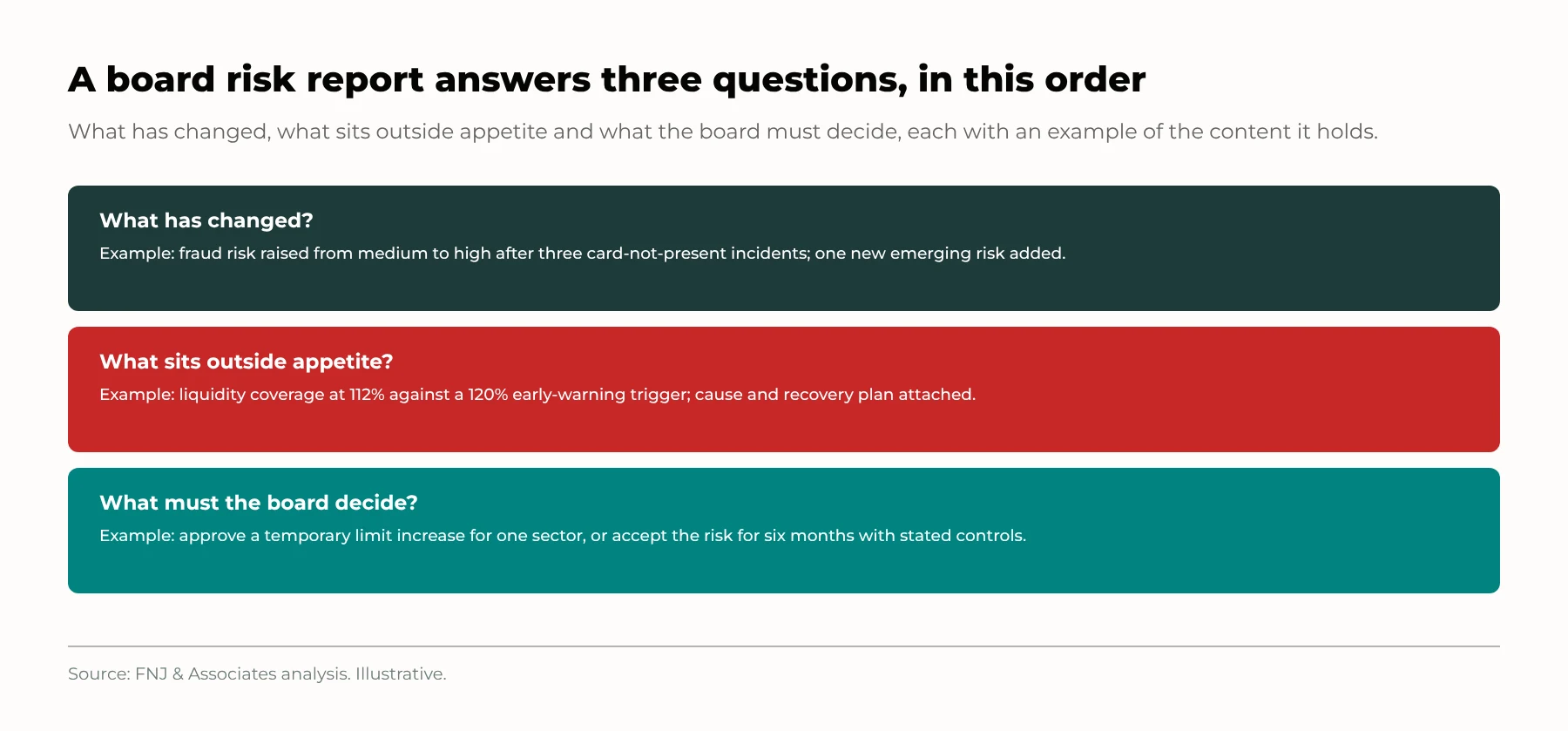
A board risk report built around three questions resolves this: what has changed, what sits outside appetite and what the board must decide. This article sets out a structure, a dashboard and a reporting rhythm that answer those questions, as part of our risk management services in Kenya.
Supervisors expect reporting that is timely and meaningful
The Central Bank of Kenya’s draft Risk Management Guidelines, published for comment in 2026, emphasise regular and meaningful reporting of risk to boards, and similar expectations appear across insurance, SACCO and capital markets supervision. The test is not the volume of information but whether directors can understand the risk profile and act on it.
Donors and lenders ask comparable questions of NGOs and corporates, and a board risk report that answers them clearly is increasingly part of how organisations demonstrate sound governance to those who fund them.
Three questions should organise every board risk report
| Question | What the report shows | Why it matters |
|---|---|---|
| What has changed? | Movements in risk ratings, new and emerging risks, significant incidents since the last meeting | Directors already know the static picture; they need the movement |
| What sits outside appetite? | Metrics in the early warning and outside appetite zones, with causes and responses | These are the risks that require the board’s attention |
| What must the board decide? | Specific decisions, such as accepting a risk, approving a limit change or directing action | A report without a decision invites noting rather than oversight |
A one-page dashboard gives the whole picture at a glance
The first page of the board risk report should show every principal risk on a single page, with the current rating, the trend since the last meeting and the position against appetite, using colour together with word labels so that the page can be read in black and white. Directors can then see in a minute where attention is needed before turning to the detail.
The dashboard should draw its figures from the risk register, the key risk indicators and the incident log, so that it agrees with the underlying records and does not need to be reconciled by hand each quarter.
The narrative should explain movements, not repeat the register
Behind the dashboard, a short narrative of two or three pages explains the significant movements, the risks outside appetite and the actions under way. Each item should state the cause, the effect on the institution, the response and the owner, in plain language that a non-specialist director can follow.
Risks that are stable and within appetite need no narrative at all. Leaving them out is not a loss of information, since they remain visible on the dashboard, and it keeps the committee’s attention on the matters that need it.
Appetite should frame the whole report
The board’s risk appetite statement is the yardstick against which the report should measure every principal risk. Showing each appetite metric with its thresholds, current value and trend allows the committee to see immediately whether the institution is operating within the limits it set, and to focus its discussion on any breach and the decision it requires.
Emerging risks deserve a standing section
Some of the risks that matter most are not yet in the register, or cannot yet be measured, such as changes in regulation, new technologies, climate effects or shifts in donor or customer behaviour. A standing section in the board risk report on emerging risks, with management’s current view and the signals being watched, keeps these risks on the committee’s agenda before they become urgent.
Incidents and losses connect the report to reality
A summary of significant incidents and losses since the last meeting, with their causes and the actions taken, shows directors where risks have materialised. Linking each incident to the risk it relates to also tests the register, since a risk rated as unlikely that has occurred twice in a year probably needs to be reassessed.
Control and assurance status complete the view
Directors need to know not only what the risks are but whether the controls that manage them are working. A short section showing the results of control testing, overdue audit and compliance actions, and any risks accepted outside appetite gives the committee a view of the control environment alongside the risk profile.
A rotating deep dive builds understanding over the year
No committee can examine every principal risk in depth at every meeting. A rotating deep dive, in which one or two principal risks are examined in detail at each meeting, with the risk owner presenting, ensures that each principal risk receives thorough attention at least once a year and gives directors direct contact with the executives who manage the risks.
The deep dive should cover the risk’s drivers, the controls and their effectiveness, the indicators and the scenarios that could cause serious harm, and it should end with the owner’s view of what would improve the institution’s position.
Length discipline improves the quality of discussion
A board risk report of eight to twelve pages, with detail in appendices for directors who want it, is usually enough. Longer reports tend to bury the important points, and the discipline of a page limit forces the risk function to decide what matters, which is itself part of the judgement the board relies on.
Five weaknesses recur in board risk reports
- The full risk register reproduced, with every risk given equal space.
- No comparison with the previous meeting, so movements are invisible.
- Appetite thresholds absent from the report, so breaches are not obvious.
- Figures that differ from the finance and audit reports in the same pack.
- No clear statement of the decisions the committee is asked to take.
Sector context shapes the content
Bank and SACCO reports give most weight to credit, liquidity, capital and operational risk, and they typically include regulatory ratios alongside appetite metrics, while insurance reports focus on underwriting, reserving, reinsurance and solvency.
Fintech reports emphasise fraud, technology and data protection, NGO reports emphasise donor compliance, safeguarding, fraud and partner risk, and corporate reports emphasise strategic, supply chain and market risks. The three questions, the dashboard and the deep dive apply in every case.
The board risk report should agree with the rest of the pack
Directors lose confidence quickly when the board risk report shows one figure for non-performing loans, claims reserves or fraud losses and the finance or audit report in the same pack shows another. The risk function should reconcile the principal figures with finance and internal audit before the pack is issued, and explain any difference that reflects a genuine change in definition or timing.
A short data note at the end of the report, stating the source and cut-off date of each principal metric, helps directors understand what they are reading and gives the committee a basis for asking why a figure has moved.
Forward-looking content turns the report from history into foresight
Most risk reports describe what has already happened in the period under review. A board risk report becomes far more useful when it also sets out what management expects in the coming quarter, such as indicators expected to approach their thresholds, planned changes in products or systems that will alter the risk profile. The results of any stress tests or scenarios run since the last meeting.
Scenario results deserve particular attention, because they show directors how the institution would fare under a severe but plausible event, such as a sharp rise in defaults, a cyber incident that takes core systems offline or the loss of a major donor or customer. Presenting one or two scenarios each year, with the actions management would take, gives the committee a practical sense of resilience.
Escalation between meetings keeps the board informed when it matters
A quarterly rhythm is not enough when a significant event occurs. The risk policy should define the events that require escalation to the risk committee chair within a set period, such as a breach of a board appetite limit, a major loss, a significant regulatory finding or a serious cyber incident. The next board risk report should record each escalation and the response.
Clear escalation criteria also protect management, since they remove doubt about whether an event is serious enough to report and show that the board was informed in good time.
Directors should give feedback on the report itself
Once a year, the risk committee should review the board risk report itself, asking whether it gives directors what they need, whether anything could be removed and whether the format helps or hinders discussion. A short questionnaire to directors, or a discussion led by the committee chair, produces practical improvements and signals that the report exists to serve the board rather than to satisfy a template.
Smaller institutions can adopt the same structure
A SACCO, a growing fintech or a mid-sized NGO may not have a large risk function, but the three questions, the one-page dashboard and the rotating deep dive work equally well at smaller scale. A board risk report of five or six pages, built from a well-maintained risk register and a handful of appetite metrics, gives a small board the same clarity as a long report gives a large one. It can be produced by one risk officer in a few days each quarter.
Three moves for the next quarter
- Restructure the next board risk report around the three questions, with a decisions section at the front.
- Build a one-page dashboard of principal risks showing rating, trend and position against appetite.
- Agree a deep dive schedule so that each principal risk is examined in depth at least once in the coming year.
How we support your institution
FNJ & Associates redesigns board risk reports and dashboards, facilitates deep dives and trains risk functions and directors on risk reporting. Our board paper writing training covers the writing skills that make risk reports clear and decision-focused.
Trigarc Risk, implemented by FNJ, produces risk committee reports from the live risk register, indicators, appetite metrics and incidents, so that the figures directors see agree with the underlying records.
Questions about the board risk report
What should a board risk report contain?
A board risk report should contain a one-page dashboard of principal risks, a short narrative on significant movements and risks outside appetite, sections on emerging risks, incidents and control status. A clear statement of the decisions the board is asked to take.
How long should a board risk report be?
Most boards find that eight to twelve pages, with supporting detail in appendices, give enough information without burying the important points.
How often should the board receive a risk report?
Most risk committees receive a full report each quarter, with immediate escalation of significant events or appetite breaches between meetings.
What is a risk deep dive?
A risk deep dive is a detailed examination of one principal risk at a committee meeting, usually presented by the risk owner, covering drivers, controls, indicators and scenarios.
Should the board risk report include emerging risks?
Yes, a standing section on emerging risks keeps developments such as new regulation, technology or climate effects on the committee’s agenda before they become urgent.
How can a board risk report become more forward-looking?
It can include management’s expectations for the coming quarter, indicators approaching their thresholds, planned changes that will alter the risk profile and the results of stress tests or scenarios.
What is the most common weakness in a board risk report?
The most common weakness is reproducing the full risk register with every risk given equal space, which hides the movements, appetite breaches and decisions that the committee most needs to see.
Can FNJ & Associates redesign our board risk report?
Yes, FNJ & Associates redesigns risk reports and dashboards, facilitates deep dives and trains risk functions, and the firm can be reached through fnjassociates.co.ke to request a proposal.
Request a proposal to redesign your board risk report
FNJ & Associates helps risk functions and boards across Kenya and East Africa build risk reports that show what has changed, what sits outside appetite and what the board must decide.
About FNJ & Associates
FNJ & Associates is an ICPAK-registered CPA firm and a multidisciplinary team of 20+ professionals holding CPA(K), ACCA, CIA, CISA, CFE, CEH, CAMS and CIPP/E credentials, serving more than 100 organisations across Kenya and East Africa. The firm provides governance, risk and compliance advisory, and implements Trigarc Risk for risk identification, assessment and reporting. Visit fnjassociates.co.ke to learn more.