

Skills defined from the strategy, rated honestly and reviewed with board evaluation give the nominations committee a clear basis for recruitment and succession.
A board skills matrix sets out the skills, experience and perspectives the board needs to oversee the organisation and its strategy, and records which directors bring each one. Banks, SACCOs, insurers, NGOs, state corporations and corporates across Kenya and East Africa use the matrix to show regulators, investors and donors that the board is equipped for its role, and to plan how its composition should change.
Many boards were formed through personal networks, shareholder nominations, member elections or appointment by a parent body, and their composition reflects those routes rather than a deliberate view of the skills the organisation needs. Gaps appear as strategy changes or directors retire, and they are often noticed only when a regulator questions the board’s capacity or a crisis exposes a missing perspective.
A board skills matrix built from the strategy, rated honestly, linked to board evaluation and used for succession addresses this. This article sets out how to build and use one, drawing on our governance advisory and corporate governance training.
Regulators and stakeholders expect a deliberate approach to composition
Financial sector regulators assess the fitness and propriety of directors, as the Central Bank of Kenya’s prudential guidelines set out for banks, and expect boards to have the collective competence to oversee the institution’s risks. Governance codes for listed companies and state corporations address board composition and skills, and donors increasingly ask NGO boards how they ensure the right mix of expertise.
In each case, the expectation is that the board can explain why its composition suits the organisation, and a board skills matrix is the clearest way to do so.
Skills should be defined from the strategy
The matrix should begin with the organisation’s strategy and principal risks, not a generic list. The nominations committee or the board should ask what the organisation will need to oversee over the next three to five years, such as a digital transformation, expansion into new markets, a heavier regulatory burden or a change in funding model, and define the skills and experience that oversight requires.
| Skill area (illustrative) | Why it may matter |
|---|---|
| Industry and sector experience | Understanding the business model, customers and competitors |
| Finance and accounting | Overseeing financial reporting, capital and audit |
| Risk management and internal control | Overseeing risk appetite, controls and assurance |
| Legal and regulatory | Understanding obligations and supervisory relationships |
| Technology, data and cyber security | Overseeing digital strategy, data protection and cyber risk |
| People and culture | Overseeing leadership, remuneration and conduct |
| Strategy and transformation | Challenging and supporting major change |
| Stakeholder and community perspective | Understanding members, beneficiaries, customers or communities served |
Eight to twelve skill areas are usually enough for a board skills matrix. Each should be defined clearly, so that directors rating themselves understand what level of experience counts, for example distinguishing between general familiarity with technology and experience of overseeing a major technology programme.
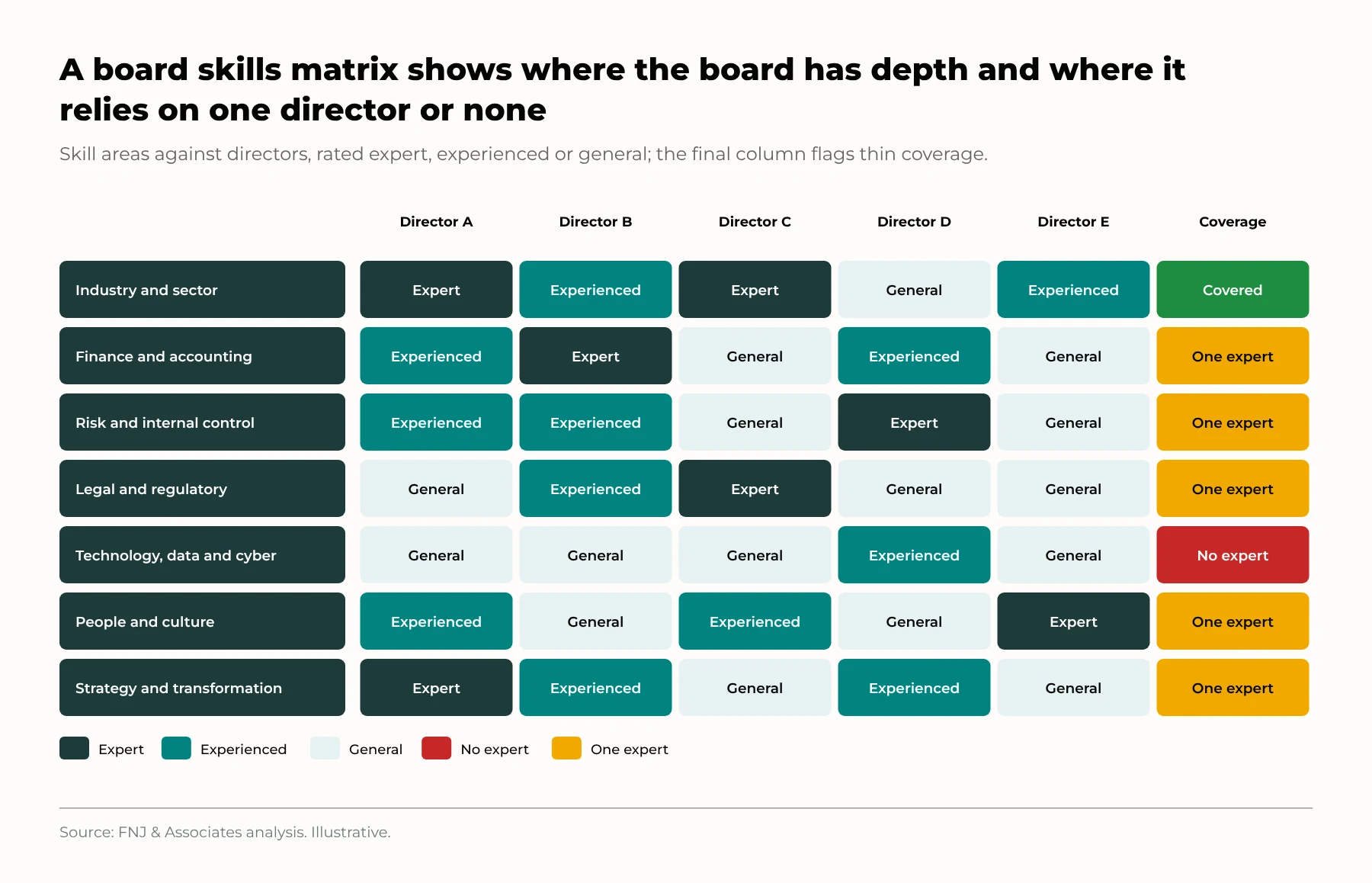
Honest ratings make the board skills matrix useful
Directors usually rate their own skills, and self-ratings tend to be generous. A simple scale, such as expert, experienced and general awareness, with a definition for each level, helps, as does asking directors to give a brief example of the experience behind any rating of expert, and having the chair or the nominations committee review the ratings for consistency.
Some boards supplement self-ratings with the views of fellow directors or an external evaluator. The aim is not to judge individuals but to give the board an accurate view of its collective capacity.
The matrix should reveal concentration and gaps
Once completed, the board skills matrix shows where the board is strong, where it depends on a single director and where it has no expertise at all. A skill held by only one director is a vulnerability, since that director’s retirement or absence leaves the board without it, and a skill that no director holds may need to be filled by recruitment, development or external advice.
The matrix should also show tenure and expected retirement dates, so that the committee can see which skills will be lost in the coming years and plan for them in advance.
Diversity of perspective matters alongside skills
Skills are not the only dimension of an effective board. Diversity of gender, age, background, geography and professional experience helps the board avoid groupthink and understand the full range of stakeholders it serves, and many governance codes and investors now expect boards to report on it. Recording these attributes alongside the matrix, where directors are willing, gives the nominations committee a fuller picture.
Board evaluation and the matrix work together
The matrix shows what skills directors have, while board evaluation shows how effectively the board uses them. Reviewing the two together each year allows the board to see whether gaps in the matrix explain weaknesses in its performance, for example limited challenge on technology matters where the matrix shows no technology expertise.
Gaps can be closed in three ways
Recruitment is the most direct way to fill a gap, and the matrix gives the nominations committee a clear specification for each vacancy. Where recruitment is not possible in the short term, the board can close gaps through director development, such as focused training on cyber risk or financial oversight, or by drawing on independent advisers and co-opted committee members with the required expertise.
Where directors are elected by members or nominated by shareholders, as in SACCOs, cooperatives and some state corporations, the board can still use the matrix to inform candidates and nominating bodies of the skills it needs, and to plan development for those who are elected.
The matrix should be reviewed every year
Strategy, risks and board membership change, so the board skills matrix should be updated at least annually, usually alongside board evaluation, and whenever a director joins or leaves. The nominations committee should report the results to the board, with a summary of gaps and the plan for addressing them.
Five weaknesses recur in board skills matrices
- Generic skill lists unrelated to the organisation’s strategy or risks.
- Self-ratings accepted without definitions or review, so every director is an expert.
- No view of tenure, so gaps from future retirements are not foreseen.
- The matrix completed once and never used for recruitment or development.
- No link to board evaluation, so the board cannot see how gaps affect its performance.
Sector context shapes the skills required
Bank and insurance boards need strong financial, risk, regulatory and technology expertise to satisfy fit and proper expectations, while SACCO boards often need to combine member representation with financial and risk skills. State corporation boards must balance policy, sector and commercial expertise.
NGO boards need programme, safeguarding, financial and fundraising expertise, together with the perspective of the communities served, as our article on NGO board governance explains. Corporate boards need industry, strategy and market experience suited to their stage of growth.
Independence and time commitment belong alongside skills
A board with the right skills still needs directors who can exercise independent judgement and who have the time to do the work. The board skills matrix should record which directors are independent under the applicable code or regulation. The nominations committee should consider each director’s other commitments, since directors holding many board seats may not be able to prepare properly or respond in a crisis.
Committee composition should also be considered, because the audit committee needs financial expertise and independence, the risk committee needs risk and sector expertise, and any technology or ethics committee needs members with relevant experience. As a result, the matrix should show whether each committee is properly equipped as well as the board as a whole.
Disclosure builds confidence with stakeholders
Many listed companies and an increasing number of other organisations disclose a summary of their board skills matrix in their annual report, showing the skill areas the board considers important and how many directors hold each. Such disclosure tells investors, members, donors and regulators that the board has considered its composition deliberately, and it encourages honest rating, since the board knows the summary will be read.
Disclosure need not identify the ratings of individual directors, since an aggregated view, combined with a brief explanation of the board’s priorities for future appointments, provides transparency without turning the matrix into a public assessment of each person.
Induction should draw on the matrix
When a new director joins, the board skills matrix shows which areas of the organisation’s business they will need to learn and which of their skills the board is relying on. A tailored induction, covering the strategy, principal risks, financial position, regulatory relationships and the committees they will join, helps new directors contribute quickly and makes the most of the skills for which they were appointed.
Smaller boards can keep the matrix simple
A SACCO board, a small NGO board or a family business board does not need an elaborate tool. A one-page board skills matrix with eight skill areas, a three-level rating and a column for expected retirement, reviewed once a year by the chair, gives most of the benefit and can be extended as the organisation grows.
The chair and the nominations committee should own the matrix
Responsibility for the board skills matrix usually rests with the nominations committee, or with the chair where there is no such committee, supported by the company secretary. The committee should agree the skill areas with the board, oversee the annual update, interpret the results and recommend actions, while the company secretary maintains the records and ensures that the matrix is used in every recruitment and induction.
When the board considers a vacancy, the committee should begin with the matrix, identify the skills most needed, prepare a role specification and consider candidates against it, rather than starting from names suggested by existing directors, which is how many boards end up with similar backgrounds and gaps that persist for years.
Used consistently in this way, the board skills matrix becomes the starting point for every conversation about board composition, rather than a document completed once for a regulator and then filed.
Three moves for the next quarter
- Define eight to twelve skill areas from the organisation’s strategy and principal risks, with a definition for each level.
- Ask every director to complete the board skills matrix, and have the chair review the ratings for consistency.
- Present the gaps and the expected retirements to the board, with a plan for recruitment, development or external advice.
How we support your institution
FNJ & Associates designs board skills matrices, facilitates board evaluations, advises nominations committees on composition and succession and delivers director development programmes, including corporate governance and board paper writing training.
Trigarc Governance, implemented by FNJ, holds director records, including appointments, tenure, declared interests and training, so that the board can see its composition and plan succession from one place.
Questions about the board skills matrix
What is a board skills matrix?
A board skills matrix sets out the skills, experience and perspectives the board needs to oversee the organisation and its strategy, and records which directors bring each one.
How many skills should the matrix include?
Most boards find that eight to twelve clearly defined skill areas, drawn from the strategy and principal risks, are enough to give a useful picture.
How should directors be rated?
A simple scale such as expert, experienced and general awareness, with definitions for each level and review by the chair, helps produce consistent and honest ratings.
How often should the matrix be updated?
The matrix should be updated at least annually, usually alongside board evaluation, and whenever a director joins or leaves.
Can elected boards use a skills matrix?
Yes, elected boards can use the matrix to inform candidates and nominating bodies of the skills needed and to plan development for directors who are elected.
Should the board skills matrix be disclosed?
Many organisations disclose an aggregated summary showing the skill areas the board considers important and how many directors hold each, without revealing individual ratings.
Who should own the board skills matrix?
The nominations committee, or the chair where there is no committee, should own the matrix, supported by the company secretary, and should use it in every recruitment, induction and succession discussion.
Can FNJ & Associates help us build a board skills matrix?
Yes, FNJ & Associates designs skills matrices, facilitates board evaluations and advises on succession, and the firm can be reached through fnjassociates.co.ke to request a proposal.
Request a proposal for a board skills review
FNJ & Associates helps boards across Kenya and East Africa match their composition to their strategy and plan succession with confidence.
About FNJ & Associates
FNJ & Associates is an ICPAK-registered CPA firm and a multidisciplinary team of 20+ professionals holding CPA(K), ACCA, CIA, CISA, CFE, CEH, CAMS and CIPP/E credentials, serving more than 100 organisations across Kenya and East Africa. The firm provides governance, risk and compliance advisory and corporate governance training, and implements Trigarc Governance for board reporting. Visit fnjassociates.co.ke to learn more.