

Boards cannot govern what they cannot see, and the board pack is how they see the institution between meetings.
The board pack is the main channel through which directors understand the institution they oversee. For listed companies, banks, insurers, SACCOs, state corporations and NGOs alike, the quality of the pack shapes the quality of the discussion, and therefore the quality of the decisions the board takes.
Many packs fall short in three ways: they arrive late, leaving directors too little time to prepare; they are fragmented, assembled from papers written by different teams in different formats; and they are untraceable, with figures that cannot easily be reconciled to the management accounts, the risk register or the previous quarter’s report.
A redesigned board pack addresses all three: it is built around the decisions the board must take, it follows a consistent template and order, and its figures come from a single source that directors and auditors can trace. This article sets out how, drawing on our governance advisory work and our board paper writing training.
Directors are accountable for what the board pack tells them
Directors carry legal duties of care, skill and diligence, and governance codes in Kenya expect boards to receive information that is accurate, timely and sufficient for their decisions. The Capital Markets Authority’s guidance on its corporate governance code is one example of the expectation that boards are properly informed.
When something goes wrong, regulators, auditors and courts look at what the board was told and when. A board pack that shows clearly what was put before directors, and what they decided, protects both the institution and the individuals who serve on its board.
A board pack should be organised around decisions
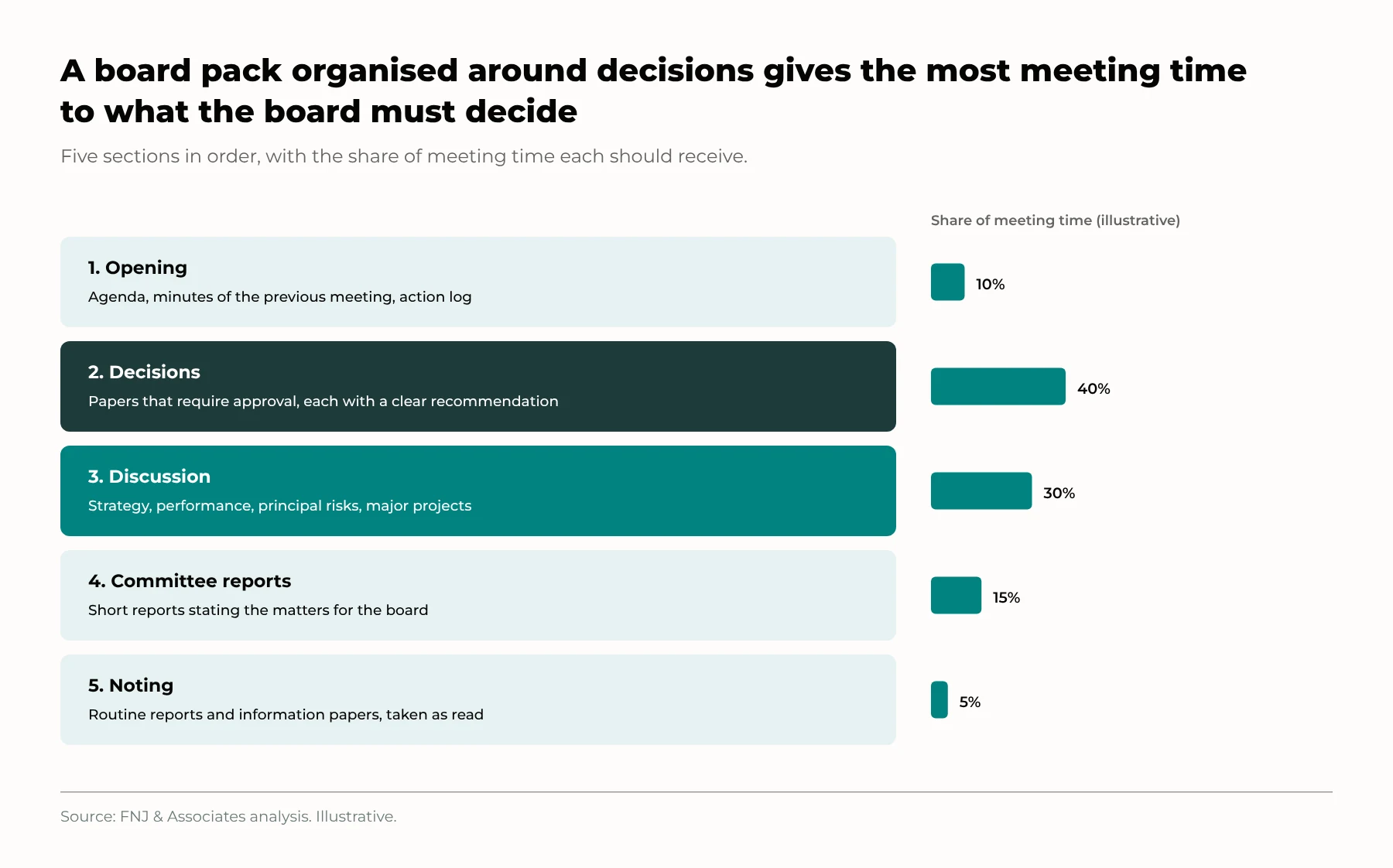
The most effective packs open with the matters that require a decision, followed by matters for discussion and then matters for noting. This order puts the board’s time where it adds most value and ensures that decisions are not rushed at the end of a long meeting.
| Section | Content | Purpose |
|---|---|---|
| 1. Opening | Agenda, minutes of the previous meeting, action log | Confirm the record and track follow-up |
| 2. Decisions | Papers that require approval, each with a clear recommendation | Focus the board on what it must decide |
| 3. Discussion | Strategy, performance, principal risks, major projects | Inform direction and challenge |
| 4. Committee reports | Short reports from each committee, stating matters for the board | Allow reliance on committee work |
| 5. Noting | Routine reports, compliance updates, information papers | Complete the record without consuming meeting time |
Every board paper should follow one template
A common template makes papers faster to read and easier to compare, and it disciplines authors to state what they are asking for. The template does not need to be elaborate, but it should be used for every paper that comes before the board.
- Purpose: one sentence stating whether the paper seeks a decision, discussion or noting.
- Recommendation: the decision the board is asked to take, written so it can be minuted as it stands.
- Summary: the key points in a few short paragraphs, readable on their own.
- Analysis: the options considered, the financial effect, the risks and the link to strategy and risk appetite.
- Consultation: who has reviewed the paper, including legal, finance, risk and compliance where relevant.
- Appendices: supporting detail for directors who want it, kept out of the main paper.
Placing the recommendation at the top is the single most effective change most institutions can make. Directors then read the rest of the paper knowing what they are being asked to decide, and they can focus their questions accordingly.
Length discipline improves the quality of discussion
A board pack of several hundred pages is unlikely to be read in full, and the important points can be lost among routine material. Setting a page limit for the main body of each paper, for example four to six pages, with detail moved to appendices, forces authors to identify what matters and helps directors prepare in the time they have.
Dashboards help in the same way, because a one-page view of financial performance, principal risks against appetite, compliance status and audit findings gives directors a quick picture of the institution before they turn to the detailed papers.
Timely circulation gives directors time to prepare
Good practice is to circulate the board pack around a week before the meeting, so that directors can read the papers, ask questions in advance and come prepared to discuss them. Late papers should be the exception, approved by the chair, and the company secretary should track circulation dates so that patterns of lateness are visible.
A planning calendar, set at the start of the year, helps authors meet these deadlines. It shows which papers are due at each meeting, who is responsible and when drafts must reach the company secretary, so that the pack can be assembled without a last-minute rush.
Traceable figures build confidence in the board pack
Directors need confidence that the figures in different papers agree with each other and with the institution’s records. When the finance report, the risk report and the strategy update each draw on different versions of the data, directors spend meeting time reconciling numbers instead of discussing what they mean.
Drawing figures from a single source, and stating the source and date beneath each table, solves most of this. Where the risk register, the compliance register and the audit tracker are held in one system, the board pack can draw on them directly and the figures will agree.
Committee reports should help the board rely on committee work
Committees exist so that the board can delegate detailed work, and their reports should make that delegation effective. A committee report of one or two pages, stating what the committee reviewed, what it concluded, what it decided under its delegated authority and what it needs the board to do, is far more useful than minutes reproduced in full.
The minutes and the action log complete the cycle
Minutes should record the decisions taken, the main points of discussion and any dissent, and the action log should track every action arising, with an owner and a due date. Reviewing the action log at the start of each meeting shows the board whether its decisions are being carried out and closes the loop between one board pack and the next.
Security and record-keeping matter as much as content
Board packs contain the institution’s most sensitive information, from strategy and results to legal matters and personnel decisions. Distributing them by email attachment creates copies that cannot be controlled, so many boards now use a secure portal with access controls, version control and the ability to withdraw documents.
The archive matters too, because when a regulator or auditor asks what the board was told on a particular date, the institution should be able to produce the exact board pack as circulated, with assurance that it has not been altered since, and a secure, time-stamped archive provides that assurance.
Sector context shapes the content of the board pack
Bank and insurance boards receive extensive regulatory and risk reporting, so their packs benefit most from dashboards and from clear separation of decisions and noting items. SACCO boards, with elected members who may be new to governance, benefit from shorter papers and plain language.
State corporation boards must reflect their performance contracts and the expectations of their parent ministries, while NGO boards need clear reporting on donor compliance, safeguarding and programme results. The principles of a decision-first, traceable and timely board pack apply in every case.
Board pack quality is visible in how the meeting runs
A chair can usually judge the quality of the board pack by watching the meeting. When directors spend time asking what a paper is for, reconciling figures between reports or requesting information that should have been provided, the board pack is not doing its job, and the meeting runs long while decisions are deferred.
When the pack works, the discussion moves quickly to the substance: directors ask about options, risks and assumptions, management responds with insight rather than explanation, and decisions are taken with confidence. Tracking how many decisions are deferred for more information is a simple measure of whether the board pack is meeting its purpose.
The chair and the company secretary share ownership of the board pack
The company secretary coordinates the board pack, sets the standards and enforces the timetable, while the chair approves the agenda and holds authors to the standards when papers fall short. The chief executive sets the tone for management, since papers improve quickly when authors know the chief executive reads and challenges them before they reach the board.
Authors benefit from guidance and examples, and a short style guide, a model paper and feedback after each meeting help management teams write papers that directors find useful, and training for frequent authors pays for itself in shorter meetings and better decisions.
Five weaknesses recur in board packs
- Papers that describe activity at length but do not state what the board is asked to decide.
- Figures that differ between the finance, risk and strategy papers.
- Committee minutes reproduced in full instead of a short report to the board.
- Routine noting items placed before decisions, consuming the best part of the meeting.
- Late papers tabled on the day, leaving directors no time to prepare.
Most of these weaknesses can be corrected within two or three board cycles. The improvements are visible to directors almost immediately, which makes the board pack one of the most rewarding areas of governance to strengthen.
Over time, a well-run board pack also becomes a record of how the board has governed the institution. Read in sequence, the packs and minutes show the issues the board identified, the decisions it took and how it followed them through, which is the evidence regulators, auditors and incoming directors look for when they assess the quality of governance.
Three moves for the next quarter
- Adopt a one-page paper template with the purpose and recommendation at the top, and apply it to every paper at the next meeting.
- Reorder the agenda so that decisions come first, discussion second and noting items last, with noting items taken as read.
- Track circulation dates and page counts for each paper, and report them to the chair after each meeting.
How we support your institution
FNJ & Associates reviews board packs and committee reporting, designs paper templates and dashboards, and trains authors through our board paper writing course. We also carry out board evaluations, which often identify the board pack as the area where improvement is quickest to achieve.
Where an institution wants its board and committee packs assembled from one source and archived securely, Trigarc Governance, implemented by FNJ, generates packs from the institution’s risk, compliance and audit records and keeps a time-stamped archive of what was circulated.
Questions about the board pack
What should a board pack contain?
A board pack should contain the agenda, the previous minutes and action log, papers requiring decisions, papers for discussion, committee reports and items for noting, with each paper following a consistent template that states its purpose and recommendation at the top.
How far in advance should a board pack be circulated?
Good practice is to circulate the board pack around a week before the meeting, so that directors have time to read, ask questions in advance and prepare for discussion.
How long should a board paper be?
Many boards set a limit of four to six pages for the main body of a paper, with supporting detail moved to appendices, so that directors can focus on the points that matter.
Who is responsible for the board pack?
The company secretary usually coordinates the board pack and sets standards for papers, while each author is responsible for the content of their paper and the chair approves the agenda.
Should board packs be distributed by email?
Email distribution creates uncontrolled copies of sensitive information, so many boards use a secure portal that controls access, manages versions and keeps an archive of what was circulated.
What is the difference between a board pack and board minutes?
The board pack is the set of papers circulated before the meeting to inform the board’s discussion and decisions, while the minutes are the formal record of what was discussed and decided at the meeting.
Can FNJ & Associates review our board pack?
Yes, FNJ & Associates reviews board packs and committee reporting, designs templates and dashboards and trains paper authors, and the firm can be reached through fnjassociates.co.ke to request a proposal.
Request a proposal for a board pack review
FNJ & Associates helps boards and company secretaries across Kenya and East Africa build board packs that show the decision required, arrive on time and draw on figures directors can trust.
About FNJ & Associates
FNJ & Associates is an ICPAK-registered CPA firm and a multidisciplinary team of 20+ professionals holding CPA(K), ACCA, CIA, CISA, CFE, CEH, CAMS and CIPP/E credentials, serving more than 100 organisations across Kenya and East Africa. The firm provides governance, risk and compliance advisory and corporate governance training, and implements Trigarc Governance for board reporting. Visit fnjassociates.co.ke to learn more.