

A policy that sets clear limits, raises the bar for public officials and tenders, and records every gift lets staff be courteous without exposing the organisation.
Gifts and hospitality are part of ordinary business relationships in Kenya and East Africa, whether a branded calendar at the end of the year, a lunch with a supplier, an invitation to a conference or a gift from a grateful customer. Most are given in good faith and carry no risk, which is why organisations should not try to ban them outright.
The same practices can, however, become the channel through which improper influence is sought, particularly when the giver is bidding for a contract, when the recipient is a public official or when the value is large enough to create a sense of obligation. Without clear rules, staff are left to judge each case alone, and the organisation cannot show what was given or received.
A gifts and hospitality policy resolves this through thresholds, approvals that rise with value and risk, a register that records every gift above a minimal level and periodic review of the register for patterns. This article sets out each element, drawing on our compliance services in Kenya and our anti-fraud and forensic work.
Kenyan law expects organisations to have procedures to prevent bribery
The Bribery Act 2016 makes it an offence to give or receive a bribe and expects private entities to put in place procedures, proportionate to their size and the nature of their business, to prevent bribery and corruption. Public officers are subject to their own ethics legislation, which restricts the gifts they may accept, and an organisation that offers gifts or hospitality to public officials must take particular care.
International standards point the same way, since ISO 37001, the standard for anti-bribery management systems, treats gifts and hospitality as a specific area requiring controls. Many donors and multinational counterparties expect their partners in Kenya to show that such controls exist.
Three questions separate acceptable gifts and hospitality from risky ones
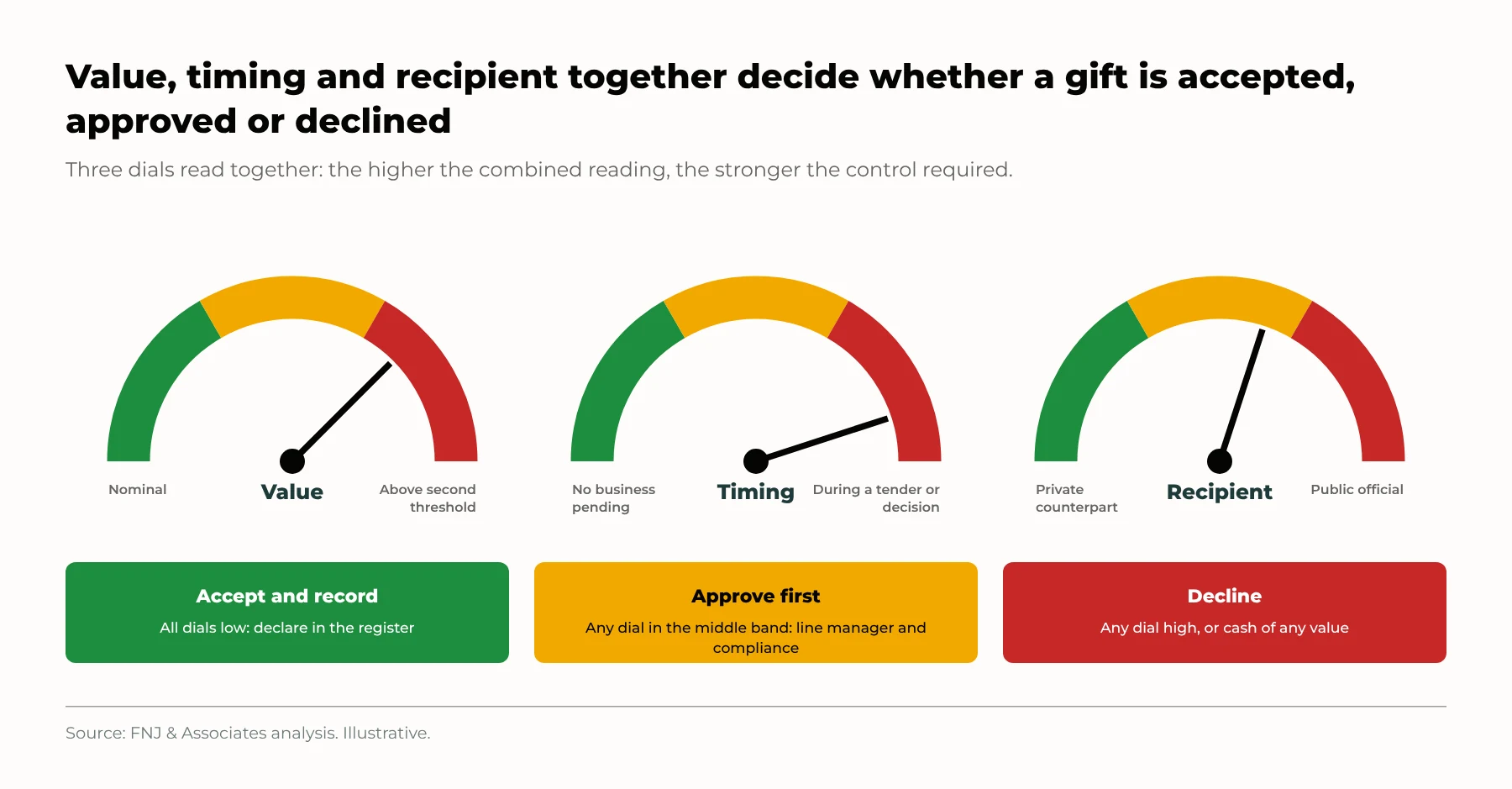
- Value: is the gift or hospitality modest, or large enough to create a sense of obligation?
- Timing: is it offered during a tender, a contract negotiation, a renewal or a regulatory decision?
- Recipient: is the recipient a public official, or in a position to influence a decision that benefits the giver?
A modest gift offered at a neutral time to someone with no influence over a pending decision carries little risk. The same gift offered to the evaluator of an open tender, or to an official responsible for a licence, carries a great deal, which is why an effective policy considers all three questions rather than value alone.
Thresholds turn judgement into a consistent rule
Thresholds give staff a clear answer for most situations and reserve judgement for the cases that need it. The table shows a structure that many organisations adopt, with figures that each organisation must set by reference to its own context, sector and risk appetite.
| Value of gift or hospitality | Action required (illustrative) |
|---|---|
| Nominal, such as promotional items | May be accepted or given; no declaration required |
| Modest, below the first threshold | May be accepted or given; declare in the register |
| Above the first threshold | Requires prior approval from the line manager and compliance; declare in the register |
| Above the second threshold | Generally declined; exceptions only with senior approval and a recorded reason |
| Cash or cash equivalents of any value | Never accepted or given |
Lower thresholds, or an outright prohibition, should apply where the recipient is a public official or where a tender or contract decision is pending. Many organisations simply prohibit all gifts and hospitality to and from parties in an open tender, which removes doubt for everyone involved.
Hospitality needs rules of its own
Meals, events, travel and accommodation raise different questions from physical gifts, because their value is often harder to judge and they may include family members or extend over several days. The policy should state that hospitality must have a legitimate business purpose, be proportionate, be offered openly and not include travel or accommodation for family members.
Where a counterparty offers to pay for travel or accommodation, for example to visit a supplier’s facility or attend a conference, the organisation should usually pay its own costs. This removes any sense of obligation and is the practice most likely to stand up to scrutiny if the relationship is later questioned.
A gifts and hospitality register makes every gift visible
The register is the control that turns the policy into evidence. It should record every gift and item of hospitality given or received above the nominal level, with the date, the giver and recipient, a description, the estimated value, the business purpose, whether approval was obtained and whether the gift was accepted, declined or returned.
Declined gifts belong in the register too, because a record of declined offers demonstrates that the policy is working. A pattern of offers from the same counterparty can be an early sign that someone is attempting to build improper influence.
Periodic review of the register reveals patterns
A single declaration rarely reveals a problem, but a review of the register over a year can. The compliance function should look for repeated gifts from the same supplier to the same person, gifts clustered around tenders or renewals, high-value hospitality that was approved as an exception, and departments that declare nothing at all, which may indicate under-reporting rather than an absence of gifts.
The results of the review should be reported to the audit committee or ethics committee, together with any breaches of the gifts and hospitality policy and the action taken. Linking the register to the conflict of interest register and to procurement records strengthens the analysis considerably.
Gifts to and from public officials need the strictest rules
Offering anything of value to a public official carries the highest risk under anti-bribery laws, because the official’s decisions are governed by public duties and their own ethics rules may prohibit acceptance. Many organisations prohibit gifts to public officials entirely, allow only modest hospitality connected with a legitimate business meeting, and require compliance approval in every case.
The same care applies to facilitation payments, the small payments sometimes requested to speed up a routine government process. These are bribes under Kenyan law, and the gifts and hospitality policy should state clearly that they are prohibited and explain how staff should respond if one is requested.
Third parties acting for the organisation are covered too
Agents, distributors, consultants and implementing partners may offer gifts or hospitality on the organisation’s behalf, and the organisation can be held responsible for their conduct. Contracts with these parties should require compliance with the organisation’s policy or an equivalent, and the organisation should ask them to report gifts given in connection with its business.
Training and communication make the policy usable
Staff need to know the thresholds, the approval process and how to use the register, and they need practical guidance for difficult situations, such as how to decline a gift politely without damaging a relationship. Short training at induction, an annual reminder before the festive season and a simple guide with examples help staff apply the gifts and hospitality policy confidently.
Communication with suppliers and partners helps as well, and many organisations write to their suppliers each year to explain the policy and ask them not to offer gifts to staff, which reduces awkward situations and signals the organisation’s standards to the market.
Sector context shapes the risks
Banks and insurers face gifts and hospitality risks in relationships with corporate clients, brokers and intermediaries, while organisations that bid for public contracts face the highest risk in their dealings with procurement officials. NGOs must consider donor rules, which often prohibit the use of grant funds for gifts and hospitality, as well as relationships with local officials whose cooperation programmes depend on.
Manufacturers and distributors face risks in relationships with buyers and regulators, and public bodies must apply the ethics rules that govern their own officers. The three questions, the thresholds and the register apply in every case.
Charitable donations and sponsorships carry similar risks
Donations to charities and sponsorship of events can be used to channel value to a person in a position of influence, for example when a donation is made to a foundation linked to an official who is considering the organisation’s application. The gifts and hospitality policy, or a related policy, should require that donations and sponsorships are approved centrally, made only to registered organisations, documented with their purpose and recorded in a register that the compliance function reviews.
The same three questions apply: the value of the donation, its timing relative to any pending decision and the connection between the recipient and anyone who could influence that decision. Where any of the three raises concern, the donation should be deferred until the decision has been made, or declined.
Five weaknesses recur in gifts and hospitality controls
- A policy that sets a value threshold but ignores timing and the identity of the recipient.
- A register that records only accepted gifts, so declined offers and patterns are invisible.
- No lower threshold or prohibition for public officials and open tenders.
- Registers kept by individual departments and never reviewed centrally.
- No link between the gifts register, the conflict of interest register and procurement records.
Each weakness can be corrected quickly, and an organisation that addresses all five will have a gifts and hospitality framework that stands up well to scrutiny by regulators, donors and auditors.
The festive season deserves a timely reminder
The weeks before the end of the year bring the greatest volume of gifts and hospitality, as suppliers, customers and partners send hampers, invitations and tokens of appreciation. A short reminder from the compliance function in late November, restating the thresholds, the register and the rules for public officials and open tenders, prevents many inadvertent breaches and gives staff a ready reference when offers arrive.
Some organisations go further and ask staff to bring gifts received during the season to a central point, where they are recorded and either distributed among staff or donated to charity. The practice removes any sense of personal obligation and gives the organisation a complete record for the period.
Three moves for the next quarter
- Review the current policy against the three questions, and add lower thresholds or prohibitions for public officials and open tenders.
- Set up or clean up the register, including declined gifts, and remind staff before the festive season.
- Review the past year’s register for patterns, and report the results to the audit or ethics committee.
How we support your institution
FNJ & Associates designs anti-bribery programmes and gifts and hospitality policies, reviews registers for patterns, trains staff and boards, and investigates suspected bribery through our team of Certified Fraud Examiners.
Trigarc Ethics, implemented by FNJ, provides a gifts and hospitality register with thresholds and approval routing, alongside conflict of interest declarations and code of conduct attestations, with reporting to the board and audit committee.
Questions about gifts and hospitality
What is a gifts and hospitality policy?
A gifts and hospitality policy sets the rules for giving and receiving gifts, meals, entertainment and travel in a business context, including thresholds, approvals, prohibitions and the requirement to record gifts in a register.
Does Kenyan law regulate gifts and hospitality?
The Bribery Act 2016 prohibits giving or receiving bribes and expects private entities to have procedures to prevent bribery, while public officers are subject to their own ethics rules on accepting gifts.
Should declined gifts be recorded?
Yes, recording declined gifts shows that the policy is working and can reveal patterns of offers from the same counterparty that may indicate an attempt to build improper influence.
Can staff accept gifts during a tender?
Most organisations prohibit all gifts and hospitality to and from parties in an open tender, because the risk of improper influence is highest while a decision is pending.
Are facilitation payments allowed in Kenya?
No, facilitation payments are treated as bribes under Kenyan law, and a gifts and hospitality policy should prohibit them and explain how staff should respond if one is requested.
How should staff decline a gift without causing offence?
Staff can thank the giver, explain that the organisation’s gifts and hospitality policy does not allow them to accept, and where appropriate suggest that the gesture is appreciated, which most business partners understand and respect.
Can FNJ & Associates review our gifts and hospitality policy?
Yes, FNJ & Associates designs and reviews anti-bribery and gifts policies, analyses registers and trains staff, and the firm can be reached through fnjassociates.co.ke to request a proposal.
Request a proposal for an anti-bribery and gifts review
FNJ & Associates helps organisations across Kenya and East Africa set clear rules for gifts and hospitality, keep a register that shows every gift and spot the patterns that matter.
About FNJ & Associates
FNJ & Associates is an ICPAK-registered CPA firm and a multidisciplinary team of 20+ professionals holding CPA(K), ACCA, CIA, CISA, CFE, CEH, CAMS and CIPP/E credentials, serving more than 100 organisations across Kenya and East Africa. The firm provides forensic audit and investigation services and governance, risk and compliance advisory, and implements Trigarc Ethics for speak-up reporting, investigations and ethics registers. Visit fnjassociates.co.ke to learn more.