

A testing programme owned by the first line finds weaknesses early, focuses internal audit’s effort and gives the board a current view of its key controls.
Control testing by management, the routine checking by the first line that its own key controls operate as designed, has become an expected part of the control framework in banks, insurers, SACCOs and fintechs, and it is spreading to NGOs, manufacturers and public bodies.
Many institutions still rely on internal audit to discover whether controls work. Internal audit visits each area only every year or two, so a control can fail for many months before anyone notices, and management learns about the weakness from an audit report rather than from its own monitoring.
A management control testing programme closes this gap through five elements: a defined set of key controls, written test steps, clear evidence standards, a test calendar and reporting that feeds the risk register. This article sets out each element as part of our risk management services in Kenya.
Management control testing sits in the first line of the three lines model
Management owns the controls, so management should know whether they work. The risk and compliance functions in the second line set standards and challenge the results. Internal audit in the third line gives the board independent assurance on the whole system, including on whether management’s own control testing can be relied upon.
When the first line tests its own controls well, internal audit can focus its effort on the highest risks and on testing the quality of management’s work, rather than repeating basic checks. The result is broader coverage for the same total effort.
Control testing should start with the key controls
Not every control merits regular testing, and key controls are those that address the institution’s principal risks, those on which several risks depend and those whose failure would not be caught by any other control, and they should be identified from the risk and control self-assessment.
In most institutions, key controls make up a fifth or less of all documented controls. Concentrating control testing on this smaller set makes the programme manageable and ensures that effort goes where failure would matter most.
Written test steps make results repeatable
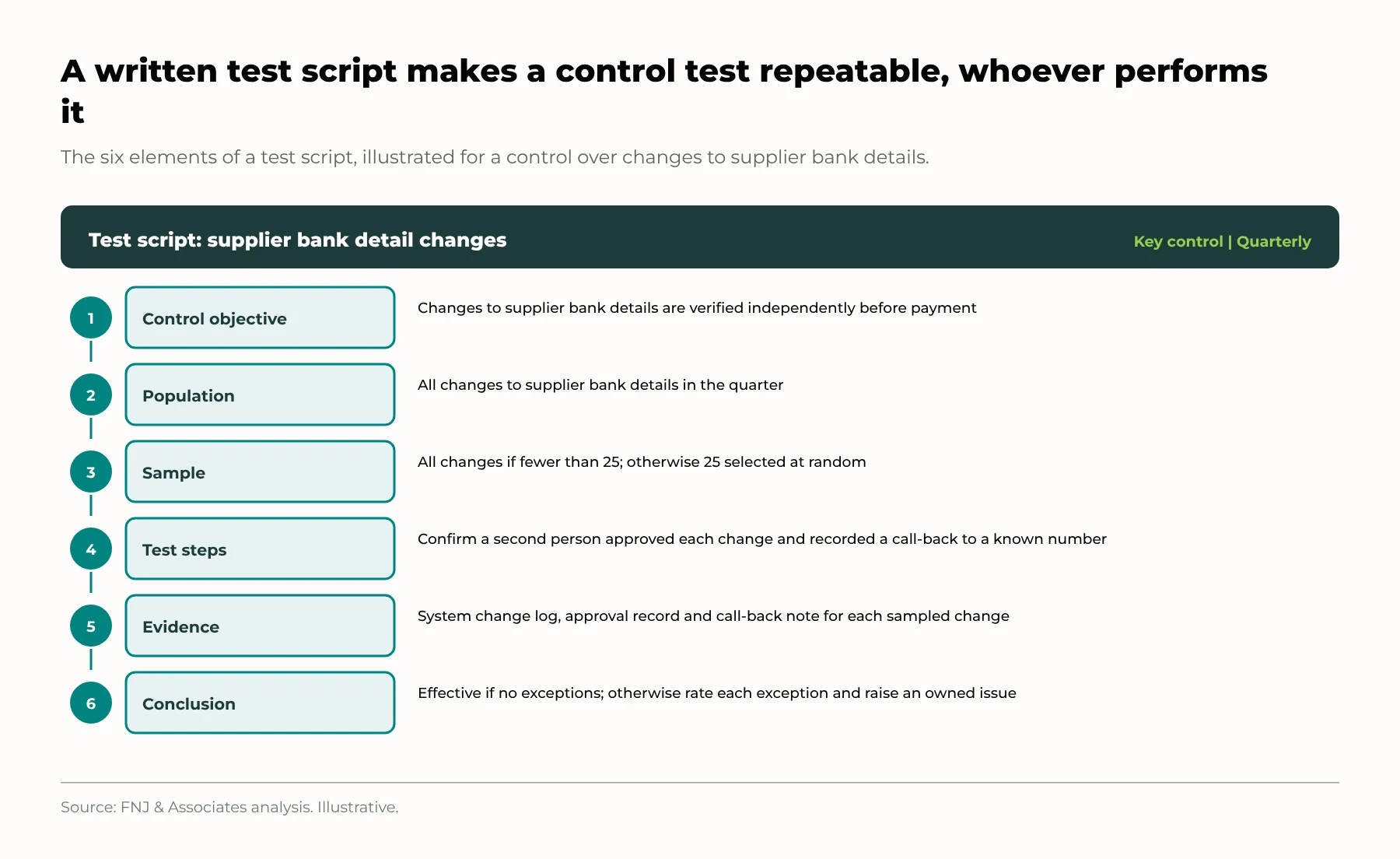
Each key control should have a short test script that states the control objective, the population to be tested, the sample to be selected, the steps to perform and the evidence that demonstrates the control operated. Written scripts allow different testers to reach the same conclusion and make it possible for the risk function and internal audit to review the work.
| Script element | Example for a supplier bank detail change control |
|---|---|
| Control objective | Changes to supplier bank details are verified independently before payment |
| Population | All changes to supplier bank details in the quarter |
| Sample | All changes if fewer than 25; otherwise 25 selected at random |
| Test steps | Confirm a second person approved each change and recorded a call-back to a known number |
| Evidence | System change log, approval record and call-back note for each sampled change |
| Conclusion | Effective if no exceptions; otherwise rate and raise an issue for each exception |
Four test methods give different strength of evidence
Management control testing uses the same methods as audit, and the Basel Committee’s Principles for the Sound Management of Operational Risk list control monitoring and assurance among the tools a well-run institution uses: inquiry, observation, inspection of records and re-performance. Inquiry alone is weak evidence and should always be supported by another method, while inspection and re-performance give the strongest assurance and should be used for the most important controls.
For management testing, the practical rule is to inspect evidence for every sampled item and to re-perform the control where the outcome can be recalculated, such as a reconciliation or an interest calculation.
Evidence standards decide whether results can be relied on
A tick in a spreadsheet records a conclusion but proves nothing. Control testing evidence should show what was tested, what was found and who performed the test, with the supporting documents attached or referenced so that a reviewer can retrace the work.
- The sample selected and how it was chosen.
- The evidence examined for each sampled item, attached or referenced.
- Any exceptions found, with an explanation of each.
- The tester’s conclusion on whether the control operated effectively.
- The reviewer’s sign-off, where the programme requires review.
A test calendar spreads the effort across the year
Testing every key control in the final month before the audit or the year-end creates a peak of work and leaves weaknesses undiscovered for most of the year. A calendar that schedules each key control for testing at a frequency matched to its risk spreads the work evenly and gives the institution a current view throughout the year.
| Control risk | Illustrative testing frequency |
|---|---|
| Highest-risk key controls, or those that failed previously | Quarterly |
| Other key controls | Twice a year |
| Supporting controls | Annually, or through indicators |
Independence within the first line improves the quality of testing
A control owner who tests their own control has an obvious conflict. As a result, many institutions assign control testing to someone in the first line who does not perform the control, such as a governance and controls team or a peer from another department. Where a dedicated team is not practical, rotating testers between areas achieves a similar effect.
Failed tests must become owned issues
The value of control testing lies in what happens when a test fails. Each failure should create an issue with an owner, a remediation action and a due date, and the related control should be re-rated in the risk register so that the residual risk reflects what the test found.
Re-testing after remediation completes the cycle, since an issue should be closed only when a fresh test shows that the control now operates, which applies the same standard that internal audit uses when closing audit findings.
Reporting connects control testing to the board
The risk committee and audit committee need a short view of control testing each quarter: the number of key controls tested against plan, the share found effective, the failures by principal risk and the status of remediation. A simple chart of results by quarter shows whether the control environment is strengthening or weakening.
Internal audit should review the programme periodically, re-performing a sample of management’s tests. Where the results agree, the audit committee gains confidence that management’s reporting can be relied upon between audits.
Sector context shapes the key controls tested
Banks and SACCOs focus control testing on credit approval, disbursement, reconciliations, access to customer accounts and anti-money laundering controls, while insurers test underwriting authority, claims approval, premium allocation and reinsurance recoveries.
Fintechs emphasise identity verification, transaction monitoring and system access, NGOs test grant expenditure approvals, partner payments and procurement, and manufacturers and public bodies test procurement, payroll, inventory and payment controls. The five elements of the programme remain the same throughout.
Automated controls need a different kind of test
Many key controls now sit inside systems, such as an approval limit that blocks a payment, a validation that rejects an incomplete record or a rule that prevents one user from both creating and approving a transaction. Testing an automated control usually means confirming that the configuration is correct and that it has not changed, rather than sampling many transactions, because an automated control applies the same rule every time.
Control testing for automated controls should therefore check the system settings against the approved design, review the change log for any modification in the period and test a small number of transactions to confirm the rule operates. Where the institution’s general information technology controls over change management are strong, a single test of the configuration can support reliance for the whole period.
Control testing results should update the risk register
The most common gap in management control testing is the absence of a link back to the risk register. When a key control fails a test, the residual risk it supports is higher than the register shows. The risk owner should reassess the rating, consider whether the risk now sits outside appetite and report the change to the risk function.
The same link works in the other direction, because a key control that passes control testing consistently over several periods gives the risk owner evidence to support the residual rating, which is far stronger than an assertion made during the annual self-assessment.
Five weaknesses recur in management control testing
- Testing every documented control instead of focusing on the key controls.
- No written test scripts, so results depend on the individual tester.
- Control owners testing their own controls without any independent review.
- Failed tests recorded but not converted into owned issues with due dates.
- Results kept within the business and never reported to the risk or audit committee.
Most of these weaknesses can be corrected within one testing cycle. The improvement is visible to the audit committee quickly, because internal audit can begin to place reliance on management’s work and redirect its own effort to the highest risks.
Smaller institutions can start with a light programme
A SACCO, a growing fintech or a mid-sized NGO does not need a dedicated controls team to benefit. Selecting fifteen to twenty key controls, writing a one-page script for each and asking managers to test each other’s controls twice a year delivers most of the value of control testing at modest cost, and the programme can grow as the institution does.
Over time, a mature control testing programme changes the conversation with regulators and external auditors as well. An institution that can show a year of planned tests, documented evidence, remediated failures and re-tests demonstrates a control environment that is actively managed, and that record often shortens inspections and reduces the testing that external auditors need to repeat.
Three moves for the next quarter
- Identify the key controls from the risk register, aiming for a list that a small team can test within the year.
- Write test scripts for the ten highest-risk key controls and test them this quarter.
- Report the results to the risk committee, with each failure linked to an owned issue and a re-test date.
How we support your institution
FNJ & Associates designs management control testing programmes, identifies key controls, writes test scripts, trains first-line testers and reviews the quality of testing on behalf of risk functions and audit committees.
Trigarc Risk, implemented by FNJ, holds the control library, schedules tests, stores evidence against each sample and raises an issue for each failure, so that control testing results flow directly into the risk register and committee reporting.
Questions about control testing
What is management control testing?
Management control testing is the routine checking by the first line that its key controls are well designed and operate as intended, using written test steps, defined samples and documented evidence.
How is management control testing different from internal audit?
Management testing is performed by the first line to monitor its own controls continuously, while internal audit is independent and provides assurance to the board, including on whether management’s testing can be relied upon.
How many controls should be tested?
Management should focus control testing on key controls, which address principal risks or have no compensating control, and which usually make up a fifth or less of all documented controls.
How often should key controls be tested?
Frequency should follow risk, with the highest-risk key controls and those that failed previously tested quarterly, other key controls twice a year and supporting controls annually or through indicators.
Who should perform management control testing?
Testing should be performed by someone in the first line who does not operate the control, such as a governance and controls team or a peer from another department.
How should automated controls be tested?
Automated controls are usually tested by confirming that the system configuration matches the approved design, checking the change log for modifications in the period and testing a small number of transactions to confirm the rule operates.
What evidence should management keep from control testing?
Management should keep the sample selected and how it was chosen, the evidence examined for each item, any exceptions with explanations, the tester’s conclusion and the reviewer’s sign-off, so that the risk function and internal audit can retrace the control testing.
Can FNJ & Associates design our control testing programme?
Yes, FNJ & Associates identifies key controls, writes test scripts, trains testers and reviews testing quality, and the firm can be reached through fnjassociates.co.ke to request a proposal.
Request a proposal for management control testing
FNJ & Associates helps institutions across Kenya and East Africa build control testing programmes that find weaknesses early and give boards a current view of their key controls.
About FNJ & Associates
FNJ & Associates is an ICPAK-registered CPA firm and a multidisciplinary team of 20+ professionals holding CPA(K), ACCA, CIA, CISA, CFE, CEH, CAMS and CIPP/E credentials, serving more than 100 organisations across Kenya and East Africa. The firm provides governance, risk and compliance advisory, and implements Trigarc Risk for risk identification, assessment and reporting. Visit fnjassociates.co.ke to learn more.