

A weakness found before go-live is designed out, whereas the same weakness found afterwards becomes a finding, a remediation project and a second budget.
Institutions across Kenya and East Africa are replacing core systems: banking and SACCO platforms, insurance claims systems, NGO grant management tools and enterprise resource planning systems in manufacturing and the public sector. Boards approve these programmes, fund them and increasingly expect project assurance on them throughout their life.
Internal audit usually arrives after go-live, by which time the design decisions are fixed, the budget is spent and correction costs far more than prevention would have.
Project assurance moves the testing earlier, and it takes three forms, covers seven areas and depends on four safeguards that protect the independence of the audit function. This article sets out each, as an extension of our internal audit services in Kenya and East Africa.
The Standards support assurance over change, with safeguards
The Global Internal Audit Standards, issued by The Institute of Internal Auditors and effective from 9 January 2025, provide for both assurance and advisory services. They also require the function to safeguard its independence and objectivity. Project assurance fits within that framework when the audit function tests and reports, and management decides and owns.
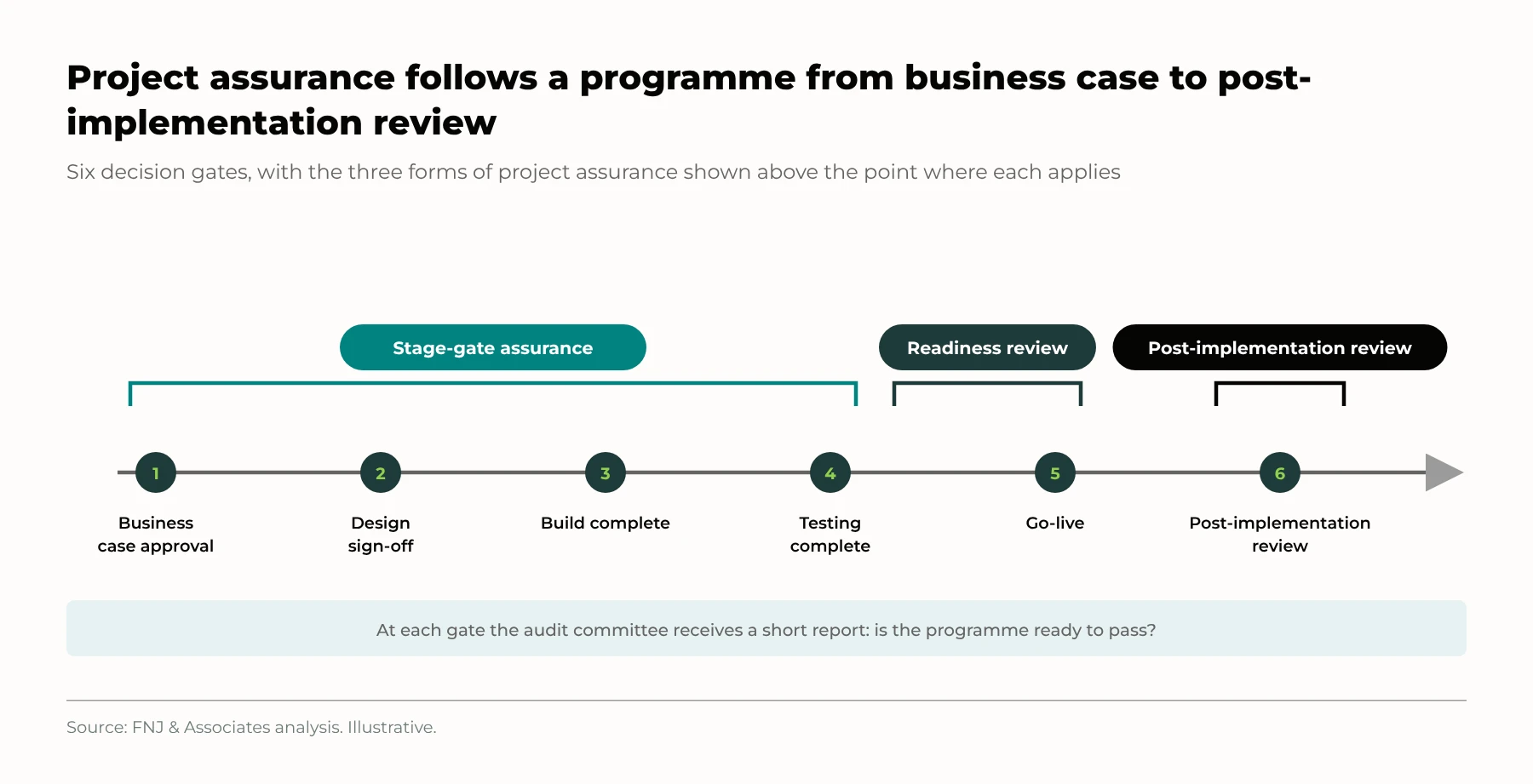
Project assurance takes three forms
| Form | Timing | What the audit committee receives |
|---|---|---|
| Stage-gate assurance | At each major decision point during the programme | A short report on whether the programme is ready to pass the gate |
| Readiness review | In the weeks before go-live | An opinion on whether the conditions for go-live have been met |
| Post-implementation review | Some months after go-live | An assessment of whether controls operate and benefits are being realised |
The three forms are complementary, so a large programme benefits from all three while a smaller one may need only a readiness review. The choice should follow the risk-based internal audit plan, which ranks the programme against other priorities.
Seven areas deserve testing before go-live
- Governance. A steering committee meets, decides and records its decisions. Roles between the sponsor, the vendor and the project team are clear.
- Requirements. Control requirements, such as approvals, limits and audit trails, were specified at the start and are traced through to testing.
- Data migration. Balances and records are reconciled between the old and new systems, and the reconciliation is reviewed and signed.
- Access and segregation of duties. User roles are designed so that no person can both initiate and approve a transaction.
- Testing evidence. User acceptance tests cover the control scenarios, defects are logged, and critical defects are closed before go-live.
- Cutover and fallback. The cutover plan is rehearsed, and there is a tested route back if the go-live fails.
- Benefits. The business case states measurable benefits, with an owner and a date for each.
A SACCO moving to a new core platform illustrates the point. If member balances are reconciled before cutover, the first month-end closes cleanly. If they are not, the differences surface in member statements, and the cost of correction is many times higher.
Four safeguards protect independence during project assurance
- Audit attends steering meetings as an observer and does not vote.
- Audit tests and reports. It does not design controls, configure the system or sign off deliverables.
- The scope and the safeguards are agreed with the audit committee in advance and recorded in the engagement terms.
- Where an auditor has advised on a design, a different auditor performs later assurance on it.
A stage-gate checklist gives the audit committee a consistent view at each decision
Project assurance is most useful when the same questions are asked at each decision point, so that the audit committee can compare the programme’s readiness from one gate to the next and see whether earlier observations were resolved.
| Gate | Questions internal audit asks | Evidence it expects to see |
|---|---|---|
| Business case approval | Are the benefits measurable, and are the costs and risks complete? | Approved business case, benefit owners, risk register for the programme |
| Design sign-off | Are control requirements specified and owned? | Requirements with approvals, limits and audit trails, signed by business owners |
| Build complete | Does the system match the approved design? | Configuration records, change log, role design |
| Testing complete | Have the control scenarios been tested and the critical defects closed? | Test scripts, results, defect log with severity and status |
| Go-live | Are data, people and fallback ready? | Signed migration reconciliation, training records, rehearsed cutover and fallback plan |
| Post-implementation | Do the controls operate and are the benefits arriving? | Control test results, benefit tracking, open issues |
Data migration deserves its own test programme
Data migration is where many system changes lose value, because errors carried into the new system surface later as incorrect balances, failed reports or customer complaints, and a dedicated set of tests gives the programme and the audit committee confidence before cutover.
- Completeness: record counts in the old and new systems agree for each data set, with every difference explained.
- Accuracy: financial balances, outstanding amounts and key dates agree in total and for a sample of individual records.
- Validity: mandatory fields are populated and values fall within permitted ranges.
- Mapping: codes, categories and account structures in the old system translate correctly to the new one.
- Rejected records: records that failed to load are listed, investigated and resolved before go-live.
- Sign-off: the data owner for each data set confirms the result in writing before cutover proceeds.
Clear roles keep project assurance from drifting into project management
The value of project assurance depends on the audit function remaining independent of the decisions it reports on, and a short statement of roles, agreed at the outset, keeps each party focused on its own responsibilities.
| Role | Responsible for | Not responsible for |
|---|---|---|
| Programme sponsor | Business case, benefits and the decision to proceed at each gate | Day-to-day delivery |
| Steering committee | Oversight, decisions on scope, budget and risk | Testing or configuration |
| Project manager and vendor | Delivery of the design, build, testing and cutover plan | Independent assurance |
| Business owners | Requirements, acceptance testing and data sign-off | Programme governance |
| Risk function | Challenge of programme risks and control design | Independent assurance to the board |
| Internal audit | Independent testing and reporting at agreed points | Designing controls, configuring the system or approving deliverables |
| Audit committee | Agreeing scope and safeguards, and acting on reports | Programme management |
Reporting must match the pace of the programme
A programme moves in weeks, so a report issued two months after fieldwork arrives after the decision it was meant to inform. Project assurance therefore uses short reports issued within days of each gate, with a clear statement of what must be fixed before the programme proceeds and what can follow later.
The audit committee then sees one view of the programme across its life: observations raised, actions agreed and actions closed. That record is also valuable evidence for a regulator or a donor who asks how the board oversaw the change.
A two-page report suits the pace of a programme
A project assurance report earns its place when a busy steering committee can read it in a few minutes, so the most effective format opens with an overall view of readiness, stated as ready, ready with conditions or not ready, followed by the conditions that must be met before the programme proceeds.
The second page lists the observations with a rating for each, the management response with an owner and a date, and the items carried forward from earlier gates, so that the committee sees at a glance whether the programme is resolving what it was told.
The approach applies across sectors with a different emphasis
In a bank moving to a new core platform, project assurance concentrates on the migration of customer balances, interest calculations and access to sensitive transactions, while an insurer replacing its claims system focuses on reserves, claims authority limits and the link to reinsurance records.
An NGO adopting a grant management system needs assurance that donor codes, budget lines and restrictions carry over correctly, a manufacturer implementing an enterprise resource planning system needs confidence in inventory valuation and costing, and a public body needs assurance over commitments, approvals and the audit trail that its auditors will later examine.
Project assurance findings tend to follow a recognisable pattern
Programmes differ in technology and scale, yet the observations raised during project assurance repeat across sectors often enough that an audit committee can ask about them before the first gate is reached.
- Control requirements added late. Approvals, limits and audit trails are specified after the design is fixed, so they are bolted on through manual workarounds.
- Testing that proves the system works but not that it controls. Acceptance tests cover the happy path and omit the scenarios in which a control should stop a transaction.
- Access designed for convenience. Broad roles are created to meet a deadline, with the intention of narrowing them later, and later never arrives.
- Migration reconciled in total only. Balances agree overall while individual records carry errors that surface in customer statements.
- Benefits without owners. The business case promises savings or growth, yet no one is named to deliver or measure them.
- Fallback never rehearsed. The plan to return to the old system exists on paper but has not been tested under time pressure.
Data analytics extends project assurance from samples to whole populations
Where the programme migrates large volumes of records, internal audit can use data analytics to compare every record in the old and new systems instead of a sample, which turns the migration reconciliation from a statement of totals into evidence that each customer, member, policy or grant carried over correctly.
The same techniques can test the role design by comparing the access assigned to each user with the segregation rules agreed at design, and they can be repeated after go-live to confirm that the controls continue to operate as the system settles into daily use.
Benefits should be measured after go-live, not assumed
The post-implementation review is the point at which the board learns whether the investment delivered what the business case promised, so the review should compare each stated benefit with its measured result, explain any shortfall and confirm that an owner remains accountable for closing it.
Three moves for the next quarter
- List the programmes in flight and rank them by risk. Use the same criteria as the annual audit plan: value, complexity and effect on customers or beneficiaries.
- Agree scope and safeguards with the audit committee for the highest-ranked programme, and record them in the engagement terms.
- Schedule a readiness review before the next go-live date, with data migration, access design and testing evidence as the minimum scope.
How we support your institution
FNJ & Associates provides project assurance on a co-sourced or outsourced basis. Our team combines internal audit, information systems and data analytics skills, so one engagement can cover governance, data migration and access design. We agree the safeguards with the audit committee before work begins.
Trigarc Audit, implemented by FNJ, covers audit planning, execution, reporting and follow-up, so observations from a programme are tracked to closure alongside other audit issues.
Questions about project assurance
What is project assurance in internal audit?
Project assurance is independent testing of a change programme while it is in progress. Internal audit reports on governance, controls and readiness at defined points, so that management can act before go-live.
Does project assurance compromise internal audit independence?
It does not when safeguards are in place, which means that audit tests and reports but does not design, configure or approve. The scope and safeguards are agreed with the audit committee in advance.
When should project assurance start?
It should start when the programme is approved, so that control requirements are tested from the design stage. A readiness review before go-live is the minimum for a significant system change.
What is the difference between a readiness review and a post-implementation review?
A readiness review takes place before go-live and gives a view on whether the programme should proceed. A post-implementation review takes place after go-live and assesses whether controls operate and benefits are realised.
Can external auditors rely on project assurance work?
External auditors decide for themselves how much reliance to place on internal audit work, but well-documented project assurance gives them a clear understanding of the new system’s controls and the migration evidence, which can reduce the work they need to repeat after go-live.
Does project assurance suit smaller institutions?
Yes, because the approach scales with the programme, so a smaller SACCO, NGO or company replacing an accounting system may need only a readiness review focused on data migration and user access, while a large bank or insurer may need assurance at every gate.
Can FNJ & Associates provide project assurance for our programme?
Yes, FNJ & Associates provides project assurance for system implementations and other change programmes across sectors, and the firm can be reached through fnjassociates.co.ke to request a proposal.
Request a proposal for project assurance
FNJ & Associates helps audit committees and programme sponsors gain assurance over system implementations and other change programmes, from the first stage gate to the post-implementation review.
About FNJ & Associates
FNJ & Associates is an ICPAK-registered CPA firm and a multidisciplinary team of 20+ professionals holding CPA(K), ACCA, CIA, CISA, CFE, CEH, CAMS and CIPP/E credentials, serving more than 100 organisations across Kenya and East Africa. The firm provides audit and assurance, internal audit, and IT and cybersecurity audits, and implements Trigarc Audit for audit planning, execution, reporting and follow-up. Visit fnjassociates.co.ke to learn more.