
Staff decide whether to speak up by watching what happened to those who spoke before, so protection must be planned, monitored and reported.
Whistleblower retaliation, the harm done to a person because they raised a concern, is the single greatest threat to an organisation’s ability to learn about misconduct early. Reports from staff and others remain the most common way fraud is detected, as the Association of Certified Fraud Examiners has found in successive editions of its report on occupational fraud, and those reports depend on people believing they will be protected.
Whistleblower retaliation is rarely open or dramatic, and it more often takes the form of exclusion from meetings, a sudden change in performance ratings, a transfer described as a business need or a contract that is not renewed, and because it is subtle it is easy to miss and hard to prove, while its effect on everyone who sees it is immediate.
Organisations can address the risk through the same model we apply to compliance: Prevent, Detect, Respond. This article sets out how each stage works for whistleblower retaliation and what the board should see, building on our guidance on the whistleblowing procedure and our anti-fraud and forensic services.
Legal protection in Kenya is partial, so organisational protection matters more
Kenya does not yet have a single whistleblower protection statute in force. Protections exist in specific laws, such as the Bribery Act 2016 for people who report bribery, and employment law offers remedies for unfair dismissal, but there is no comprehensive regime of the kind found in some other jurisdictions.
International frameworks offer a useful reference, and the European Union’s Directive 2019/1937 prohibits a wide range of retaliatory measures, from dismissal and demotion to negative performance assessments, intimidation and blacklisting, and many organisations with European links or donors adopt similar commitments. In the absence of a full domestic regime, an organisation’s own policy and practice are what protect the people who report.
Whistleblower retaliation takes overt and subtle forms
Policies often list only the obvious forms of retaliation, yet the subtle forms are more common and do as much damage to trust. Recognising both is the first step to preventing whistleblower retaliation in all its forms.
| Overt forms | Subtle forms |
|---|---|
| Dismissal or non-renewal of a contract | Exclusion from meetings, emails or decisions |
| Demotion or loss of responsibilities | Unexplained decline in performance ratings |
| Withheld promotion or pay increase | Transfer to a less desirable role or location |
| Disciplinary action on unrelated grounds | Increased scrutiny of the reporter’s work |
| Threats or harassment | Social isolation by colleagues or managers |
| Disclosure of the reporter’s identity | Removal from training or development opportunities |
Retaliation can also reach people around the reporter, such as colleagues who supported the report, witnesses in the investigation and family members employed by the same organisation. A protection policy against whistleblower retaliation should cover these people as well, with the same monitoring and the same consequences for those who harm them.
Prevent: protection starts when the report is received
The risk of retaliation should be assessed at intake, alongside the assessment of the concern itself. The handler considers who is named in the report, the reporter’s position relative to them, how easily the reporter could be identified and whether the reporter has expressed fear of consequences.
Where the risk is significant, the handler agrees a protection plan with the reporter. The plan may include keeping the reporter’s identity restricted to a small number of people, sequencing investigation steps so that the source is not obvious, arranging a temporary change in reporting line where the reporter works for the person named, and naming a contact the reporter can approach if they experience any adverse treatment.
Confidentiality is the foundation of prevention, so access to case files should be restricted to those handling the case, the reporter’s identity should be disclosed only with their consent or where the law requires it, and anyone who discloses it without authority should face disciplinary consequences.
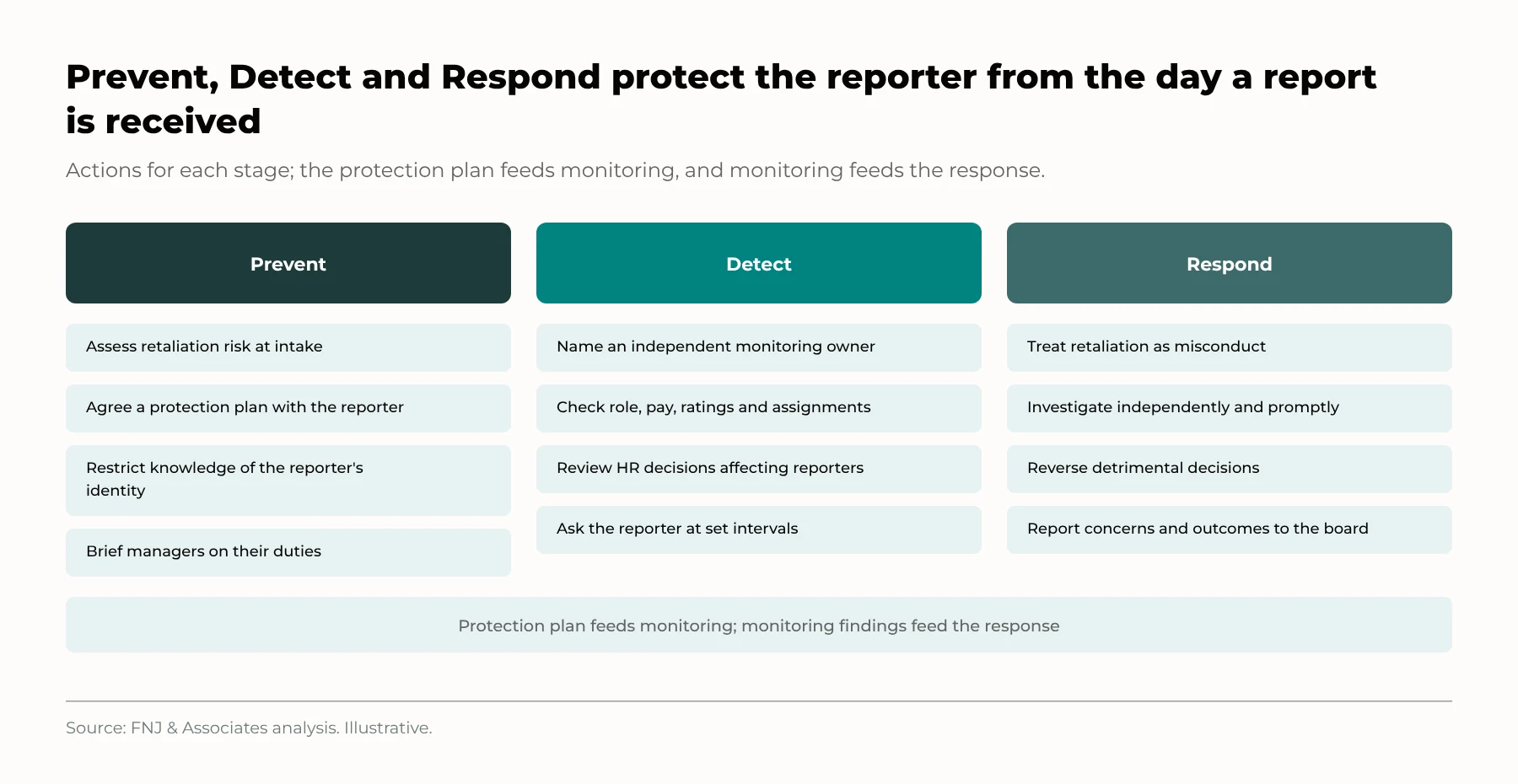
Detect: monitoring finds whistleblower retaliation before it becomes a pattern
Because retaliation is often subtle, it is rarely reported unless someone is watching for it. A named person, independent of the reporter’s management line, should check the reporter’s position at set intervals after the report, for example at one, three, six and twelve months, and record the outcome of each check.
The check should include a conversation with the reporter and a review of any changes to their role, pay, performance rating, location or reporting line in the period. Human resources can support this by flagging any proposed action affecting a reporter for review by the ethics or compliance function before it is taken.
- Has the reporter’s role, reporting line or location changed since the report?
- Has their performance rating, pay or bonus changed compared with previous years?
- Have they been excluded from meetings, projects or training they would normally attend?
- Has any disciplinary or performance process been started?
- Does the reporter feel they have been treated differently, and by whom?
Respond: retaliation is misconduct in its own right
When a concern about retaliation is raised, it should be investigated with the same rigour as the original report, by someone independent of the people involved. The burden of explanation should rest with the organisation: where adverse treatment follows a report, managers should be able to show that the decision was taken for legitimate reasons unconnected with the report.
Substantiated whistleblower retaliation should be treated as serious misconduct, with disciplinary consequences for those responsible regardless of seniority. The organisation should also remedy the harm to the reporter, for example by reversing the adverse decision, and it should communicate, without identifying anyone, that retaliation has been acted on, since visible consequences are the strongest deterrent.
Anonymity helps but does not remove the need for protection
Many reporters choose to remain anonymous because they fear retaliation, and an anonymous channel with two-way communication is an important safeguard. Anonymity is not complete protection, however, because the content of a report can point to the reporter, particularly in a small team or a remote field office.
Investigators should therefore consider how their enquiries might reveal the source and plan accordingly. Where the reporter’s identity is likely to be inferred, the protection plan should apply even though the reporter has not been named.
Communities and external reporters face particular risks
For NGOs, the people who report concerns are often beneficiaries or community members who depend on the organisation’s services. They may fear losing access to support, and they may have no employment relationship through which protection can be monitored.
Protection for these reporters depends on accessible and confidential channels, on separating the handling of reports from the delivery of services, and on clear commitments that raising a concern will not affect anyone’s entitlement to support. Partners delivering programmes on the organisation’s behalf should be bound by the same commitments.
The board should treat whistleblower retaliation as a key indicator of culture
The board or audit committee should receive, as part of regular speak-up reporting, the number of retaliation concerns raised, the number substantiated, the actions taken and the results of monitoring checks. It should also see the results of staff surveys on whether people feel safe to speak up.
A rising number of retaliation concerns is not necessarily a bad sign, since it may reflect greater confidence in the channel. A complete absence of concerns, combined with low report volumes and survey results showing fear of consequences, is a warning that retaliation may be going unreported.
Managers need training to recognise and avoid whistleblower retaliation
Many acts of retaliation are committed by managers who do not see their behaviour in those terms. A manager who feels embarrassed or criticised by a report may withdraw support from the reporter, scrutinise their work more closely or describe them as difficult, without recognising that each of these is a form of whistleblower retaliation.
Training helps managers understand what retaliation looks like, why it matters and how to respond professionally when a concern is raised about their area. It should explain that managers must not try to identify the source of a report, must not discuss the report with the team and must seek advice from the ethics or human resources function before taking any decision that affects the reporter.
Human resources decisions are the most common channel for retaliation
Performance reviews, restructuring, contract renewals, transfers and disciplinary processes are legitimate management tools, but they are also the means through which retaliation most often occurs. A simple control, requiring the ethics or compliance function to review any proposed human resources action affecting a known reporter in the year after a report, catches most problems before they happen.
The review does not prevent legitimate decisions, because it simply asks the decision-maker to document the business reason, confirms that the reason is unconnected with the report and records the outcome, which protects the organisation as well as the reporter if the decision is later challenged.
Five weaknesses recur in protection against whistleblower retaliation
- Policies that prohibit retaliation but name no one responsible for monitoring it.
- No assessment of retaliation risk when a report is received.
- Human resources decisions affecting reporters taken without any review.
- Retaliation concerns handled by the same managers the reporter complained about.
- Board reporting that covers report volumes but says nothing about retaliation.
Addressing these weaknesses costs little and signals to every member of staff that the organisation means what its policy says, which is ultimately what persuades people to speak up.
Exit interviews add a further safeguard against whistleblower retaliation, because when a person who raised a concern leaves the organisation within a year or two of the report, a confidential exit conversation led by someone outside their management line can reveal whether retaliation played a part. The pattern across several departures can show the board whether its protection commitments are holding in practice.
Organisations that take these steps often find that the volume and quality of reports rise within a year, as staff see that colleagues who spoke up were protected and that concerns were acted on, which is the clearest return on the investment in preventing whistleblower retaliation.
Three moves for the next quarter
- Add a retaliation risk assessment to intake, with a protection plan for every report assessed as significant.
- Name an independent monitoring owner and schedule checks at set intervals for every reporter from the past year.
- Report retaliation concerns and monitoring results to the audit committee alongside the existing speak-up measures.
How we support your institution
FNJ & Associates reviews speak-up programmes, designs retaliation protection policies and monitoring, trains handlers and managers, and investigates allegations of retaliation independently through our team of Certified Fraud Examiners.
Trigarc Ethics, implemented by FNJ, records retaliation flags against each case, restricts access to case files to those authorised and reports retaliation measures to the board and audit committee alongside the wider speak-up programme.
Questions about whistleblower retaliation
What is whistleblower retaliation?
Whistleblower retaliation is any adverse treatment of a person because they raised a concern, including dismissal, demotion, negative performance ratings, exclusion, harassment, transfer or disclosure of their identity.
Are whistleblowers protected by law in Kenya?
Kenya has no single whistleblower protection statute in force, although specific laws such as the Bribery Act 2016 protect people who report certain matters and employment law provides remedies for unfair dismissal, so organisational policies play a central role.
How can an organisation prevent retaliation?
An organisation can prevent retaliation by protecting the reporter’s identity, assessing retaliation risk at intake, agreeing a protection plan where the risk is significant and making clear that retaliation is serious misconduct.
How long should a reporter be monitored after making a report?
Many organisations monitor a reporter’s position for at least a year after the report, with checks at set intervals, because retaliation can occur long after the concern is raised.
What should happen if retaliation is substantiated?
The organisation should take disciplinary action against those responsible, remedy the harm to the reporter and communicate, without identifying anyone, that retaliation has been acted on.
Can a manager take action against a reporter for unrelated performance issues?
A manager may address genuine performance issues, but the decision should be reviewed by the ethics or human resources function, documented with the business reason and shown to be unconnected with the report, so that it cannot reasonably be seen as whistleblower retaliation.
Can FNJ & Associates investigate a retaliation complaint?
Yes, FNJ & Associates investigates retaliation complaints independently and reviews speak-up programmes, and the firm can be reached through fnjassociates.co.ke to request a proposal or a demo.
Book a Trigarc Ethics demo with FNJ
FNJ & Associates helps organisations across Kenya and East Africa protect the people who speak up, from retaliation risk assessment and monitoring to independent investigation and board reporting.
About FNJ & Associates
FNJ & Associates is an ICPAK-registered CPA firm and a multidisciplinary team of 20+ professionals holding CPA(K), ACCA, CIA, CISA, CFE, CEH, CAMS and CIPP/E credentials, serving more than 100 organisations across Kenya and East Africa. The firm provides forensic audit and investigation services and governance, risk and compliance advisory, and implements Trigarc Ethics for speak-up reporting, investigations and ethics registers. Visit fnjassociates.co.ke to learn more.