

Matters reserved for the board, a single authority matrix and regular testing of approvals give directors confidence that delegated power is used as intended.
A delegation of authority framework sets out which decisions the board keeps for itself and which it delegates to the chief executive, and from the chief executive to other managers, with the limits that apply to each. Banks, SACCOs, insurers, NGOs, state corporations and corporates across Kenya and East Africa all depend on such a framework, because no board can approve every contract, payment, appointment or loan.
In many institutions, the delegation of authority has grown piecemeal. Limits sit in board resolutions, finance policies, procurement manuals and old memos, they have not been updated as the institution has grown. Some managers exercise authority that was never formally delegated to them, while internal audit rarely tests whether approvals actually follow the limits that were set.
A clear framework with matters reserved for the board, a single authority matrix, controls over sub-delegation, system enforcement and regular testing resolves these issues. This article sets out each element, drawing on our governance, risk and risk management services.
The board remains accountable for what it delegates
Company law allows a board to delegate its powers within the limits of the institution’s articles or constitution, and sector rules add their own expectations, from bank governance requirements in the Central Bank of Kenya’s prudential guidelines to SACCO by-laws and the governance code for state corporations. In every case, delegation transfers the power to act but not the board’s ultimate accountability for the outcome.
That is why the board needs to know what it has delegated, to whom, within what limits, and whether those limits are respected. A delegation of authority framework is therefore a governance control as much as an administrative convenience.
Matters reserved for the board come first
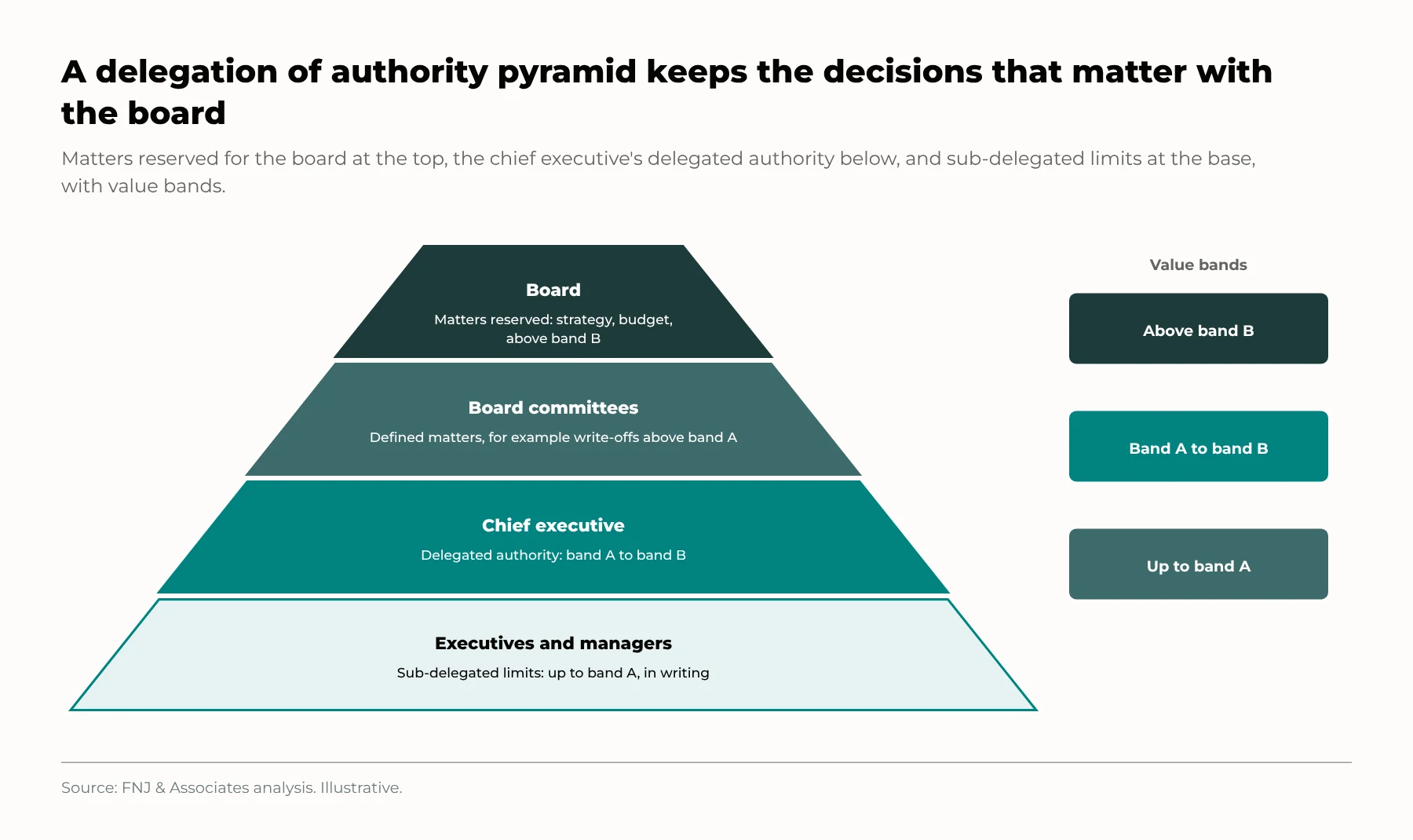
The framework should begin with a short list of matters that only the board may decide. These typically include approving strategy and the annual budget, setting risk appetite, appointing and removing the chief executive, approving major acquisitions, disposals and borrowings, approving financial statements, and approving transactions with directors or other related parties above a set value.
Keeping this list short and explicit ensures that the board’s time is spent on decisions that warrant it. Anything not reserved is delegated to the chief executive, who may then delegate further within the limits the framework allows.
A single authority matrix removes doubt
All delegated limits should sit in one delegation of authority matrix, organised by type of decision, showing who may initiate, recommend, approve and be informed at each value band. Consolidating limits from separate policies into one matrix removes contradictions and gives every manager a single reference.
| Decision type (illustrative) | Up to band A | Band A to band B | Above band B |
|---|---|---|---|
| Operating expenditure within budget | Head of department | Chief finance officer | Chief executive |
| Capital expenditure within budget | Chief finance officer | Chief executive | Board |
| Unbudgeted expenditure | Chief executive | Board committee | Board |
| Contract award after tender | Tender committee | Chief executive | Board |
| Write-off of receivables or loans | Chief finance officer | Chief executive | Board committee |
| Staff appointment | Head of department with human resources | Chief executive | Board for senior executives |
Value bands should reflect the institution’s size and risk, and they should be reviewed at least every two or three years, since inflation and growth can make limits set years ago either too restrictive or, where the institution has shrunk, too generous.
Non-financial decisions belong in the matrix too
Many delegation of authority matrices cover only spending, yet decisions such as entering new markets, launching products, signing partnership agreements, settling litigation, granting policy exceptions, accepting risks and communicating with regulators can be just as consequential, and they should appear in the matrix with clear approvers.
Our article on risk acceptance shows how the authority to accept risks can follow the same logic, rising with the size of the residual risk.
Sub-delegation needs written rules
The chief executive will usually need to sub-delegate parts of their authority to executives and managers. The framework should state whether sub-delegation is permitted for each type of decision, require that it be in writing, prevent a delegate from approving above the limit of the person who delegated to them, and set out how authority is exercised when the holder is absent.
Acting arrangements deserve particular care, because when an executive is on leave, the person acting should have a written delegation for the period, rather than an informal understanding, so that approvals made in their absence can be shown to be valid.
Separation of duties limits what one person can do
A sound delegation of authority framework prevents one person from initiating, approving and recording the same transaction. The matrix should separate the roles of requester, approver and payer for financial transactions, and it should prohibit managers from approving transactions in which they have a personal interest, which links the framework to the conflict of interest declaration process.
Systems should enforce the limits where possible
Limits written in a document are only as strong as the controls that enforce them. Wherever approvals pass through an accounting, procurement, payroll or loan system, the workflow should route each transaction to an approver with the necessary authority and block approval above that limit, so that the delegation of authority is applied automatically rather than relying on memory.
System workflows must be kept in line with the matrix. When the board changes a limit or a person changes role, the system configuration should be updated at the same time, and a periodic reconciliation between the matrix and the system rules confirms that they agree.
Testing shows whether approvals follow the framework
Internal audit should test the delegation of authority regularly, by sampling transactions across value bands and decision types and confirming that each was approved by a person with the right authority, that sub-delegations were in writing and that no one approved their own transaction. Data analytics can test whole populations for approvals above limit, split transactions designed to stay below a threshold and approvals by people who were not authorised at the time.
The results should be reported to the audit committee, together with any patterns such as frequent use of urgent approvals or repeated splitting of purchases, which often indicate that limits are set too low or that controls are being circumvented.
Five weaknesses recur in delegation of authority
- Limits scattered across resolutions, policies and memos, with contradictions between them.
- Value bands not reviewed for years, so they no longer reflect the institution’s size.
- Sub-delegation and acting arrangements made informally, without written records.
- System workflows that do not match the approved matrix.
- No testing of whether approvals follow the limits, and no reporting to the audit committee.
Sector context shapes the matrix
Banks and SACCOs need detailed credit approval limits by loan size, sector and risk grade, with clear rules on lending to insiders, while insurers need limits for underwriting, claims settlement and reinsurance. State corporations must align their matrix with public finance and procurement rules and with oversight by their parent ministries.
NGOs need limits that reflect donor requirements, which may be stricter than the organisation’s own, and they must manage authority across country offices and field locations. Corporates must cover procurement, pricing, credit to customers and capital projects. The same principles of delegation of authority apply throughout, whatever the sector.
Urgent approvals need their own rule
Every institution occasionally needs to act before the normal approver is available, for example to make an emergency repair, secure a time-limited opportunity or respond to a crisis. The delegation of authority framework should define what counts as urgent, who may approve in that case, the maximum value allowed and the requirement to report the decision to the usual approver or the board at the next opportunity.
Urgent approvals should be logged and reviewed, because a rising number of urgent approvals usually indicates poor planning, limits that are set too low or a deliberate attempt to avoid scrutiny, and the audit committee should see the trend.
Group structures need authority that crosses entities
Where an institution operates through subsidiaries, country offices or branches, the delegation of authority framework must make clear which decisions belong to each entity’s own board, which require approval from the group, and how local limits relate to group limits. Subsidiary boards retain their own legal duties, so group approval should complement rather than replace their decisions, and the matrix should record both.
For NGOs with country offices and corporates with regional operations, the same issue arises in a simpler form. Country directors need sufficient authority to run operations without constant referral to headquarters, while the board needs confidence that significant commitments in any country receive appropriate approval.
Communication makes the framework usable
A delegation of authority matrix that managers cannot find, or do not understand, will not be followed. The matrix should be published in one place, explained in induction for every new manager, summarised in a one-page guide for each function and confirmed by each delegate in writing when their authority is granted or changed.
Finance and procurement teams should also know the limits well, because they are often the last point at which an approval above limit can be noticed before a payment is made or a contract is signed.
The board should review the framework periodically
The board should review the delegation of authority at least every two or three years, and whenever the institution’s strategy, structure or size changes significantly. The review should consider whether reserved matters remain appropriate, whether limits still reflect the institution’s scale, what the testing results and urgent approval trends show, and whether non-financial decisions are adequately covered.
Recording the outcome of each review in a board resolution, with the effective date of any change, keeps the delegation of authority history clear and allows auditors to test approvals against the limits that applied at the time.
Three moves for the next quarter
- Agree a short list of matters reserved for the board, and confirm it in a board resolution.
- Consolidate all limits into one delegation of authority matrix, covering financial and non-financial decisions.
- Ask internal audit to test a sample of approvals against the matrix and report the results to the audit committee.
How we support your institution
FNJ & Associates reviews and redesigns delegation of authority frameworks, consolidates authority matrices, aligns system workflows with approved limits and tests approvals through internal audit and data analytics. We also train boards and management on governance and their respective responsibilities.
Trigarc Governance, implemented by FNJ, records board resolutions and the decisions they authorise, while Trigarc Audit supports testing of approvals and follow-up of exceptions.
Questions about delegation of authority
What is a delegation of authority framework?
A delegation of authority framework sets out which decisions the board keeps for itself and which it delegates to management, with the limits, approvers and conditions that apply to each type of decision.
What are matters reserved for the board?
Matters reserved for the board are decisions only the board may take, such as approving strategy, the budget, risk appetite, major transactions, the financial statements and the appointment of the chief executive.
Can a manager sub-delegate their authority?
Sub-delegation should be permitted only where the framework allows it, in writing, and never above the limit of the person who delegated the authority.
How often should approval limits be reviewed?
Most institutions review their delegation of authority every two or three years, and sooner when the institution grows significantly, changes structure or finds that limits are routinely circumvented.
How can we test whether approvals follow the limits?
Internal audit can sample transactions across value bands and use data analytics to identify approvals above limit, split transactions and approvals by unauthorised people.
How should urgent approvals be handled?
The framework should define what counts as urgent, who may approve, the maximum value and the requirement to report the decision to the usual approver or the board, and urgent approvals should be logged and their trend reported to the audit committee.
Should non-financial decisions be in the delegation of authority?
Yes, decisions such as launching products, settling litigation, granting policy exceptions, accepting risks and communicating with regulators can be as significant as spending, and they should have clear approvers in the matrix.
Can FNJ & Associates review our delegation of authority?
Yes, FNJ & Associates reviews and redesigns delegation frameworks, aligns system workflows and tests approvals, and the firm can be reached through fnjassociates.co.ke to request a proposal.
Request a proposal for a delegation of authority review
FNJ & Associates helps boards and management across Kenya and East Africa set clear limits, enforce them in systems and test that delegated authority is used as intended.
About FNJ & Associates
FNJ & Associates is an ICPAK-registered CPA firm and a multidisciplinary team of 20+ professionals holding CPA(K), ACCA, CIA, CISA, CFE, CEH, CAMS and CIPP/E credentials, serving more than 100 organisations across Kenya and East Africa. The firm provides governance, risk and compliance advisory and corporate governance training, and implements Trigarc Governance for board reporting. Visit fnjassociates.co.ke to learn more.