

Event-driven declarations, a management plan for every conflict and checks against supplier and payroll data catch what an annual form misses.
A conflict of interest declaration is the means by which staff, board members and others tell the organisation about personal interests that could influence, or appear to influence, their decisions. NGOs, public bodies, financial institutions and corporates across Kenya and East Africa rely on declarations to protect procurement, recruitment, lending and grant decisions from improper influence.
Most organisations collect declarations once a year on a standard form, file them and rarely look at them again. The conflicts that cause real harm, such as a relative’s company bidding in a tender or a staff member’s side business supplying the organisation, often arise between annual declarations and are never recorded, while the forms that are collected are seldom compared with the organisation’s own data.
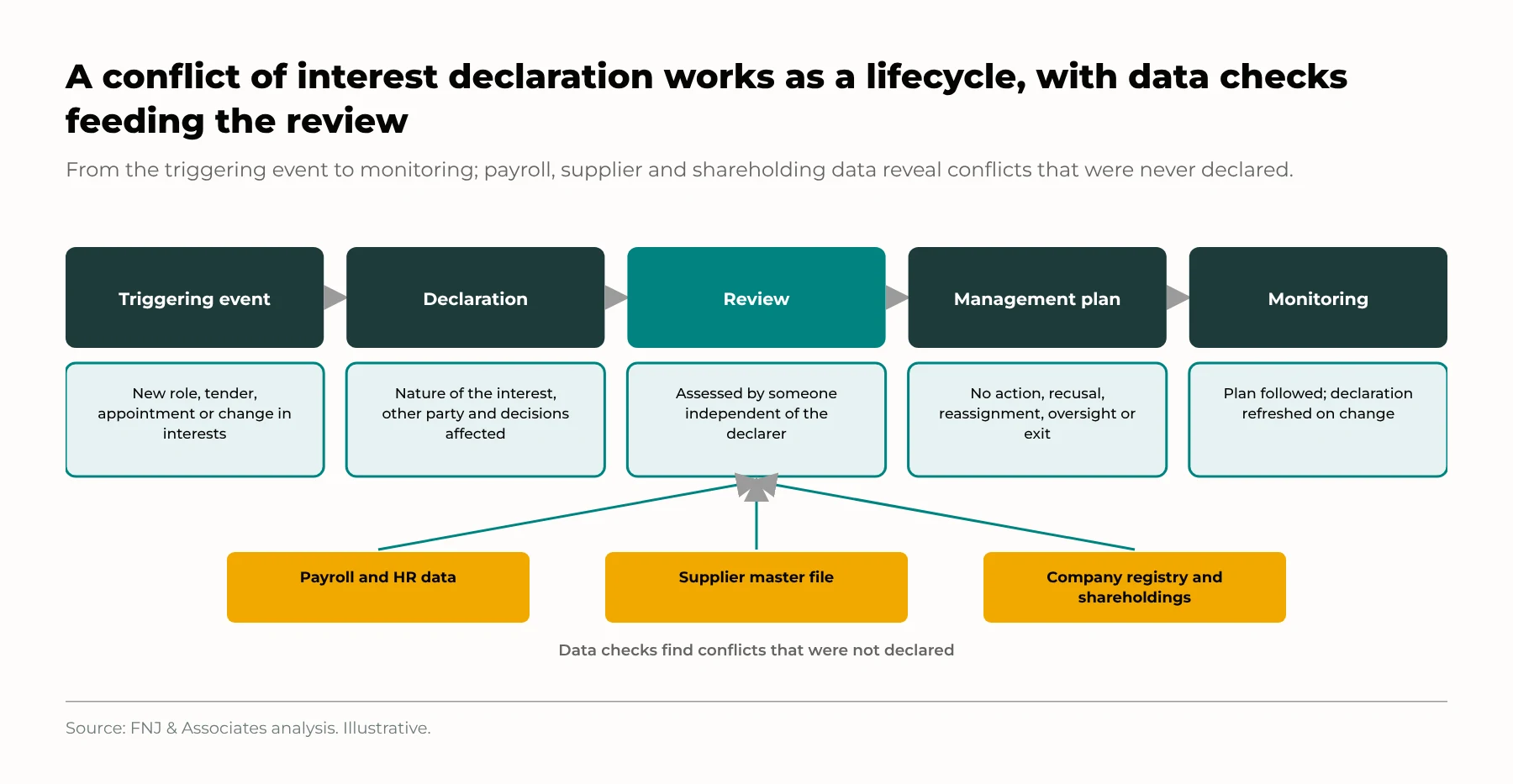
Three changes turn declarations into an effective control: declarations triggered by events, a management plan for every declared conflict, and checks that compare declarations with supplier, payroll and procurement records. This article sets out each, drawing on our compliance services in Kenya and our forensic work.
Conflicts can be actual, potential or perceived
| Type | Meaning | Example |
|---|---|---|
| Actual | A personal interest currently influences, or could directly influence, a decision | A procurement officer evaluates a bid from a company owned by a sibling |
| Potential | A personal interest could influence a decision in future | A finance manager’s spouse joins a firm that may bid for the audit contract |
| Perceived | A reasonable observer might believe a personal interest influences a decision | A board member is a close friend of a major supplier’s director |
All three deserve declaration, because a perceived conflict can damage trust and reputation as much as an actual one, even when no improper decision was made. A conflict is not wrongdoing in itself; the wrongdoing lies in failing to declare it or failing to manage it.
Legal and regulatory expectations apply in several sectors
Company law in Kenya requires directors to declare their interests in proposed transactions with the company, and public procurement law and public officer ethics legislation impose specific duties on those involved in public decisions. Regulators of banks, insurers and SACCOs expect governance frameworks to address conflicts, and donors require NGOs to manage conflicts in procurement and partner selection.
International standards reinforce these expectations, and ISO 37301, the standard for compliance management systems, and anti-bribery frameworks treat conflict management as a core control, and many donors and multinational counterparties expect to see it working before they sign.
Annual declarations miss the conflicts that matter most
An annual conflict of interest declaration captures a person’s interests on one day of the year. A relative may start a business, a staff member may take on a directorship or an investment may change the following week. The organisation will not know until the next annual cycle, by which time a decision may already have been made.
Event-driven declarations close this gap: staff should be required to declare a new interest within a short period of it arising, and specific events should prompt a fresh declaration, such as joining a tender evaluation panel, a recruitment panel or a grant selection committee.
A conflict of interest declaration should capture enough to act on
- The nature of the interest, such as ownership, directorship, employment, family relationship or significant debt.
- The other party involved, such as a company, supplier, customer or partner.
- The decisions or processes the interest could affect.
- The date the interest arose and whether it is continuing.
- A confirmation that the declaration is complete, with the declarant’s signature or electronic acknowledgement.
Every declared conflict needs a management plan
A declaration that is filed without any action protects no one. Each declared conflict should be reviewed by a designated person, usually in compliance, human resources or the company secretary’s office, who decides how it will be managed and records the decision.
| Response | When it fits |
|---|---|
| No action needed | The interest is remote from the person’s responsibilities |
| Recusal | The person withdraws from specific decisions where the interest is relevant |
| Reassignment | Responsibilities are moved to someone without the conflict |
| Additional oversight | A second reviewer approves decisions the person is involved in |
| Divestment or exit | The interest is incompatible with the role and must end |
The plan should be communicated to the person and to anyone who needs to apply it, such as the chair of a tender evaluation committee, and it should be reviewed when the person’s role or the interest changes.
Data checks find conflicts that were not declared
The most serious conflicts are often the ones no one declares. Comparing the organisation’s own data can reveal them: matching staff bank accounts, telephone numbers and addresses in the payroll system against the supplier master file, comparing staff and supplier directors using company registry information, and reviewing tender awards for patterns linked to particular evaluators.
These checks are standard forensic techniques, and they can be run periodically as a control rather than only during an investigation. A match does not prove wrongdoing, but it identifies a relationship that should have been declared and deserves an explanation.
Procurement and recruitment carry the highest risk
Procurement is the area where conflicts most often lead to loss, through inflated prices, poor quality or contracts awarded to connected parties. Every member of a tender evaluation panel should complete a conflict of interest declaration for the specific tender, after seeing the list of bidders and before evaluation begins.
Recruitment carries similar risks, particularly when relatives or associates of existing staff apply. A declaration by each panel member for the specific recruitment, together with a clear policy on employing relatives, protects the fairness of the process and the reputation of the people involved.
The register should be one record, not many files
Declarations, review decisions and management plans should sit in one register that the compliance function can search, so that a procurement officer can confirm in minutes whether a panel member has declared an interest in a bidder. Paper forms in personnel files cannot provide that assurance quickly enough to protect a live decision.
The register also supports reporting, since the board or audit committee should receive a periodic summary of declarations received, conflicts identified, management plans in place and any undeclared conflicts discovered through data checks, together with the action taken.
Five weaknesses recur in conflict of interest controls
- Declarations collected only once a year, with no requirement to declare new interests promptly.
- Declarations filed without review or a management plan.
- No specific declaration before tender evaluation or recruitment panels.
- No comparison of declarations with payroll, supplier and procurement data.
- No reporting to the board on conflicts declared, managed or discovered.
Sector context shapes where conflicts arise
NGOs face conflicts in procurement, partner selection and recruitment, often in small communities where relationships are close and declarations are especially important. Public bodies must apply procurement and ethics legislation that sets specific duties for officers involved in decisions.
Banks and SACCOs face conflicts in lending to staff, directors and their associates, which regulators watch closely, while corporates face conflicts in procurement, distribution and investment decisions. The three changes described here, namely event-driven declarations, management plans and data checks, apply in every case.
Board members need the same discipline as staff
Directors often hold several directorships, investments and community roles, which makes conflicts more likely at board level than anywhere else. Every board member should complete a conflict of interest declaration on appointment, update it promptly when interests change and confirm at the start of each meeting whether they have an interest in any agenda item.
Where a director declares an interest, the minutes should record the declaration and the action taken, such as the director leaving the room for the item or abstaining from the vote. Supervisors and auditors read board minutes closely for these records, and their absence suggests either that conflicts do not exist or that they are not being recorded.
Gifts, hospitality and outside work are closely related
Conflicts of interest rarely arise in isolation from other ethical risks. A supplier that offers generous hospitality, a staff member who takes on paid outside work for a customer, or a board member whose relative joins a counterparty all create conflicts that the conflict of interest declaration should capture. The gifts and hospitality register and outside employment approvals should be read alongside it.
Bringing these records together in one place lets the compliance function see the full picture for each person and each counterparty, so that a pattern of hospitality from a bidder, combined with an undeclared relationship, is noticed before a contract is awarded.
Training and simple guidance improve the quality of declarations
Many people under-declare because they are unsure what counts as an interest, or worry that declaring will cast doubt on their integrity. Short training with practical examples, and guidance stating clearly that declaring is expected and protects the person, encourages complete declarations and reduces the number of conflicts found later through data checks.
A simple rule helps: if a reasonable colleague learning of the interest might wonder whether it affected a decision, the interest should be declared. Staff who apply that test will rarely fail to complete a conflict of interest declaration when one is needed.
Undeclared conflicts should lead to consistent consequences
When a data check or an investigation reveals an interest that should have been declared, the organisation should respond consistently, distinguishing between an honest oversight that is promptly corrected and a deliberate concealment linked to a decision. The code of conduct should state that failing to make a conflict of interest declaration is a disciplinary matter, and the response to each case should be recorded and reported in summary to the audit committee.
Consistency matters because staff watch how cases are handled, and an organisation that treats a senior manager’s undeclared interest more leniently than a junior officer’s will find that declarations become a formality rather than a control.
Three moves for the next quarter
- Require a specific conflict of interest declaration from every tender evaluation and recruitment panel member before the process begins.
- Review every declaration received in the past year, and record a management plan for each conflict identified.
- Run a data check comparing staff payroll details with the supplier master file, and follow up any matches.
How we support your institution
FNJ & Associates designs conflict of interest policies and registers, reviews declarations and management plans, runs data analytics to identify undeclared conflicts and investigates suspected conflicts through our team of Certified Fraud Examiners. Our article on gifts and hospitality covers a closely related control.
Trigarc Ethics, implemented by FNJ, provides a conflict of interest register with declarations, reviewer decisions and management plans, alongside gifts and hospitality and code of conduct attestations, with reporting to the board and audit committee.
Questions about the conflict of interest declaration
What is a conflict of interest declaration?
A conflict of interest declaration is a statement by a staff member, board member or other person disclosing personal interests that could influence, or appear to influence, decisions they make for the organisation.
How often should conflicts of interest be declared?
Most organisations require an annual declaration together with a prompt declaration whenever a new interest arises and a specific declaration before tender evaluation, recruitment and similar decisions.
What happens after a conflict is declared?
A designated reviewer decides how the conflict will be managed, for example through recusal, reassignment or additional oversight, and records the plan in the register.
Is having a conflict of interest wrong?
No, a conflict is not wrongdoing in itself, but failing to declare it or failing to manage it once declared can lead to improper decisions and disciplinary consequences.
How can organisations find undeclared conflicts?
Organisations can compare payroll, supplier and procurement data, for example matching staff bank accounts and addresses with suppliers, to identify relationships that should have been declared.
Should board members complete a conflict of interest declaration?
Yes, board members should declare their interests on appointment, update them when they change and confirm at each meeting whether they have an interest in any agenda item, with declarations and actions recorded in the minutes.
Can FNJ & Associates review our conflict of interest controls?
Yes, FNJ & Associates designs policies and registers, reviews declarations and runs data checks for undeclared conflicts, and the firm can be reached through fnjassociates.co.ke to request a proposal.
Request a proposal for a conflict of interest review
FNJ & Associates helps organisations across Kenya and East Africa move from annual forms to a live register that captures, manages and checks conflicts of interest.
About FNJ & Associates
FNJ & Associates is an ICPAK-registered CPA firm and a multidisciplinary team of 20+ professionals holding CPA(K), ACCA, CIA, CISA, CFE, CEH, CAMS and CIPP/E credentials, serving more than 100 organisations across Kenya and East Africa. The firm provides forensic audit and investigation services and governance, risk and compliance advisory, and implements Trigarc Ethics for speak-up reporting, investigations and ethics registers. Visit fnjassociates.co.ke to learn more.