
Testing every transaction reveals exceptions a sample would miss, and a few well-chosen tests pay back within the first audit cycle.
Data analytics in internal audit is the use of software to examine complete populations of transactions, records and system activity, rather than relying on a sample, in order to test controls, identify exceptions and detect patterns that point to error or fraud. Banks, SACCOs, insurers, NGOs, state corporations and corporates across Kenya and East Africa hold almost every transaction in a system, which makes this approach practical for any internal audit function willing to invest in the skills.
Most functions still test controls by selecting a sample of twenty-five or forty items. Sampling has a place, but it means that exceptions outside the sample go unseen, that rare but significant events such as duplicate payments or approvals above limit are unlikely to be selected. That the audit committee receives conclusions resting on a small fraction of the evidence that sits in the institution’s own systems.
A focused analytics programme, starting with a few tests that pay back quickly and supported by sound data handling and documentation, changes what auditors can see. This article sets out how to build one, drawing on our internal audit services in Kenya and East Africa and our forensic work.
Data analytics in internal audit tests the whole population
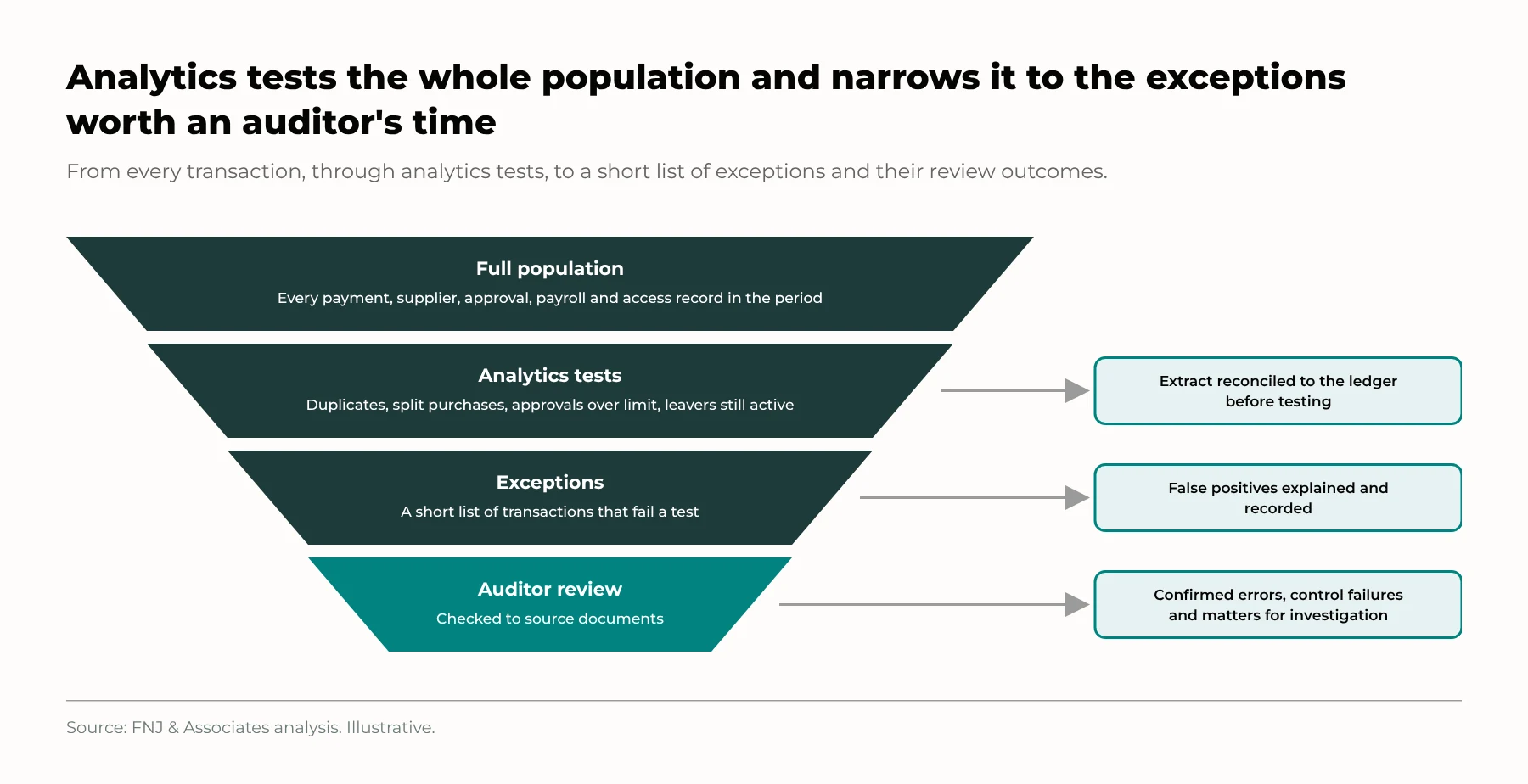
When an auditor tests every payment, every loan disbursement or every change to supplier bank details, the conclusion no longer depends on whether the sample happened to include the problem. Exceptions are identified directly, their number and value can be stated precisely, and the auditor’s time moves from selecting and checking routine items to investigating the exceptions that matter.
The Global Internal Audit Standards expect internal auditors to consider the use of technology in performing their work and to obtain sufficient, reliable and relevant evidence. Full population testing often provides stronger evidence than a sample, and it gives the audit committee a clearer view of the size of any control failure.
A few tests pay back in the first cycle
Functions new to analytics should begin with tests that are simple to run, apply to data the institution already holds and frequently reveal exceptions worth investigating. The following tests meet those criteria in most institutions and make a sound first step in data analytics in internal audit.
| Area | Test (illustrative) | What it can reveal |
|---|---|---|
| Payments | Duplicate payments by supplier, amount, invoice number and date | Overpayments and possible fraud |
| Supplier master file | Supplier bank accounts, phone numbers or addresses matching staff records | Undeclared conflicts and fictitious suppliers |
| Approvals | Transactions approved above the approver’s limit, or by the person who initiated them | Breaches of the delegation of authority |
| Purchasing | Purchases split just below an approval threshold | Circumvention of procurement controls |
| Payroll | Staff paid after their leaving date, or sharing bank accounts | Ghost employees and payroll fraud |
| User access | Active system accounts belonging to leavers | Access control weaknesses |
| Lending | Loans disbursed before approval, or to related parties above limits | Credit control and insider lending issues |
Each test produces a list of exceptions, and not every exception is an error, since some will have valid explanations, but each must be reviewed, and the results usually justify the effort within the first engagement.
Data access is the first practical hurdle
Data analytics in internal audit depends on obtaining complete and accurate data from the institution’s systems. Internal audit should agree with information technology a standard way to request extracts, the fields required for each test and the period covered. The internal audit charter should confirm the function’s right of access to data, as it does to records and people.
Read-only access to reporting databases or data warehouses, where available, is more efficient than repeated extract requests, and it reduces the risk that data is filtered or altered before it reaches the auditor.
Every extract must be validated before it is tested
A test run on incomplete data gives false comfort to auditors and the audit committee alike. Before testing, the auditor should confirm that the extract is complete, for example by reconciling the total value and number of records to the general ledger or a system report. That key fields are populated and in the expected format, so that the population tested is the population that exists.
Analytics must be documented so it can be repeated
The working paper for an analytics test should record the source of the data, how completeness was confirmed, the logic or script applied, the output and the follow-up of each exception. Saving the script and the data extract with the working paper allows a reviewer to repeat the test and reach the same result, which is the standard our article on audit working papers describes.
Exceptions need disciplined follow-up
Data analytics in internal audit often produces more exceptions than a sample, and they must be handled systematically. Auditors should group exceptions by likely cause, investigate a sample of each group where volumes are large, obtain explanations and evidence from management, and distinguish between data quality issues, control failures and possible fraud, which may need to be referred under the organisation’s investigation procedures.
Skills can be built in stages
A function does not need a team of data scientists to begin data analytics in internal audit. Spreadsheet tools handle many of the tests described here for moderate data volumes, while dedicated audit analytics software, database queries or scripting languages become valuable as volumes and ambitions grow. Training one or two auditors as analytics champions, and pairing them with others on engagements, spreads the skills over time.
Co-sourcing is a practical option for the first engagements, because an external specialist can build and run the initial tests alongside the internal team, document them for reuse and hand over the scripts, so that the function gains both results and capability.
Repeatable tests lead to continuous monitoring
Once a test has been built and validated, it can be run every month or quarter rather than once a year. Continuous auditing of this kind lets internal audit identify exceptions soon after they occur and track whether control failures are being fixed, while management may eventually adopt the same tests as part of its own monitoring, which our article on management control testing describes.
When management owns the monitoring, internal audit’s role shifts to confirming that the monitoring works, which is a more efficient use of both functions’ time and an example of combined assurance in practice.
Data protection and confidentiality still apply
Data analytics in internal audit often involves personal data about customers, staff and suppliers. Internal audit should take only the data it needs, store it securely with restricted access, delete or archive it in line with the retention policy and respect the Data Protection Act 2019, particularly when combining datasets in ways that reveal information about individuals.
Five weaknesses recur in audit analytics
- Tests run on extracts that were never reconciled to the ledger or source system.
- Scripts and data not kept with the working paper, so tests cannot be repeated.
- Exceptions reported in bulk without investigation or explanation.
- Analytics treated as a one-off project rather than built into the audit methodology.
- Personal data extracted in full and stored without restriction.
Data analytics in internal audit strengthens the audit plan
Analytics is valuable before fieldwork as well as during it. Running a small set of indicators across the institution, such as the volume of manual journal entries, the rate of system overrides, the age of open exceptions and unusual changes in transaction patterns by branch or department, helps internal audit identify where risk appears to be rising and direct the audit plan accordingly.
This risk-based use of data gives the chief audit executive objective evidence for the plan presented to the audit committee, and it allows the plan to adapt during the year when indicators move.
Visualisation helps the audit committee understand results
A finding that states that one hundred and twelve payments were approved above limit is clearer when accompanied by a simple chart showing how those payments were distributed by value, approver and month. Presenting analytics results visually, in the report and in the audit committee pack, helps directors understand the scale and pattern of a control failure and the priority of the response.
Common pitfalls are avoidable with planning
Functions starting data analytics in internal audit often encounter the same obstacles: extracts that take weeks to arrive, data fields that mean different things in different systems, large volumes of false positives and auditors unsure how to explain results to management. Planning the data request early, understanding the meaning of each field with the system owner, refining tests after a first run to reduce false positives, and agreeing with management how exceptions will be presented avoid most of these problems.
Analytics supports fraud prevention as well as detection
The same tests that detect exceptions can also deter them. When staff and suppliers know that every payment, every change to bank details and every approval is examined, the perceived chance of detection rises, which is one of the most effective deterrents to fraud. Communicating, in general terms, that internal audit tests full populations can therefore strengthen the control environment before any exception is found.
Results from data analytics in internal audit should also feed the fraud risk assessment, since recurring exception patterns show where fraud controls are weakest and where management’s own monitoring should focus.
Sector context shapes the most valuable tests
Banks, SACCOs and fintechs gain most from tests over lending, transactions, customer data changes and user access, insurers from claims and commission tests, and corporates from procurement, inventory and payroll tests. NGOs benefit from tests over grant expenditure, partner payments and field cash, and state corporations from procurement and payroll tests, which together make data analytics in internal audit relevant in every sector.
Three moves for the next quarter
- Choose three analytics tests from payments, the supplier master file and approvals, and run them in the next relevant engagement.
- Agree a data request protocol with information technology, covering fields, periods and completeness checks.
- Add an analytics section to the working paper template covering data source, validation, script and exception follow-up.
How we support your institution
FNJ & Associates designs audit analytics programmes, builds and runs full population tests, co-sources analytics with internal audit teams and trains auditors to sustain the work. Our forensic team uses the same techniques to identify fraud indicators and support investigations.
Trigarc Audit, implemented by FNJ, covers audit planning, execution, reporting and follow-up, so that analytics results, exceptions and resulting findings are recorded in the engagement file and tracked to closure.
Questions about data analytics in internal audit
What is data analytics in internal audit?
It is the use of software to examine complete populations of transactions, records and system activity in order to test controls, identify exceptions and detect patterns that point to error or fraud.
Which analytics tests should we start with?
Most functions start with duplicate payments, matches between supplier and staff details, approvals above limit, split purchases, payroll anomalies and active accounts belonging to leavers.
Do we need specialist software for data analytics in internal audit?
Not at first, since spreadsheet tools handle many tests for moderate data volumes, while dedicated analytics software, database queries or scripting become useful as volumes grow.
How do we know the data is complete?
The auditor should reconcile the extract’s total value and record count to the general ledger or a system report and check that key fields are populated before running any test.
What is continuous auditing?
Continuous auditing is the regular running of validated analytics tests, monthly or quarterly, so that exceptions are identified soon after they occur and the fixing of control failures can be tracked.
Can analytics help with audit planning?
Yes, running indicators such as manual journal volumes, override rates and unusual transaction patterns across the institution helps internal audit identify where risk is rising and direct the audit plan accordingly.
Does data analytics replace sampling?
Not entirely, since some controls, such as judgement-based reviews, still need sampling, but analytics replaces sampling for many transaction controls and directs where any remaining samples should be drawn.
Can FNJ & Associates help us start an analytics programme?
Yes, FNJ & Associates designs analytics programmes, co-sources tests with internal audit teams and trains auditors, and the firm can be reached through fnjassociates.co.ke to request a proposal.
Request a proposal for an audit analytics programme
FNJ & Associates helps internal audit functions across Kenya and East Africa test whole populations, find the exceptions samples miss and build analytics into every audit cycle.
About FNJ & Associates
FNJ & Associates is an ICPAK-registered CPA firm and a multidisciplinary team of 20+ professionals holding CPA(K), ACCA, CIA, CISA, CFE, CEH, CAMS and CIPP/E credentials, serving more than 100 organisations across Kenya and East Africa. The firm provides audit and assurance, internal audit, and IT and cybersecurity audits, and implements Trigarc Audit for audit planning, execution, reporting and follow-up. Visit fnjassociates.co.ke to learn more.