
A standing readiness pack, a disciplined protocol and remediation tracked to closure turn an inspection from a disruption into a demonstration of control.
A regulatory inspection is one of the most consequential events in the life of a regulated institution. Banks, SACCOs, insurers, fintechs, pension schemes and regulated NGOs in Kenya and East Africa all face periodic on-site and off-site reviews, and the findings can lead to directions, penalties or restrictions on business.
Many institutions treat each inspection as a separate project, assembling documents only after the notification letter arrives. The first requests are then answered slowly, documents arrive in inconsistent versions, and the inspectors form an early impression that the institution does not have its records under control.
Institutions that handle inspections well prepare continuously, through a standing readiness pack, a protocol for managing the inspection and a remediation process that closes findings before the next visit. This article sets out each element as part of our compliance services in Kenya.
Supervisors across sectors now take a risk-based approach
The Central Bank of Kenya, SASRA, the Insurance Regulatory Authority, the Capital Markets Authority, the Retirement Benefits Authority, the Financial Reporting Centre, the Office of the Data Protection Commissioner and the PBO Regulatory Authority each supervise institutions within their mandates. Most now apply a risk-based approach to each regulatory inspection, focusing on the areas where an institution’s risks and weaknesses are greatest.
This makes the institution’s own records more important, not less, and for banks the Central Bank of Kenya’s prudential guidelines set out many of the standards against which records will be read. Inspectors begin by understanding how the board and management identify, assess and control risk, and an institution that can show this clearly helps direct the inspection towards a fair assessment.
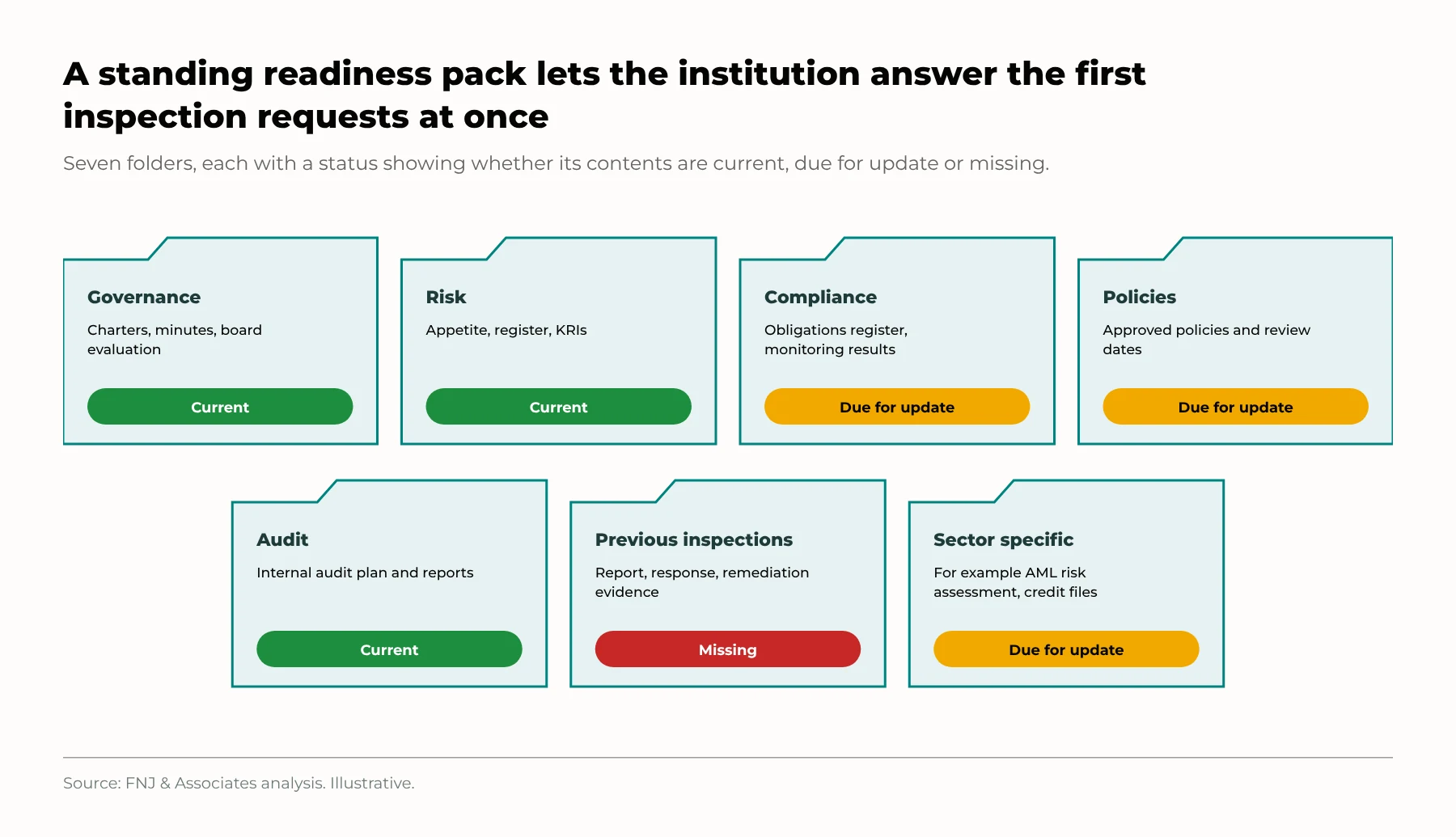
A standing readiness pack answers the first requests at once
Most regulatory inspections begin with requests for the same core documents, so the institution should keep a current pack ready at all times. The contents vary by sector, but the core is consistent.
| Area | Typical documents |
|---|---|
| Governance | Board and committee charters, minutes for the past two years, board evaluation results, organisation chart |
| Risk | Risk appetite statement, risk register, risk assessments, key risk indicators, risk committee reports |
| Compliance | Obligations register, compliance monitoring plan and results, breach log, regulatory returns |
| Policies | Current approved policies with approval dates and review schedule |
| Audit | Internal audit plan and reports, external audit management letters, status of all open findings |
| Previous inspections | Last inspection report, the institution’s response and evidence of remediation |
| Sector specific | For example anti-money laundering risk assessment, credit files, claims files, member records |
Keeping the pack current is far easier than assembling it under pressure. The act of maintaining it reveals gaps, such as a policy past its review date or a finding without evidence of closure, which can be fixed before an inspector finds them.
Previous findings deserve the closest attention
Inspectors almost always start with the findings from the last regulatory inspection, because unresolved findings suggest that the institution does not act on supervisory concerns. The institution should be able to show, for each previous finding, the action agreed, the evidence that it was implemented and the evidence that it is working.
The standard for closure should be the same as the one our article on closing audit findings sets out: the action completed, the control operating and the risk reduced. A finding marked closed on the strength of a memo will not satisfy an inspector who tests the control.
A single coordinator keeps the regulatory inspection orderly
Every inspection should have one coordinator, usually from the compliance function, who receives all requests, assigns them to the right owners, tracks deadlines and reviews responses before they are released. A request log, recording each request, the owner, the date due, the date provided and any follow-up, gives the coordinator and senior management a clear view of progress.
Reviewing documents before release does not mean withholding or editing them. It means checking that the version provided is the correct and current one, that it answers the request and that any context the inspector needs is provided alongside it.
Interviews benefit from preparation, not scripting
Inspectors interview board members, executives and staff to understand how processes work in practice. Staff should be briefed on the purpose of the inspection, reminded to answer truthfully and within their knowledge, and encouraged to say when they do not know and to offer to find out, rather than guessing.
Directors should be ready to explain how the board oversees risk and compliance, how it challenges management and how it followed up the last inspection’s findings. A short briefing for directors before the inspection, covering the institution’s risk profile and the status of open matters, helps them answer with confidence.
Daily wrap-ups surface issues early
Where inspectors are willing, a brief daily meeting to review progress and any emerging observations allows the institution to correct misunderstandings, provide missing information and prepare responses while the inspection is still under way. Issues raised for the first time in a draft report are much harder to resolve.
The draft report should be checked for accuracy and answered with a plan
When the draft report arrives, the institution should check every finding for factual accuracy and respond with evidence where something is wrong, while accepting findings that are fair. For each accepted finding, the response should set out a specific action, an owner and a realistic date, because regulators judge institutions as much on the quality of their remediation plans as on the findings themselves.
Remediation should be tracked to closure before the next visit
After the regulatory inspection, each finding becomes an action tracked with the same discipline as an audit finding. The board or its committee should receive a regular report on progress, and the compliance function or internal audit should validate closure before the institution reports to the regulator that a matter has been resolved.
Many regulators ask for periodic progress updates, and an institution that meets every reporting deadline with evidence of genuine progress builds credibility that will carry into its next inspection.
Thematic reviews and off-site requests need the same discipline
Supervisors increasingly run thematic reviews across several institutions, on topics such as cyber security, consumer protection or anti-money laundering controls, and they request information off-site between inspections. These requests deserve the same coordinator, log and review as an on-site inspection, because the responses form part of the supervisor’s view of the institution.
Five weaknesses recur in inspection readiness
- No standing pack, so the first days of the inspection are spent assembling documents.
- Previous findings marked closed without evidence that the remedy works.
- Requests answered directly by many staff, with no coordinator or log.
- Policies and board minutes that cannot be produced in their final approved versions.
- Remediation plans with vague actions and dates that are later missed.
A mock regulatory inspection tests readiness before the real one
A mock regulatory inspection, carried out by internal audit or an external adviser using the regulator’s published guidelines and the themes of recent supervisory findings, gives the institution a realistic test of its readiness. It reveals documents that cannot be found, controls that do not operate as described and staff who are unsure how processes work, while there is still time to correct them.
The mock exercise also rehearses the protocol, since running requests through the coordinator, testing the response times and practising interviews with directors and managers builds confidence and shows senior management where the process needs strengthening.
Board involvement signals that the institution takes supervision seriously
Supervisors pay close attention to the role of the board. A board that receives regular reports on regulatory matters, discusses the last regulatory inspection report in full, approves the remediation plan and monitors its progress demonstrates the kind of oversight supervisors expect, and that record will be visible in the minutes the inspectors read.
Some institutions invite the regulator to present its findings directly to the board or a board committee at the end of an inspection. Where the regulator agrees, this gives directors an unfiltered view of the supervisor’s concerns and shows the supervisor that the board is engaged.
Data and reporting systems are increasingly in scope
Supervisors now test the accuracy of regulatory returns, the integrity of the data behind them and the controls over the systems that produce them. Institutions should be able to show how each significant return is prepared, reviewed and reconciled to source data, and who approved it before submission, since errors in returns are a common finding in a regulatory inspection.
Data protection is also a growing area of attention, with the Office of the Data Protection Commissioner able to inspect how institutions handle personal data. The readiness pack should therefore include the data protection registration, records of processing, impact assessments and the breach log.
Lessons from each regulatory inspection should reach the whole institution
Findings in one area often point to weaknesses that exist elsewhere, such as a policy not followed in one branch that is likely to be unevenly applied in others. After each regulatory inspection, the compliance function should ask whether each finding could apply more widely, extend the remediation where it does, and share the lessons with business units that were not inspected this time.
The same lessons should feed the compliance monitoring plan for the following year, so that the themes regulators are testing are also tested internally before the next visit.
Over successive cycles, institutions that follow these practices usually find that each regulatory inspection runs more smoothly than the last, with fewer requests outstanding, fewer findings and a supervisory relationship built on confidence in the institution’s own records, its board’s oversight and its willingness to correct what the inspectors find.
Three moves for the next quarter
- Assemble the readiness pack against the seven areas, and record any documents that are missing or out of date.
- Validate the closure of every finding from the last regulatory inspection, with evidence that each remedy works.
- Name an inspection coordinator and agree the request log and review protocol with senior management.
How we support your institution
FNJ & Associates carries out inspection readiness reviews, mock inspections, validation of remediation and support during and after regulatory inspections for banks, SACCOs, insurers, fintechs and regulated NGOs. We also build the compliance obligations register and compliance monitoring plan that make readiness a continuous state rather than a project.
Trigarc Compliance, implemented by FNJ, keeps obligations, evidence, regulatory findings and corrective actions in one place, so that the documents an inspector asks for can be produced from current records.
Questions about regulatory inspection
How should an institution prepare for a regulatory inspection?
An institution should keep a standing readiness pack of core governance, risk, compliance, policy and audit documents, validate the closure of previous findings and name a coordinator to manage requests during the inspection.
What do regulators usually ask for first?
Regulators usually ask for board and committee minutes, policies, risk assessments, compliance and audit reports, and evidence on the findings from the previous inspection.
Should staff be briefed before inspector interviews?
Yes, staff should be briefed on the purpose of the inspection and encouraged to answer truthfully within their knowledge, saying when they do not know rather than guessing.
How should an institution respond to a draft inspection report?
It should check every finding for factual accuracy, provide evidence where something is wrong and respond to accepted findings with specific actions, owners and realistic dates.
What happens if previous findings are not resolved?
Unresolved findings suggest that the institution does not act on supervisory concerns, which can lead to escalated supervisory action and colours the regulator’s view of the whole institution.
What is a mock regulatory inspection?
A mock regulatory inspection is a rehearsal carried out by internal audit or an external adviser, using the regulator’s guidelines and recent supervisory themes, to test the institution’s documents, controls, staff knowledge and inspection protocol before a real inspection.
Who should coordinate a regulatory inspection?
A single coordinator, usually from the compliance function, should receive all requests, assign them to owners, track deadlines in a request log and review responses before release, with regular updates to senior management.
Can FNJ & Associates help us prepare for a regulatory inspection?
Yes, FNJ & Associates carries out readiness reviews and mock inspections and supports institutions during and after inspections, and the firm can be reached through fnjassociates.co.ke to request a proposal.
Request a proposal for an inspection readiness review
FNJ & Associates helps regulated institutions across Kenya and East Africa keep their evidence ready, manage inspections well and close findings before the next visit.
About FNJ & Associates
FNJ & Associates is an ICPAK-registered CPA firm and a multidisciplinary team of 20+ professionals holding CPA(K), ACCA, CIA, CISA, CFE, CEH, CAMS and CIPP/E credentials, serving more than 100 organisations across Kenya and East Africa. The firm provides governance, risk and compliance advisory, including AML/CFT, anti-bribery and data protection, and implements Trigarc Compliance for obligation tracking, evidence and corrective actions. Visit fnjassociates.co.ke to learn more.