
Risk-based testing, planned across the year and reported with its evidence, gives the board assurance that attestations alone cannot provide.
A compliance monitoring plan sets out what the compliance function will test during the year, how and when, so that the institution knows whether its obligations are being met. Banks, SACCOs, insurers, fintechs and regulated NGOs in Kenya and East Africa are increasingly expected by regulators to show such a plan and its results.
Many compliance functions still rely mainly on attestation, asking business units to confirm each quarter that they have complied with the relevant rules. Attestations are quick to collect, but they record what managers believe rather than what the evidence shows, and regulators who find breaches that were attested as compliant draw conclusions about the compliance function as well as about the business.
A risk-based plan replaces attestation with testing for the obligations that matter most. This article sets out how to build the plan, choose methods, rate and report results, and connect the plan to the compliance obligations register, as part of our compliance services in Kenya.
Monitoring is how the compliance function knows rather than assumes
International practice treats monitoring as a core compliance activity, and ISO 37301:2021, the standard for compliance management systems, includes monitoring, measurement and compliance reporting among its requirements, and sector regulators in Kenya expect compliance functions to test the effectiveness of controls over regulatory obligations, not only to advise on them.
Monitoring also protects the compliance function itself, because when a breach comes to light, a compliance officer who can show a plan, the testing performed and the issues raised stands on firm ground, while one who can show only collected attestations does not.
A compliance monitoring plan starts from the obligations register
The plan should be built from the institution’s obligations register, so that every material obligation is either tested during the cycle or consciously excluded with a reason. Starting from the register prevents the common problem of a plan that tests the same familiar areas each year while new obligations go unexamined.
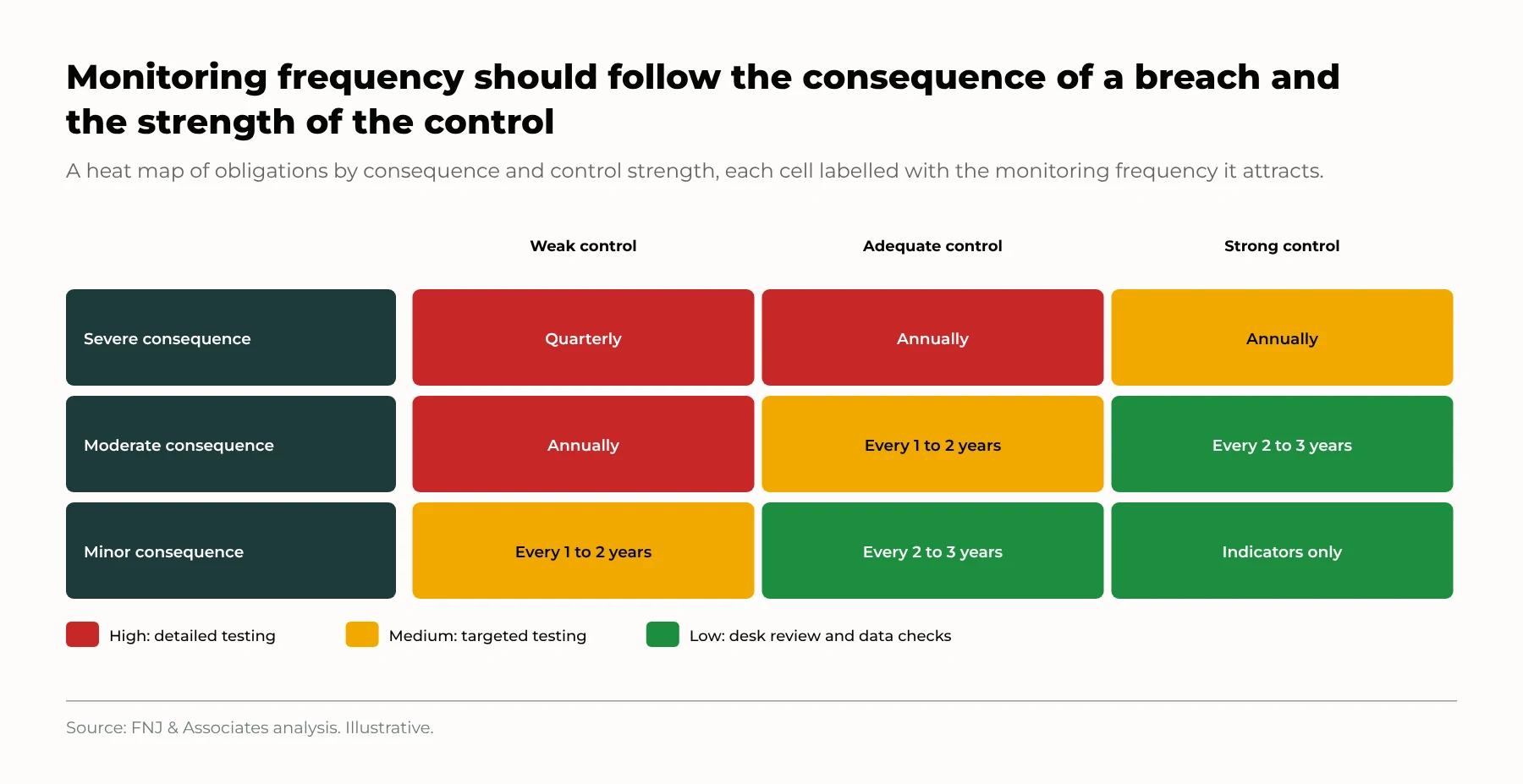
Each obligation in the register is assessed for compliance risk, considering the consequence of a breach, the complexity of the requirement, the quality of the controls in place, the results of previous monitoring and any recent regulatory change. The assessment determines how often and how deeply the obligation is tested.
Risk determines how often each area is tested
| Compliance risk | Illustrative monitoring frequency | Typical depth |
|---|---|---|
| High | At least annually, some areas quarterly | Detailed testing of samples or whole populations |
| Medium | Every one to two years | Targeted testing of key controls |
| Low | Every two to three years, or through indicators | Desk review and data checks |
High-risk areas for a bank or SACCO typically include anti-money laundering controls, customer due diligence, regulatory reporting and consumer protection, while insurers add claims handling and intermediary oversight, and fintechs add data protection and payment system rules. The compliance monitoring plan should show this risk ranking explicitly so that the board can see why coverage is allocated as it is.
Five monitoring methods give different kinds of evidence
| Method | What it involves | Best suited to |
|---|---|---|
| Desk review | Reviewing policies, procedures, reports and returns | Confirming that requirements are documented and returns submitted |
| File testing | Examining a sample of customer or transaction files | Customer due diligence, credit files, claims files |
| Data analytics | Testing whole populations of transactions or records | Transaction monitoring, pricing, reporting accuracy |
| Thematic review | Examining one issue across several business units | Conduct, complaints, a new regulation |
| Mystery shopping or observation | Experiencing a process as a customer would | Sales practices, disclosures, branch conduct |
Most compliance monitoring plans combine these methods, using data analytics wherever the data allows because it tests every record rather than a sample. File testing remains essential for judgements that data cannot capture, such as whether the due diligence on a high-risk customer was adequate.
Test scripts make monitoring consistent and reviewable
Each monitoring activity should have a short script that states the obligation tested, the control expected, the population and sample, the test steps and the evidence required. Scripts allow different compliance officers to reach consistent conclusions, make the work reviewable by the head of compliance and internal audit, and shorten the time needed to repeat a test in a later cycle.
Findings should be rated and owned
Every exception found in monitoring should be recorded as a finding with a rating, an owner and an agreed action, using a scale consistent with the one internal audit uses so that the board can compare findings from both sources. Findings that suggest a reportable breach should be escalated immediately, since many regulators expect notification within a defined period.
Follow-up completes the cycle, so the compliance function should re-test after the action is implemented, and it should track open findings with the same discipline that internal audit applies when closing audit findings.
Attestation still has a place, alongside testing
Attestation is not worthless, because it requires managers to consider their obligations and to take personal responsibility for their statements. It works best when it is combined with testing, so that the compliance monitoring plan samples attested areas and the results show whether attestations can be relied upon.
Where testing finds that an area attested as compliant was not, the gap is itself a finding, and it tells the board something important about the reliability of attestation in that part of the business.
Reporting should show coverage as well as results
The board and its committees need to know not only what monitoring found but how much of the obligations universe it covered. A quarterly compliance report should show progress against the compliance monitoring plan, the share of high-risk obligations tested in the cycle, the findings by rating and area, and the status of open actions.
A coverage view is especially valuable when resources are tight. If the plan cannot be completed, the report shows which high-risk areas remain untested, allowing the board to decide whether to add resources or to accept the gap explicitly.
The plan should adapt during the year
A compliance monitoring plan approved at the start of the year will need to change as new regulations arrive, incidents occur and business priorities shift. The head of compliance should review the plan each quarter, add reviews where new risks have emerged and report any changes to the committee, so that the plan remains risk-based throughout the year rather than only at approval.
Five weaknesses recur in compliance monitoring
- Monitoring that relies on attestation without any testing.
- Plans that repeat the same areas each year regardless of risk.
- No link between the plan and the obligations register.
- Findings recorded but not followed up or re-tested.
- Reports that describe activity but say nothing about coverage.
Anti-money laundering controls deserve a dedicated section of the plan
For reporting institutions, anti-money laundering and counter-terrorist financing controls usually carry the heaviest regulatory consequences, so the compliance monitoring plan should give them a dedicated section. Typical tests cover customer due diligence for new and existing customers, enhanced due diligence for higher-risk customers, the effectiveness of transaction monitoring alerts, the timeliness of suspicious transaction reports, sanctions screening and record keeping.
Data analytics is particularly effective here, since it can test every customer file for missing identification, every alert for the time taken to close it and every payment against sanctions lists. The results give the money laundering reporting officer and the board far stronger evidence than a small sample could provide.
Resourcing the compliance monitoring plan is a board decision
A plan that cannot be completed with the resources available is a statement of intent, not assurance. The head of compliance should estimate the effort each review requires, compare it with the team’s capacity and present the result to the committee, which can then decide whether to add staff, use outsourced or co-sourced support, or accept a narrower plan with the gaps stated explicitly.
Co-sourcing is often the most practical answer for specialist areas, such as data analytics, information technology or a new regulatory regime, because it brings the skills for the period they are needed without permanent cost.
Coordination with internal audit avoids duplication
The compliance monitoring plan and the internal audit plan should be shared and coordinated, so that the two functions do not test the same area in the same quarter while other areas go untested. Internal audit can then rely on compliance monitoring where it has assessed its quality, and focus its own work on the effectiveness of the compliance function and on areas where the second line does not test.
A combined view of planned coverage, shared with the audit and risk committees, shows directors how assurance over regulatory obligations is divided between the two functions and where gaps remain.
Regulators look for the plan, the evidence and the follow-up
When supervisors examine a compliance function, they typically ask to see the approved compliance monitoring plan, the risk assessment that supports it, a sample of completed reviews with their evidence, and the record of findings and their resolution. A function that can produce all four quickly demonstrates that monitoring is embedded in the way it works, which shapes the supervisor’s view of the institution’s whole compliance framework.
Keeping completed reviews in a consistent format, with scripts, evidence and conclusions held together, is the simplest way to be ready for that request. It also makes the work easier to hand over when compliance staff change, which protects continuity in small teams.
Over successive cycles, the results of monitoring also show where compliance risk is falling and where it persists, which lets the compliance function shift its effort towards the areas where testing continues to find problems and reduce it where controls have proved reliable over several years, so that the compliance monitoring plan becomes sharper and more efficient with each cycle.
Three moves for the next quarter
- Rank the obligations in the register by compliance risk, and identify the high-risk areas that have not been tested in the past year.
- Write test scripts for the five highest-risk areas and schedule them in the next two quarters.
- Add a coverage measure to the compliance report, showing the share of high-risk obligations tested in the cycle.
How we support your institution
FNJ & Associates designs compliance monitoring plans, writes test scripts, performs monitoring on an outsourced or co-sourced basis and reviews the effectiveness of compliance functions for boards and regulators. Our compliance work follows the model of Prevent, Detect, Respond, and monitoring is the core of the Detect stage.
Trigarc Compliance, implemented by FNJ, links each obligation to its monitoring results, records findings and corrective action plans, and reports coverage and results to the board.
Applicants for a VASP licence in Kenya will need monitoring of this kind from their first licensed month, when monthly returns to the regulator begin.
Questions about the compliance monitoring plan
What is a compliance monitoring plan?
A compliance monitoring plan is a risk-based schedule of the tests the compliance function will perform during the year to check whether the institution is meeting its legal, regulatory and internal obligations.
How is compliance monitoring different from internal audit?
Compliance monitoring is performed by the second line to test compliance with specific obligations on an ongoing basis, while internal audit is independent and provides assurance on the whole control framework, including the effectiveness of the compliance function.
Is attestation enough for compliance monitoring?
Attestation alone records what managers believe, so it should be combined with testing that checks a sample of attested areas against evidence.
How often should the compliance monitoring plan be updated?
The plan should be approved annually and reviewed each quarter, with changes made when new regulations, incidents or business changes alter the risk profile.
What should be reported to the board about compliance monitoring?
The board should see progress against the plan, the coverage of high-risk obligations, findings by rating and area, and the status of open actions.
Should compliance monitoring use data analytics?
Yes, wherever the data allows, because analytics can test whole populations of customers or transactions, which gives stronger evidence than a sample and makes it practical to repeat the test each period.
Who approves the compliance monitoring plan?
The head of compliance prepares the compliance monitoring plan and the board, usually through its risk or audit committee, approves it, together with the resources needed to complete it and any changes made during the year.
Can FNJ & Associates design our compliance monitoring plan?
Yes, FNJ & Associates designs risk-based plans, writes test scripts and performs monitoring on an outsourced or co-sourced basis, and the firm can be reached through fnjassociates.co.ke to request a proposal.
Request a proposal for your compliance monitoring plan
FNJ & Associates helps compliance functions across Kenya and East Africa move from attestation to testing, with risk-based plans, consistent scripts and reporting that shows coverage and results.
About FNJ & Associates
FNJ & Associates is an ICPAK-registered CPA firm and a multidisciplinary team of 20+ professionals holding CPA(K), ACCA, CIA, CISA, CFE, CEH, CAMS and CIPP/E credentials, serving more than 100 organisations across Kenya and East Africa. The firm provides governance, risk and compliance advisory, including AML/CFT, anti-bribery and data protection, and implements Trigarc Compliance for obligation tracking, evidence and corrective actions. Visit fnjassociates.co.ke to learn more.