

A policy on policies, a single register and a review cycle tied to change turn a collection of documents into a control the board can rely on.
Policy management is the set of arrangements by which an institution decides which policies it needs, writes and approves them, keeps them current, communicates them to staff and confirms that they are followed. Banks, SACCOs, insurers, fintechs, NGOs, public bodies and corporates across Kenya and East Africa all rely on policies to translate board decisions and legal obligations into daily practice.
Most institutions have accumulated dozens of policies over many years, each written by a different function in a different format. When a regulator, an auditor or the board asks which version is current, who approved it, when it was last reviewed and whether staff have read it, the answers often take days to assemble. They reveal policies that are years past their review date, that overlap or that contradict one another.
Seven elements turn a collection of documents into a working control: a policy on policies, a single register, clear ownership, a review cycle tied to change, recorded approval, attestation by staff and periodic testing. This article sets out each element, as part of our compliance services in Kenya.
A policy on policies sets the rules for every other policy
International standards such as ISO 37301 treat documented policies as a core element of a compliance management system. The starting point for sound policy management is a short policy, approved by the board, that defines what a policy is, how it differs from a procedure or a guideline, who may approve each level of document, how often each must be reviewed and what format every policy must follow. Without it, each function sets its own rules and the institution ends up with documents of uneven quality and authority.
| Document level | Purpose | Typical approver |
|---|---|---|
| Board policy | Sets principles, appetite and accountability for a significant area | Board or board committee |
| Management policy | Sets rules for an area within the board’s principles | Executive committee or chief executive |
| Procedure | Describes how a process is performed | Head of function |
| Guideline or standard | Gives practical guidance or technical requirements | Head of function or specialist owner |
Clarity about levels prevents two common problems in policy management: boards are spared approving operational procedures that management should own, and important principles are not left in procedures that change without board oversight.
A single register shows every policy and its status
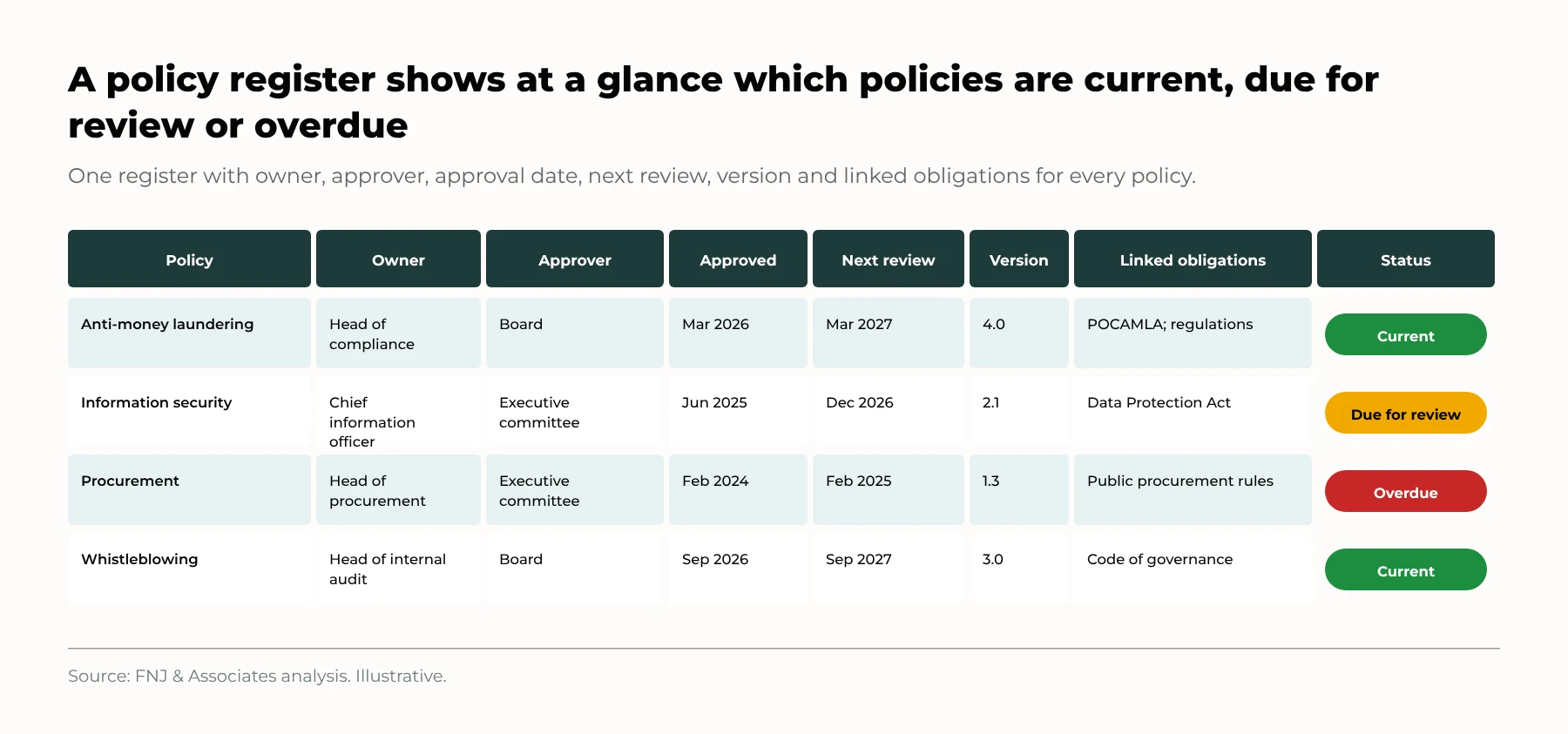
Every policy, procedure and guideline should be listed in one register that records its owner, approver, approval date, next review date, current version and the obligations or risks it addresses. The register is the institution’s answer to the question of which documents are in force, and it should be the only place staff go to find the current version.
Linking each policy to the obligations it meets, as recorded in the compliance obligations register, shows whether every significant obligation is covered by a policy and whether any policy exists without a clear purpose.
Every policy needs one accountable owner
Each policy should have a named owner, usually the head of the function most affected, who is responsible for keeping it current, answering questions about it and proposing changes when circumstances change. Shared ownership tends to mean no ownership, and policies without an owner are the ones most likely to fall out of date.
The compliance function or the company secretary should coordinate the framework, maintain the register and remind owners of upcoming reviews, but it should not own the content of every policy, since that would separate the policy from the people who apply it.
Review should follow change as well as the calendar
Most institutions set a regular review period for each policy, commonly between one and three years depending on its significance, and some sector guidelines, such as the Central Bank of Kenya’s prudential guidelines for banks, set expectations for particular policies. A calendar review alone is not enough, because the policy may become outdated as soon as a law changes, a new product is launched or an incident reveals a gap.
The policy on policies should therefore name the events that trigger an early review, such as a change in law or regulation, a significant audit or inspection finding, a new product, system or market, a major incident and a reorganisation that changes responsibilities.
Approval records make policy management defensible
Every approved policy should carry an approval record showing who approved it, when, and in which meeting or decision, with a reference to the minutes or resolution. Inspectors and auditors routinely ask for this evidence, and a policy that cannot be shown to have been approved by the right authority may carry little weight.
A version history, showing what changed in each revision and why, helps reviewers and staff understand how the policy has developed. It allows the institution to show which version was in force on a particular date when a past decision is questioned.
Attestation confirms that staff have read the policies that apply to them
Publishing a policy on the intranet does not mean that staff have read it. Requiring the people to whom a policy applies to confirm that they have read and understood it, when they join, when the policy changes significantly and periodically thereafter, gives the institution evidence of communication and reminds staff of their obligations.
Attestation works best when it is targeted at the people a policy actually governs. Asking every employee to attest to every policy produces fatigue and careless clicking, while asking each role to attest only to the policies that govern its work produces more meaningful confirmations and a clearer record.
Testing shows whether policies are followed
A current, approved and attested policy is still only a statement of intent. The compliance monitoring plan and internal audit should test whether significant policies are followed in practice, for example by sampling transactions against the approval limits in a credit policy, or recruitment files against the vetting requirements in a human resources policy.
Where testing shows that a policy is routinely not followed, the institution must decide whether to enforce it, change it or retire it. A policy that everyone ignores is worse than no policy, because it creates a documented expectation that the institution knowingly fails to meet.
Simplification improves compliance
Long, dense policies are hard to follow, and a consistent template with a purpose statement, scope, key requirements, roles and responsibilities, and references to related procedures makes policies easier to read, while consolidating overlapping documents reduces the number staff must know and removes contradictions between them.
Five weaknesses recur in policy management
- No policy on policies, so each function sets its own format, approval and review rules.
- Several versions of the same policy in circulation, with no single register of the current one.
- Policies years past their review date, or never reviewed after a change in law.
- No record of who approved a policy or when.
- No evidence that staff have read the policies that apply to them, and no testing of whether they are followed.
Sector context shapes the policy set
Banks, SACCOs and insurers carry policies required by their regulators, covering areas such as credit, liquidity, anti-money laundering, outsourcing, information security and business continuity, and supervisors examine them closely during inspections. Fintechs must add data protection, consumer protection and technology risk policies as they grow.
NGOs maintain policies demanded by donors, including safeguarding, anti-fraud, procurement and conflict of interest, and they must often show donors that partners follow equivalent policies. Corporates and public bodies add policies for procurement, health and safety, delegation of authority and ethics. The seven elements of policy management apply in each case, whatever the size of the institution.
Policy management should connect to risk and obligations
Each significant policy exists to manage one or more risks and to meet one or more obligations. Recording those links in the register allows the institution to see which risks rely on a policy as a key control, to check whether a policy change affects the institution’s risk profile, and to identify obligations that have no policy behind them, which are often the gaps an inspector finds first.
When the risk function updates the risk register or the compliance function adds a new obligation, the policy owner should be told, so that the policy can be reviewed against the change. This feedback loop is what keeps policy management aligned with the institution’s actual risks rather than with the risks it faced when each policy was first written.
Exceptions to policy need a controlled route
Every policy will occasionally need to be set aside for a good reason, such as an urgent payment outside normal approval channels or a supplier engaged before full due diligence is complete. The policy on policies should define how exceptions are requested, who may approve them, how long they last and how they are recorded, so that exceptions remain visible and do not become a quiet alternative to the policy itself.
A periodic report of exceptions by policy, function and approver shows the board where policies are under pressure. Frequent exceptions to the same requirement often mean that the policy needs to change, while repeated exceptions approved by the same person deserve closer attention.
Retired policies should be archived, not deleted
When a policy is replaced or withdrawn, the old version should be archived with its approval history rather than deleted. Regulators, auditors and courts sometimes need to know which rules applied when a past decision was made, and an archive of superseded versions, linked to the current one, provides that answer quickly and protects the institution in disputes.
Smaller institutions can keep policy management light
A SACCO, a growing fintech or a mid-sized NGO does not need an elaborate system to apply these elements. A two-page policy on policies, a spreadsheet register with owners and review dates, a standing item on the board or committee agenda for policies due for approval and a short annual attestation deliver most of the value of mature policy management, and they can move into a compliance platform as the institution grows.
Three moves for the next quarter
- Approve a policy on policies that defines document levels, approvers, review periods and the events that trigger early review.
- Build one policy register listing every document, its owner, approval date, next review date and linked obligations.
- Prioritise the overdue policies that address the most significant obligations, and schedule their review.
How we support your institution
FNJ & Associates reviews policy frameworks, drafts policies on policies, builds policy registers linked to compliance obligations and tests whether significant policies are followed. Our compliance work follows the model of Prevent, Detect, Respond, and sound policy management is the foundation of prevention.
Trigarc Compliance, implemented by FNJ, holds policies with their owners, approvals, versions and review dates, links them to obligations and records staff attestations, with reminders when reviews fall due.
Questions about policy management
What is policy management?
Policy management is the set of arrangements by which an institution decides which policies it needs, writes and approves them, keeps them current, communicates them to staff and confirms that they are followed.
What is a policy on policies?
A policy on policies is a short board-approved document that defines the levels of policy documents, who approves each level, the format they follow, how often they are reviewed and what triggers an early review.
How often should policies be reviewed?
Most institutions review policies every one to three years depending on their significance, and also review them early when laws, products, systems or responsibilities change or when an incident or finding reveals a gap.
Why ask staff to attest to policies?
Attestation gives evidence that staff have read and understood the policies that apply to their roles and reminds them of their obligations, especially when it is targeted to the policies relevant to each role.
How do we know whether policies are followed?
Compliance monitoring and internal audit should test significant policies by sampling transactions, files or decisions against the requirements the policy sets.
How should exceptions to a policy be handled?
Exceptions should follow a defined route, with a request, an approver of appropriate authority, a time limit and a record in the register, and the board should receive a periodic report of exceptions by policy and approver.
Who should own a policy?
Each policy should have one named owner, usually the head of the function most affected, while the compliance function or company secretary coordinates the framework and maintains the register.
Can FNJ & Associates review our policy framework?
Yes, FNJ & Associates reviews policy frameworks, builds policy registers linked to obligations and tests compliance with policies, and the firm can be reached through fnjassociates.co.ke to request a proposal.
Request a proposal for a policy framework review
FNJ & Associates helps institutions across Kenya and East Africa keep every policy owned, current, approved, read and followed.
About FNJ & Associates
FNJ & Associates is an ICPAK-registered CPA firm and a multidisciplinary team of 20+ professionals holding CPA(K), ACCA, CIA, CISA, CFE, CEH, CAMS and CIPP/E credentials, serving more than 100 organisations across Kenya and East Africa. The firm provides governance, risk and compliance advisory, including AML/CFT, anti-bribery and data protection, and implements Trigarc Compliance for obligation tracking, evidence and corrective actions. Visit fnjassociates.co.ke to learn more.