

One map of assurance providers against principal risks, with a common rating of strength, turns separate reports into a coherent view for the audit committee.
Combined assurance is the practice of coordinating the work of every assurance provider in an institution so that, together, they give the board a complete and efficient view of how well the principal risks are managed. Banks, insurers, state corporations, listed companies and large NGOs in Kenya and East Africa all receive assurance from several sources, which makes coordination increasingly valuable.
Those sources usually work separately, as management, risk, compliance, internal audit, external audit, regulators and specialist reviewers each plan their own work and report through their own channels. As a result, some areas are tested several times in the same year while others receive no assurance at all, and the board cannot easily tell which is which.
A single assurance map, a common rating of assurance strength and a coordinated calendar resolve this. This article sets out how to build each, as part of our internal audit services in Kenya and East Africa.
The three lines model provides the foundation for combined assurance
The Institute of Internal Auditors’ Three Lines Model describes how management, the second-line risk and compliance functions and internal audit contribute to governance. The Global Internal Audit Standards expect internal audit to coordinate with other assurance providers and to consider relying on their work. Combined assurance turns those expectations into a working arrangement that the audit committee can see and direct.
The concept is well established in the region, having been promoted by the King IV Report in South Africa, and audit committees in Kenya increasingly ask for a combined view rather than separate reports from each provider.
An institution typically has seven assurance providers
| Provider | Line | Typical focus |
|---|---|---|
| Management and control owners | First | Day-to-day operation and self-testing of controls |
| Risk management | Second | Risk assessments, indicators, appetite monitoring |
| Compliance | Second | Regulatory obligations and compliance testing |
| Other specialist functions | Second | Information security, health and safety, quality, safeguarding |
| Internal audit | Third | Independent assurance across the risk framework |
| External audit | External | Financial statements and related controls |
| Regulators and other external reviewers | External | Supervisory inspections, donor reviews, certifications |
The assurance map plots providers against principal risks
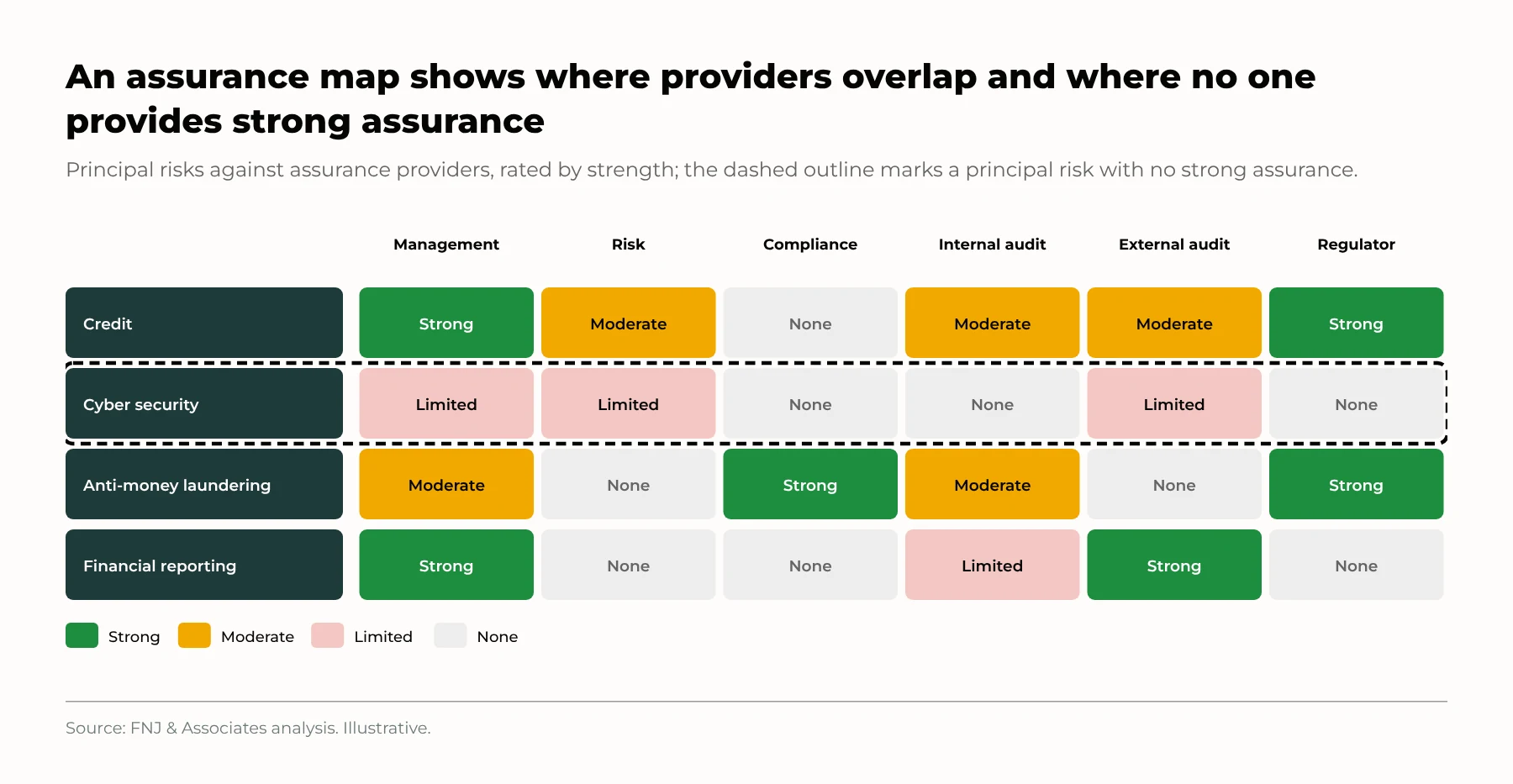
The core of combined assurance is a map with the institution’s principal risks as rows and the assurance providers as columns. Each cell records whether that provider gives assurance over that risk, when it last did so and how strong the assurance was, which allows the audit committee to see the whole picture on a single page.
| Principal risk | Management | Risk | Compliance | Internal audit | External audit | Regulator |
|---|---|---|---|---|---|---|
| Credit | Strong | Moderate | None | Moderate | Moderate | Strong |
| Cyber security | Limited | Limited | None | None | Limited | None |
| Anti-money laundering | Moderate | None | Strong | Moderate | None | Strong |
| Financial reporting | Strong | None | None | Limited | Strong | None |
The illustrative map shows the value immediately, because credit and anti-money laundering receive assurance from several directions, while cyber security, one of the most significant risks for most institutions, receives only limited assurance from anyone, which is exactly the kind of gap the audit committee needs to see.
A common rating of assurance strength makes the map comparable
For the map to be meaningful, every provider’s work must be rated on the same scale. A simple four-point scale works well: strong, where the provider tested the key controls with sound evidence in the past year; moderate, where testing was partial or older; limited, where the provider relied mainly on enquiry or self-assessment; and none, where the provider did not cover the risk.
Rating strength requires some judgement about the quality of each provider’s work. Internal audit is usually best placed to make that judgement, having reviewed the methods of the second line and understood the scope of external audit and regulatory work. The ratings should be agreed with each provider before they are reported.
Gaps and overlaps drive the next year’s plans
Once the map is complete, each provider can adjust its plan. A principal risk with no strong assurance from any provider is a candidate for a review by internal audit or a specialist, while a risk tested heavily by several providers may allow one of them to redirect its effort, which is where combined assurance delivers its efficiency.
Overlap is not always wasteful, since the board may want independent confirmation of the most critical risks. The point is that overlap should be deliberate, agreed and visible, rather than an accident of separate planning.
Reliance on other providers needs clear criteria
Internal audit can reduce its own testing where another provider’s work is reliable, but reliance should rest on an assessment of that provider’s independence, competence, methodology and evidence. Re-performing a sample of the other provider’s tests, at least initially, gives internal audit a sound basis for reliance and tells the audit committee how far the second line’s results can be trusted.
Our article on management control testing describes the kind of first-line programme on which internal audit can place reliance once its quality has been confirmed.
A shared calendar and taxonomy make coordination practical
Combined assurance depends on providers using the same list of principal risks, the same rating scales for findings and a shared calendar of planned work. A short annual planning meeting between the heads of risk, compliance, internal audit and, where appropriate, the external auditor allows each to see what the others intend and to adjust timing so that business units are not visited by three teams in the same month.
The audit committee needs a short combined report
The combined assurance report to the audit committee should be brief: the assurance map, the principal risks with limited or no assurance, the significant findings from all providers in the period and the actions agreed to close gaps. This replaces several separate presentations with one coherent view and gives the committee a basis for directing assurance effort where it is most needed.
Our article on the questions every audit committee should ask includes several that a combined report can answer directly, such as which high risks receive no assurance this year.
Five weaknesses recur in combined assurance
- Providers using different risk lists, so their work cannot be mapped against the same rows.
- Assurance strength rated generously, so the map shows more assurance than exists.
- A map produced once and never updated as plans change.
- Reliance placed on other providers without any assessment of their work.
- No change in plans after the map reveals gaps, so the exercise becomes a report rather than a tool.
Sector context shapes the providers and the risks
Banks and insurers have well-developed second lines and frequent regulatory inspections, so combined assurance for them focuses on coordinating many providers and reducing duplication. State corporations must also consider the supreme audit institution and parent ministry reviews, while listed companies add the requirements of their governance code.
Large NGOs coordinate internal audit with donor audits, verification missions and partner reviews, which often cover the same grants and can overwhelm programme teams if they are not planned together. The map, the strength scale and the shared calendar help in every case.
Combined assurance should cover emerging risks as well as established ones
Assurance providers naturally gravitate towards risks they know how to test, such as credit, financial reporting and regulatory compliance. Emerging risks, including artificial intelligence, climate effects, new digital channels and third-party technology dependence, often receive little assurance from anyone, because no provider yet has an established method for them.
Including emerging risks as rows on the assurance map makes this visible. The audit committee can then decide whether to commission a specialist review, ask internal audit to develop a new approach or accept that assurance will build over time, which is a far better position than discovering the gap after an incident.
Combined assurance also reduces the burden on the business
Business units often experience assurance as a series of separate visits, questionnaires and evidence requests from different teams, sometimes asking for the same documents within weeks of each other. Coordinating timing and sharing evidence between providers, where independence allows, reduces that burden noticeably and improves cooperation with every provider.
A shared evidence repository helps, because when the evidence for a control test performed by the second line is stored where internal audit can review it, internal audit need not request the same documents again. The business sees one coordinated assurance effort rather than several competing ones.
Board risk and audit committees should share the map
Where an institution has separate audit and risk committees, both benefit from seeing the same assurance map. The risk committee learns how well the risks it oversees are being tested, and the audit committee learns which parts of the control environment rely on second-line work, so that neither committee assumes the other has a matter covered.
Combined assurance matures over two or three cycles
Few institutions produce a complete and accurate assurance map in the first year. The first map usually relies on judgement and reveals gaps in information about what each provider actually covered, while the second and third cycles bring better data, agreed ratings and plans that respond to the map, at which point combined assurance becomes the way assurance is planned rather than a report produced after the event.
Starting with the principal risks and the three or four main providers, and adding specialist and external providers later, keeps the first cycle manageable and gives the audit committee a useful view from the outset.
The investment pays back quickly, because the audit committee gains a single view of assurance, providers reduce duplicated work and the business experiences fewer, better coordinated reviews that respect its time and give each provider the evidence it needs from a single request.
Three moves for the next quarter
- Agree one list of principal risks for all assurance providers to use.
- Build a first assurance map for the current year, rating each cell on the four-point scale.
- Present the map to the audit committee with the risks that have limited or no assurance and a proposal to close the most significant gap.
How we support your institution
FNJ & Associates builds combined assurance maps, assesses the reliability of second-line work, coordinates assurance planning and designs combined reports for audit committees. We also provide outsourced and co-sourced internal audit and external quality assessments.
Trigarc, implemented by FNJ, holds risks, controls, tests, audit findings and compliance results in one platform, so the assurance map can be drawn from the records of every provider rather than assembled by hand.
Questions about combined assurance
What is combined assurance?
Combined assurance is the coordination of all assurance providers in an institution, including management, risk, compliance, internal audit, external audit and regulators, so that together they give the board a complete and efficient view of how the principal risks are managed.
What is an assurance map?
An assurance map shows the institution’s principal risks against its assurance providers, recording for each combination whether assurance is provided, when and how strong it is.
Who should lead combined assurance?
Internal audit usually coordinates combined assurance because of its independence and its view across the institution, working with the heads of risk and compliance and reporting to the audit committee.
Does combined assurance reduce the work of internal audit?
It can, where internal audit is able to rely on other providers whose work it has assessed, allowing it to redirect effort to risks that receive little assurance.
How often should the assurance map be updated?
The map should be refreshed at least annually as plans are set, and updated during the year when significant reviews are completed or plans change.
What is the difference between combined assurance and the three lines model?
The three lines model describes the roles of management, risk and compliance functions and internal audit, while combined assurance is the practice of coordinating those roles and external providers so that their work covers the principal risks without gaps or unnecessary overlap.
How is assurance strength rated on the map?
Many institutions use a four-point scale, rating assurance as strong where key controls were tested with sound evidence in the past year, moderate where testing was partial or older, limited where it relied on enquiry or self-assessment, and none where the risk was not covered.
Can FNJ & Associates build our combined assurance map?
Yes, FNJ & Associates builds assurance maps, assesses second-line work and designs combined reports for audit committees, and the firm can be reached through fnjassociates.co.ke to request a proposal.
Request a proposal for combined assurance
FNJ & Associates helps audit committees and assurance providers across Kenya and East Africa see where assurance overlaps, where gaps remain and how to direct effort where it matters most.
About FNJ & Associates
FNJ & Associates is an ICPAK-registered CPA firm and a multidisciplinary team of 20+ professionals holding CPA(K), ACCA, CIA, CISA, CFE, CEH, CAMS and CIPP/E credentials, serving more than 100 organisations across Kenya and East Africa. The firm provides audit and assurance, internal audit, and IT and cybersecurity audits, and implements Trigarc Audit for audit planning, execution, reporting and follow-up. Visit fnjassociates.co.ke to learn more.