
Status as of 19 November 2026. In force; no provider licensed yet. Sources are listed at the end.
For any VASP, Kenya now requires a licence before serving Kenyan customers. The right regulator, capital of up to KES 300m and a complete 21-item file decide how quickly a provider can start.
A VASP licence in Kenya is now a live application rather than a future requirement, since the one-year transition for existing operators ended on 04 November 2026. That transition began when the Virtual Asset Service Providers (VASP) Act, 2025 came into force on 04 November 2025. In a joint public notice on 13 November 2026, the Central Bank of Kenya (CBK) and the Capital Markets Authority (CMA) directed persons providing or intending to provide virtual asset services to apply to the relevant regulator. The notice set no filing deadline and confirmed that no provider had yet been licensed under the Act.
An applicant needs three things in place: the right licence category, capital of up to KES 300m and a complete 21-item application file. The regulator decides within 30 days, but the clock starts only when the file is complete, so this guide covers the three requirements in turn. It forms part of FNJ & Associates’ work on GRC advisory in Kenya for financial institutions and fintechs.
Companies serving customers in or from Kenya need a VASP licence
The Act requires a licence before a person carries on, or holds itself out as carrying on, virtual asset services in or from Kenya. The Regulations read that phrase widely, covering a provider that actively solicits or targets Kenyan consumers, or earns income from Kenya, whether or not it has a physical presence. Foreign platforms with Kenyan users therefore fall within scope, even when they have no local office.
Only a company limited by shares may apply, whether it is incorporated in Kenya or is a foreign company registered under the Companies Act. Providing virtual asset services without a licence is an offence, with fines of up to KES 25m for a company.
Two regulators issue the VASP licence in Kenya, split by service
The First Schedule to the Act splits the ten virtual asset services between the two regulators, and a business that offers services under both regulators applies to both.
| Virtual asset service | Regulator |
|---|---|
| Wallet provider (custodial wallets) | CBK |
| Payment processor | CBK |
| Stablecoin issuance | CBK |
| Exchange | CMA |
| Broker | CMA |
| Investment adviser | CMA |
| Virtual asset manager | CMA |
| Initial coin offering | CMA |
| Tokenisation of real-world assets | CMA |
| Token issuance platform | CMA |
Source: First Schedule, Virtual Asset Service Providers Act, 2025.
A provider that converts virtual assets to or from foreign currency also needs a separate CBK authorisation. The CBK decides those applications within ten days, and the authorisation runs to 31 December of the year of issue.
A VASP licence in Kenya costs KES 60,000 to KES 2.1m in first-year fees
Fees are the smaller part of the cost of a VASP licence in Kenya: the First Schedule to the Regulations sets an application fee and a licence fee for the ten categories. Together they range from KES 60,000 for an investment adviser to KES 2.1m for a stablecoin issuer.
| Licence category | Application fee | Licence fee | First-year fees |
|---|---|---|---|
| Investment adviser | KES 10,000 | KES 50,000 | KES 60,000 |
| Broker | KES 100,000 | KES 100,000 | KES 200,000 |
| Virtual asset manager | KES 50,000 | KES 200,000 | KES 250,000 |
| Payment processor | KES 100,000 | KES 200,000 | KES 300,000 |
| Wallet provider | KES 100,000 | KES 500,000 | KES 600,000 |
| Initial coin offering | KES 100,000 | KES 500,000 | KES 600,000 |
| Tokenisation | KES 100,000 | KES 500,000 | KES 600,000 |
| Token issuance platform | KES 100,000 | KES 500,000 | KES 600,000 |
| Exchange | KES 100,000 | KES 1,000,000 | KES 1,100,000 |
| Stablecoin issuance | KES 100,000 | KES 2,000,000 | KES 2,100,000 |
Source: First Schedule, Virtual Asset Service Providers Regulations, 2026 (Legal Notice No. 134). First-year fees are the sum of the two fees.
Offerings carry a further approval fee, as the CMA charges 0.25% of the value of a successful initial coin offering or tokenisation, subject to a minimum of KES 200,000 and a maximum of KES 30m. Renewal fees for wallet providers, exchanges, offering providers and stablecoin issuers are the higher of a fixed sum and a share of turnover.
CBK and CMA capital requirements range from nil to KES 300m
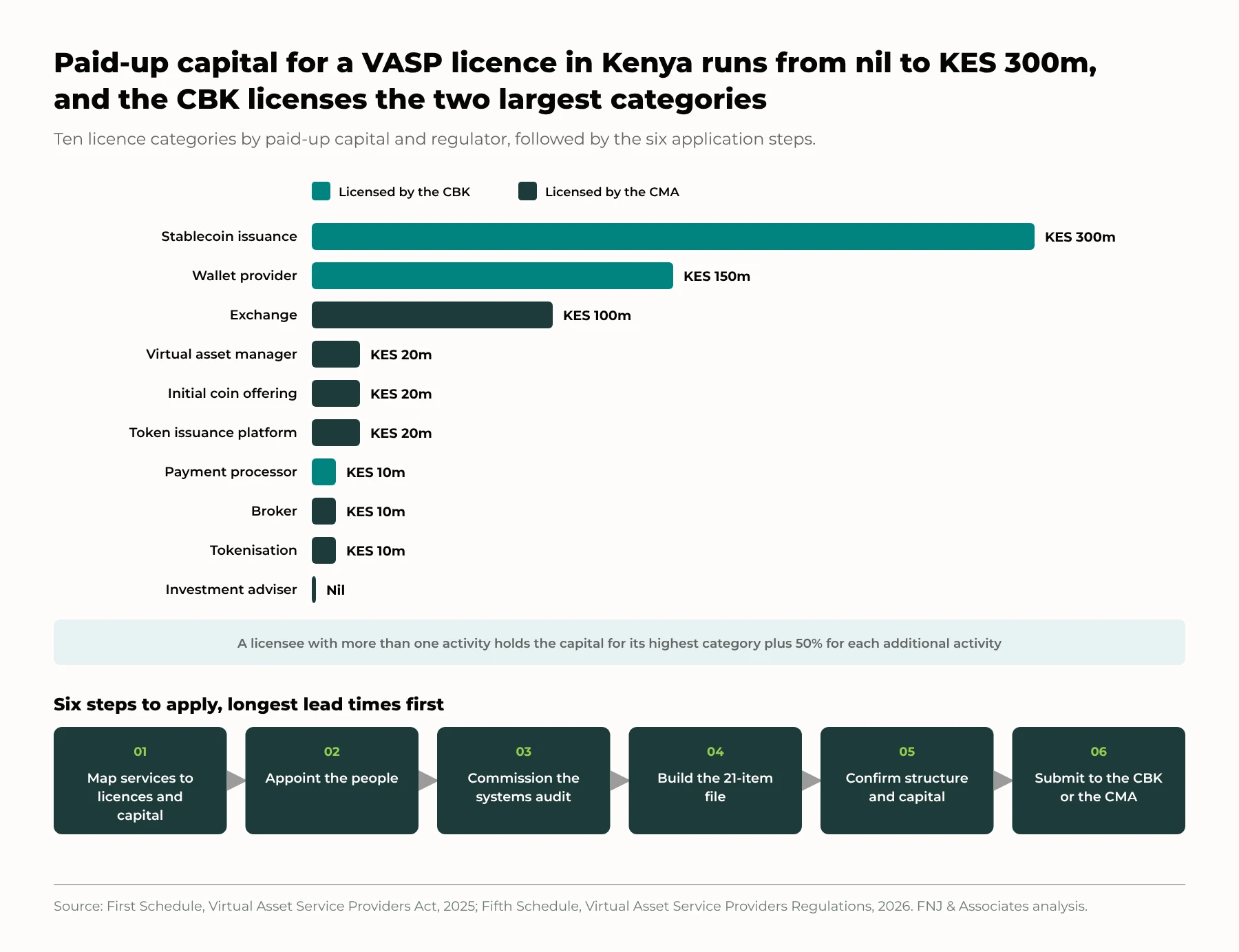
Capital is the larger commitment, and the Fifth Schedule sets paid-up and liquid capital for the ten categories.
| Licence category | Paid-up capital | Liquid capital |
|---|---|---|
| Investment adviser | Nil | Nil |
| Payment processor | KES 10m | 100% of current liabilities for 30 days |
| Broker | KES 10m | KES 2m or 8% of total liabilities, whichever is higher |
| Tokenisation | KES 10m | KES 2m or 8% of total liabilities, whichever is higher |
| Virtual asset manager | KES 20m | KES 4m or 8% of total liabilities, whichever is higher |
| Initial coin offering | KES 20m | KES 4m or 8% of total liabilities, whichever is higher |
| Token issuance platform | KES 20m | KES 4m or 8% of total liabilities, whichever is higher |
| Exchange | KES 100m | KES 20m or 8% of total liabilities, whichever is higher |
| Wallet provider | KES 150m | KES 30m or 100% of current liabilities for 30 days, whichever is higher |
| Stablecoin issuance | KES 300m | KES 60m or 100% of current liabilities for 30 days, whichever is higher |
Source: Fifth Schedule, Virtual Asset Service Providers Regulations, 2026.
A licensee with more than one activity holds the capital for its highest category plus 50% per additional activity. Licences are renewed annually, with the renewal application due at least two months before expiry. Budgets should also cover costs the Regulations create outside the fee schedule: insurance, the independent information systems audit, audited financial statements and qualified finance, internal audit and compliance staff.
VASP licence requirements: the 30-day decision starts only when the file is complete
Regulation 6(2) lists 21 items that accompany an application, lettered (a) to (u), and the application form in the Second Schedule turns them into a checklist of 30 attachments. An applicant for a VASP licence in Kenya can use that checklist as the index of the submission file.
| Group | What the file contains |
|---|---|
| Company | Memorandum and articles, certificate of incorporation, CR12 (the Registrar’s record of directors and shareholders), BOF1 (the beneficial ownership form), tax compliance certificate, ownership and organisational charts |
| People | Personal details, fit and proper forms and source-of-funds declarations for directors, senior officers, significant shareholders and beneficial owners |
| Plan and policies | Business plan in the Third Schedule format, and written policies covering risk, anti-money laundering, counter-terrorist financing and counter-proliferation financing (AML/CFT/CPF), data protection, cybersecurity, complaints, market conduct, consumer protection, conflicts of interest and business continuity |
| Money | Application fee, evidence of paid-up and liquid capital, insurance, audited financial statements, schedule of proposed fees |
| Systems | Independent information systems audit with a vulnerability assessment and penetration test, systems and controls, business rules and market integrity controls |
| Operations | Bankers, auditors and custodians, outsourcing and custody agreements, consumer terms, clearing and settlement process, cross-border operations |
Source: regulation 6(2) and the Second Schedule, Virtual Asset Service Providers Regulations, 2026.
Three details catch applicants out, starting with the declaration, which at least two directors sign before a Commissioner for Oaths or a magistrate. Directors, senior officers, significant shareholders and beneficial owners also complete a fit and proper form with a current credit reference bureau report and three referees. Finally, regulation 6(2) requires three years of audited financial statements while the form requires two, so FNJ & Associates advises applicants to prepare three.
The regulator may interview the applicant, and it decides within 30 days of receiving the required documents and completing its due diligence. An incomplete file therefore delays the decision rather than shortening the work, and a licensee must start business within 12 months of the grant.
Disclaimer: this checklist summarises regulation 6(2) and the Second Schedule for general guidance as of 19 November 2026. It is not legal advice and does not replace the Regulations or a regulator’s own checklist. Confirm requirements with the CBK or the CMA before you file.
A VASP licence in Kenya brings continuing duties for the board, controls and client assets
Applicants that design for these duties at the outset avoid rework after the licence is granted, and are better placed for regulatory inspection readiness from the first year.
Board and management: the board has at least three directors, of whom one third are independent, and the chairperson or a director cannot also be the chief executive. The chief executive is fit and proper, competent in virtual assets or a related field, and domiciled in Kenya.
Control functions: the board appoints a compliance officer with direct access to it. The persons who manage finance and internal audit are members in good standing of the Institute of Certified Public Accountants of Kenya (ICPAK) or an equivalent recognised body. External auditors are ICPAK members, are approved by the regulator and serve no more than four consecutive financial years, as our guide to VASP audit requirements in Kenya explains.
AML/CFT/CPF: a licensee is a reporting institution under the Proceeds of Crime and Anti-Money Laundering Act. It applies customer due diligence before onboarding, complies with targeted financial sanctions and keeps transaction records for seven years. The Act also prohibits mixers, tumblers and other anonymity-enhancing services, and our guide to VASP AML compliance in Kenya covers the programme in detail.
Customer disclosures: before any transaction, a licensee discloses its licence status, fees, conflicts of interest and complaints procedure. It also gives a full statement of the risks of the virtual asset and the service, including market volatility and cybersecurity.
Cybersecurity: a licensee appoints a chief information security officer or equivalent, and runs vulnerability assessments and penetration tests twice in its first licensed year and at least annually after that. It reports cybersecurity incidents to the regulator within 24 hours and files a detailed report within five working days.
Client assets: wallet providers segregate client holdings on separate addresses and ledgers, and do not lend or pledge them. Client and company accounts are held at a bank licensed in Kenya, and licensees carry insurance against cybersecurity risk, theft, loss of keys and operational failure.
Reporting calendar for a licensee
| Obligation | Timing |
|---|---|
| Monthly returns to the regulator | By the 10th day of the following month |
| Quarterly financial statements | By the 10th day after the quarter ends |
| Audited annual financial statements | Within three months of the 31 December year end |
| Business continuity plan test | Annually |
| Licence renewal application | At least two months before expiry |
| Outsourcing agreements | Regulator approval at least 30 days before implementation |
Source: regulations 11, 21, 24, 26, 92, 95 and 113, Virtual Asset Service Providers Regulations, 2026; section 29 of the Act.
Licensees meet these dates more reliably when they run them as a system rather than as separate diary entries. A statutory compliance calendar gives deadlines an owner, a backup and a record, and a compliance monitoring plan tests the controls behind them. Because outsourcing needs regulator approval, a third-party risk assessment of custodians and technology providers should come before the 30-day notice.
How to apply for a VASP licence in Kenya: six steps, longest lead times first
- Map services to licences and capital: list the services, including custody, conversion and payments, then match them to categories and regulators and size capital under the 50% rule.
- Appoint the people: seat the board, the Kenya-domiciled chief executive, the compliance officer and the ICPAK-qualified finance and internal audit leads, since recruitment usually takes longest.
- Commission the independent systems audit: complete the vulnerability assessment and penetration test, and close the findings before filing so that the report supports the application.
- Build the file: prepare the business plan, a policy set with owners and review dates, financial statements and fit and proper forms, using the Second Schedule checklist as the index.
- Confirm structure and capital: incorporate or register a company limited by shares, place the capital and obtain the letter from the principal banker that the file requires.
- Submit and respond: file with the CBK ([email protected]) or the CMA ([email protected]), answer information requests and prepare for the interview.
The CBK and the CMA will publish lists of licensed providers, and customers, banks and counterparties will check them before dealing with a provider. Applicants that start steps 2 and 3 this month will be best placed to file a complete application early and to appear on those lists sooner.
Frequently asked questions
Is crypto legal in Kenya?
Yes, because the Virtual Asset Service Providers Act, 2025 regulates virtual asset services rather than prohibiting them. A business that provides those services needs a VASP licence in Kenya from the CBK or the CMA. Users can check a provider against the lists the two regulators will publish before they open an account.
Which VASPs are licensed in Kenya?
None yet: in their joint public notice of 13 November 2026, the CBK and the CMA stated that they had not licensed any VASPs under the Act to operate in or from Kenya. The two regulators will publish lists of licensed providers, and users, banks and counterparties should check those lists before dealing with a provider.
Is there a deadline for a VASP licence in Kenya?
Existing operators had one year from the Act’s commencement, and that period ended on 04 November 2026. The Act sets no further window, and the joint notice of 13 November 2026 sets no filing deadline, although it directed providers and intending providers to apply.
How long does a Kenya VASP license take?
The regulator decides within 30 days of receiving the required documents and completing its due diligence, but the clock starts only when the file is complete. The overall timeline depends on recruiting the board and control functions, completing the independent systems audit and assembling that complete file. A licensee then starts business within 12 months of the grant.
How much does a VASP licence in Kenya cost?
First-year fees range from KES 60,000 for an investment adviser to KES 2.1m for a stablecoin issuer. Paid-up capital ranges from nil to KES 300m, including KES 100m for an exchange and KES 150m for a wallet provider, while insurance, audits and qualified staff add to the cost.
Can a foreign crypto exchange serve customers in Kenya?
Only with a licence, because the Regulations cover a platform that targets Kenyan consumers or earns income from Kenya, even without a local office. A foreign company applies once registered under the Companies Act, with a chief executive domiciled in Kenya and accounts at a bank licensed in Kenya.
Where is the VASP licence application checklist?
The application form and its checklist of 30 attachments are in the Second Schedule to the Virtual Asset Service Providers Regulations, 2026, and the fit and proper forms are in the Fourth Schedule. The CBK and the CMA said on 13 November 2026 that licensing checklists are also available on their websites.
Can FNJ & Associates prepare the application?
Yes: FNJ & Associates prepares the application for a VASP licence in Kenya, including the business plan and projections, the policy set and the fit and proper documentation. For applicants that use another adviser for the file, our team can instead conduct the independent information systems audit, the external audit or AML/CFT audits. Independence rules keep these advisory and audit roles separate for a given client, so contact [email protected] to agree the right role and request a proposal.
Further reading
Prepare your VASP licence application
FNJ & Associates helps exchanges, wallet providers, payment processors and token issuers prepare a complete application for the CBK or the CMA, with practical support that runs from licence mapping and capital planning to the final submission.
Request a VASP licence proposal Book a Trigarc demo with FNJ
About this research. Requirements, fees and capital are from the Virtual Asset Service Providers Act, 2025 and the Virtual Asset Service Providers Regulations, 2026 (Legal Notice No. 134), read on 13 and 14 November 2026 and reviewed on 19 November 2026, and from the CBK and CMA joint public notice of 13 November 2026. Groupings, sequencing and implications are FNJ analysis.
Sources. Virtual Asset Service Providers Act, 2025 (Kenya Law); Virtual Asset Service Providers Regulations, 2026, Legal Notice No. 134 (Kenya Law; CMA copy); CBK and CMA joint public notice, 13 November 2026.
Disclaimer. This article is general information as of 19 November 2026. It is not legal, tax or financial advice. Confirm requirements with the CBK, the CMA and your legal counsel before you act.
About FNJ & Associates
FNJ & Associates is an ICPAK-registered CPA firm and a multidisciplinary team of 20+ professionals holding CPA(K), ACCA, CIA, CISA, CFE, CEH, CAMS and CIPP/E credentials, serving more than 100 organisations across Kenya and East Africa. The firm provides licence application support, AML/CFT audits, compliance and risk advisory, and internal audit for financial institutions and fintechs, and implements Trigarc Compliance to track regulatory obligations and reporting. Visit fnjassociates.co.ke to learn more.