

In force since 15 September 2026, the requirement asks auditors to assess the same governance, risk management and control processes whenever third-party risk is in scope.
The Institute of Internal Auditors’ Third-Party Topical Requirement took effect on 15 September 2026. It forms part of the International Professional Practices Framework and sets a baseline for internal audit whenever an assurance engagement covers the risks that arise from suppliers, outsourced service providers, agents, partners and other third parties.
Banks, insurers, fintechs, NGOs, state corporations and corporates in Kenya and East Africa depend heavily on third parties for technology, payments, distribution, programme delivery and support services. Internal audit has long reviewed procurement and vendor management, but the depth and focus of that work has varied from one engagement to the next and from one function to another.
The Third-Party Topical Requirement brings consistency by setting out the governance, risk management and control processes that auditors should assess. This article explains what it requires and how to apply it, as part of our internal audit services in Kenya and East Africa.
The Third-Party Topical Requirement is now mandatory for assurance work
According to The IIA, the Third-Party Topical Requirement was issued on 15 September 2025 and became effective on 15 September 2026, as a mandatory element of the framework. It applies when internal audit provides assurance services on third-party risk, whether in a dedicated third-party engagement or where third-party risk is a significant part of a wider engagement.
For advisory engagements, The IIA recommends but does not require use of topical requirements. Internal audit functions that follow the Global Internal Audit Standards will need to show conformance with the requirement in their next external quality assessment, so the methodology changes should be in place now.
Topical requirements set a baseline, not a full audit programme
Topical requirements describe the minimum aspects of governance, risk management and control that auditors must consider for a specific risk area. They do not replace professional judgement or the engagement’s own risk assessment, and they do not prevent auditors from going further where the risk justifies it.
Not every individual requirement will apply to every engagement, and where the auditor judges that a requirement does not apply, the reason must be documented and retained, which means the applicability assessment itself becomes part of the working papers that a quality assessor will review.
The requirement covers three areas of third-party management
| Area | What auditors assess (summarised) |
|---|---|
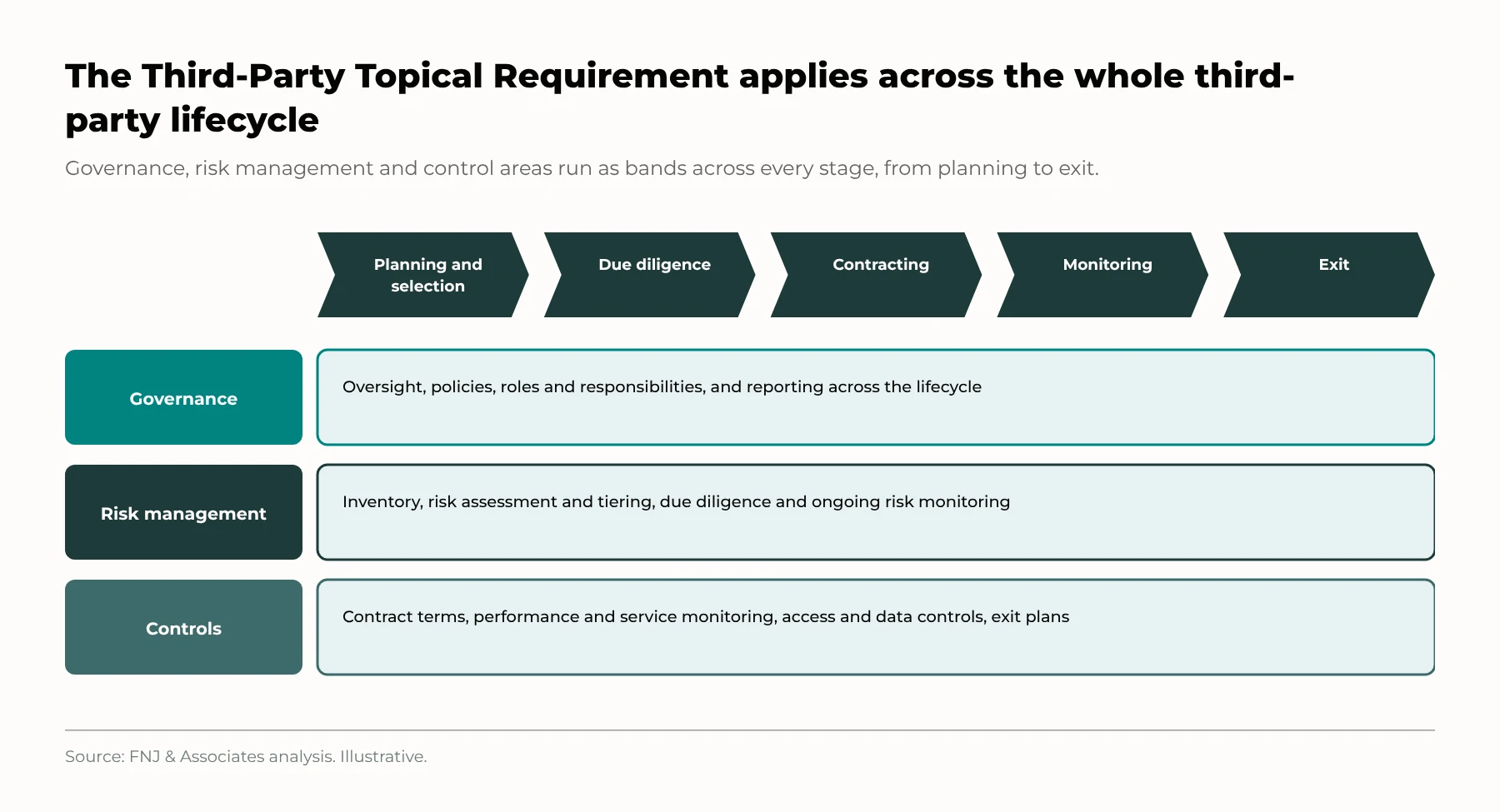
| Governance | Board and management oversight, policies and procedures, roles and responsibilities, and how third-party risk links to the organisation’s strategy and risk appetite |
| Risk management | How third parties are identified, inventoried, assessed and tiered, how due diligence is performed and how risks are monitored over the relationship |
| Controls | Contract terms, performance and service monitoring, access and data controls, issue management and the arrangements for ending a relationship |
These areas follow the lifecycle of a third-party relationship, from the decision to use a third party, through selection and contracting, to ongoing monitoring and exit. Our article on third-party risk assessment describes how management builds the processes that auditors will now assess against this baseline.
Governance questions start with the inventory
An organisation cannot manage third-party risk without knowing which third parties it relies on. Auditors applying the Third-Party Topical Requirement will usually begin by asking whether there is a complete inventory of third parties, whether each has an owner, and whether the board or a committee receives information on the most significant relationships.
Many organisations find that their inventory is incomplete, because supplier master files include every vendor that has ever been paid, while some critical relationships, such as data processors, agents or implementing partners, sit outside the procurement system altogether and are known only to the business unit that uses them.
Risk management questions focus on tiering and due diligence
The requirement expects auditors to assess how the organisation decides which third parties need the most attention. A sound approach tiers third parties by the criticality of the service and the sensitivity of the data or assets they handle, and it applies more thorough due diligence and more frequent monitoring to the highest tiers.
Auditors will look for evidence that due diligence was performed before contracting, that it covered relevant risks such as financial stability, information security, data protection, anti-bribery and business continuity, and that the results influenced the decision or the contract terms.
Control questions follow the relationship to its end
Contracts are the first control over a third party, and auditors will examine whether they include service levels, audit and information rights, data protection terms, subcontracting restrictions, incident notification and termination provisions. They will then assess whether performance is monitored against those terms and whether issues are escalated and resolved.
Exit arrangements are often overlooked in contracts and in audits alike. For critical services, the organisation should know how it would move to another provider or bring the service in-house, how its data would be returned or destroyed, and how long the transition would take, and auditors will ask whether those plans exist and have been tested.
Internal audit should update its methodology and plan
Applying the Third-Party Topical Requirement consistently means building it into the audit methodology. Most functions add a standard applicability checklist to the engagement planning template, map the requirement’s areas to their existing audit programmes, and record the applicability decision for each engagement where third-party risk is in scope.
The audit plan itself should also be reviewed against the organisation’s dependence on third parties. Where third-party risk is significant, the chief audit executive should consider whether the plan provides enough assurance over it, and should discuss with the audit committee any decision to defer such work. Our article on the internal audit charter explains how the charter supports access to third-party records and premises.
Sector context shapes the significant third parties
Banks and fintechs rely on core banking and payment providers, cloud services, agents and card processors, many of which are subject to supervisory expectations on outsourcing. Insurers depend on intermediaries, claims administrators and reinsurers, while state corporations and corporates rely on contractors, logistics providers and technology vendors.
NGOs work through implementing partners and sub-grantees who handle donor funds and deliver programmes in the field, which makes partner due diligence and monitoring central to any third-party engagement. The same three areas of the requirement apply in each case.
Five gaps recur when functions first apply the requirement
- No documented applicability assessment for engagements where third-party risk is in scope.
- Audit programmes that cover procurement but not ongoing monitoring or exit.
- Reliance on the supplier master file as a complete inventory of third parties.
- No review of whether due diligence results influenced contract terms.
- Third-party risk absent from the audit plan despite significant dependence on outsourced services.
Information security and data protection are central to third-party risk
Many of the most serious third-party failures involve data, whether a cloud provider suffers a breach, a payroll bureau mishandles staff records or a marketing agency uses customer data without a lawful basis. Auditors applying the Third-Party Topical Requirement should consider how the organisation assesses each third party’s information security and data protection controls, and whether the Data Protection Act 2019 obligations are reflected in contracts.
The IIA’s Cybersecurity Topical Requirement, which took effect earlier in 2026, may also apply where a third party provides or supports critical technology. Auditors should consider both requirements together when the engagement covers technology outsourcing.
Fourth parties extend the chain of risk
A third party often relies on its own suppliers for hosting, software, staff or logistics, and a failure at one of those fourth parties can interrupt the service just as surely as a failure at the third party itself. Auditors should ask whether the organisation knows which critical fourth parties support its most important services, and whether contracts require notice of material subcontracting.
Evidence of monitoring matters more than policy
Many organisations have a sound third-party policy but limited evidence that it operates. Under the Third-Party Topical Requirement, auditors will want to see performance reports reviewed by the relationship owner, issues logged and escalated, periodic reassessment of the highest-tier relationships and records of the decisions taken, because these are what show that the policy is applied in practice.
Where evidence is thin, the auditor’s finding should focus on the operation of the process rather than its design, and the recommendation should name the records management should keep so that the next engagement can rely on them.
Reporting to the audit committee should show the whole picture
Third-party findings are often spread across several engagements, such as procurement, information technology, finance operations and programme audits. A periodic summary for the audit committee, drawing together the significant third-party findings from every engagement and the status of related actions, helps directors see whether third-party risk is being managed well across the organisation.
Smaller functions can apply the requirement proportionately
A small internal audit function in a SACCO, a mid-sized NGO or a growing fintech may not perform a dedicated third-party audit every year. It can still apply the Third-Party Topical Requirement proportionately, by completing the applicability checklist whenever an engagement touches a significant third party, by focusing on the few relationships that matter most, and by using a co-sourced specialist where the technical depth required exceeds the team’s own skills.
Documenting that proportionate approach in the audit methodology, and agreeing it with the audit committee, gives the function a defensible position when its conformance is assessed.
Management benefits from the same baseline
Although the Third-Party Topical Requirement is addressed to internal auditors, it also gives management a useful checklist. Procurement, risk and business owners who know which governance, risk management and control processes auditors will assess can strengthen those processes in advance, and second-line functions can align their own third-party reviews with the same areas, which supports combined assurance and reduces duplicated requests to the business and to the third parties themselves.
Three moves for the next quarter
- Add a Third-Party Topical Requirement applicability checklist to the engagement planning template.
- Map existing audit programmes for procurement, outsourcing and technology vendors to the governance, risk management and control areas.
- Brief the audit committee on the requirement and confirm whether the current plan gives adequate assurance over third-party risk.
How we support your institution
FNJ & Associates helps internal audit functions apply the Third-Party Topical Requirement through methodology updates, applicability checklists and readiness reviews, and we perform third-party and outsourcing audits on an outsourced or co-sourced basis. Our external quality assessments include conformance with topical requirements, so functions can confirm their readiness before the next assessment cycle.
Trigarc Audit, implemented by FNJ, covers audit planning, execution, reporting and follow-up, so that applicability checklists, working papers and findings for third-party engagements are recorded in one place for review and quality assessment.
Questions about the Third-Party Topical Requirement
What is the IIA Third-Party Topical Requirement?
It is a mandatory element of The IIA’s professional framework that sets a baseline for internal audit assurance over the governance, risk management and control of third-party relationships.
When did the Third-Party Topical Requirement take effect?
The IIA issued it on 15 September 2025, and it became effective on 15 September 2026.
Does the requirement apply to every audit?
It applies to assurance engagements where third-party risk is in scope, and auditors must document the assessment of which individual requirements apply, while use in advisory engagements is recommended rather than required.
What happens if a requirement does not apply to an engagement?
The auditor must document why the requirement was judged not to apply and retain that rationale with the engagement records.
Will the requirement affect our external quality assessment?
Yes, functions that follow the Global Internal Audit Standards will need to show conformance with applicable topical requirements, so assessors are likely to review applicability assessments and related working papers.
Does the Third-Party Topical Requirement cover NGO implementing partners?
Where internal audit provides assurance over relationships with implementing partners or sub-grantees, those relationships are third-party relationships, so the requirement should be considered when planning the engagement.
Is the Third-Party Topical Requirement relevant to management?
Yes, although it is addressed to internal auditors, it shows management and second-line functions which governance, risk management and control processes auditors will assess, so they can strengthen those processes in advance.
Can FNJ & Associates help us apply the requirement?
Yes, FNJ & Associates updates audit methodology, prepares applicability checklists, performs third-party audits and includes topical requirements in external quality assessments, and the firm can be reached through fnjassociates.co.ke.
Request a proposal for third-party audit support
FNJ & Associates helps internal audit functions across Kenya and East Africa apply the Third-Party Topical Requirement and provide consistent assurance over outsourced risk.
About FNJ & Associates
FNJ & Associates is an ICPAK-registered CPA firm and a multidisciplinary team of 20+ professionals holding CPA(K), ACCA, CIA, CISA, CFE, CEH, CAMS and CIPP/E credentials, serving more than 100 organisations across Kenya and East Africa. The firm provides audit and assurance, internal audit, and IT and cybersecurity audits, and implements Trigarc Audit for audit planning, execution, reporting and follow-up. Visit fnjassociates.co.ke to learn more.