

The charter defines what internal audit may do, to whom it reports and what it may see, so an outdated charter weakens the function exactly when it is tested.
An internal audit charter is the document through which the board grants internal audit its mandate, its independence and its access to people, records and systems. Banks, SACCOs, insurers, NGOs, state corporations and corporates across Kenya and East Africa all need one, and audit committees rely on it whenever the scope or standing of the function is questioned.
Many charters were written years ago and have not been revisited since The Institute of Internal Auditors’ Global Internal Audit Standards took effect in January 2025. They may describe outdated reporting lines, omit advisory services, say little about the board’s own responsibilities or fail to address how the function coordinates with other assurance providers.
A current charter addresses each of these points and is reviewed by the board on a regular cycle. This article sets out what the charter should contain, how it protects the function, and how to keep it current, drawing on our internal audit services in Kenya and East Africa and our external quality assessment work.
The Standards make the internal audit charter a board responsibility
The Global Internal Audit Standards require the chief audit executive to develop and maintain an internal audit charter and the board to approve it. The Standards also expect the charter to set out the mandate of the function, its organisational position and reporting relationships, the scope and types of services it provides. The responsibilities of the board, senior management and the chief audit executive.
This places the charter firmly in the board’s hands, so when a dispute arises over access to information, over a request to exclude an area from audit or over the reporting line of the chief audit executive, the board-approved charter is the reference that settles it.
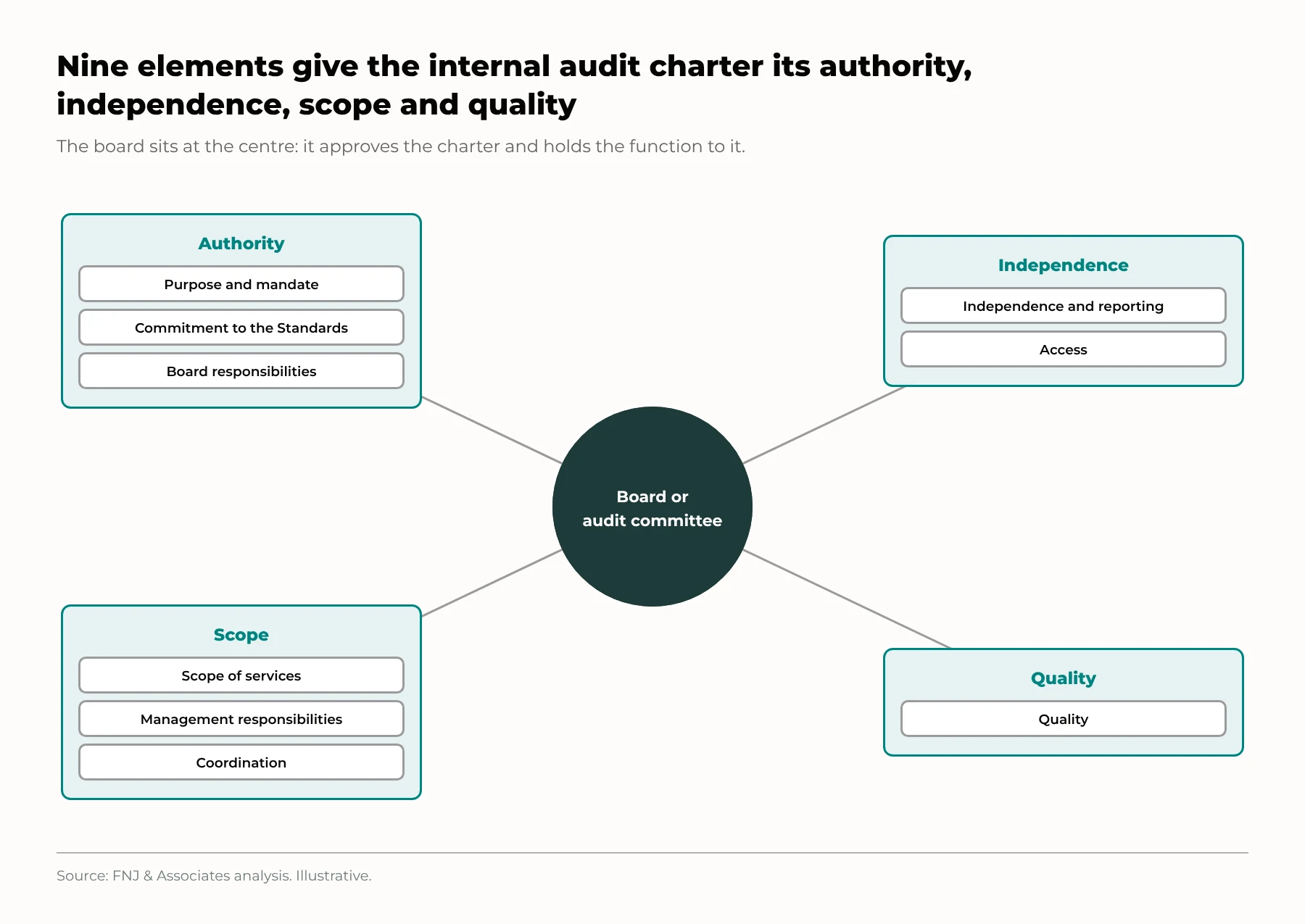
An internal audit charter should contain nine elements
| Element | What it should say |
|---|---|
| Purpose and mandate | Why the function exists and the authority the board grants it |
| Commitment to the Standards | That the function conforms with the Global Internal Audit Standards and any sector requirements |
| Independence and reporting | Functional reporting to the board or audit committee, administrative reporting to senior management |
| Access | Unrestricted access to people, records, systems and premises needed for its work |
| Scope of services | Assurance and advisory services, and any limits on advisory work to protect objectivity |
| Board responsibilities | Approving the charter, plan and budget, and the appointment and removal of the chief audit executive |
| Management responsibilities | Cooperating with audits, responding to findings and implementing agreed actions |
| Coordination | How internal audit relies on and coordinates with other assurance providers |
| Quality | The quality assurance and improvement programme, including external assessment |
Independence depends on the reporting line the charter defines
The charter should state that the chief audit executive reports functionally to the board or its audit committee and administratively to a senior executive, usually the chief executive. Functional reporting covers the approval of the charter, the audit plan, the budget and the appointment, evaluation and removal of the chief audit executive, which are the decisions that protect the function from undue influence.
The charter should also give the chief audit executive direct and unrestricted access to the board chair and the audit committee chair, including the right to meet them without management present. These provisions matter most when internal audit has to report something that senior management would prefer to keep from the board.
Access rights should be stated without qualification
An internal audit charter that grants access “subject to management approval” or “where appropriate” invites disputes. The charter should grant internal audit unrestricted access to all records, personnel, systems and physical premises relevant to its work, with an obligation on staff to cooperate and a route to the audit committee if access is refused.
For groups with subsidiaries, joint ventures or significant outsourced activities, the charter should also address access to those entities and to third parties, usually by requiring that contracts include audit rights. Without this, important parts of the institution’s operations may fall outside internal audit’s reach.
The charter should define both assurance and advisory services
Internal audit increasingly provides advisory services, such as reviews of new systems, support on control design and facilitation of risk workshops, alongside its assurance work. The charter should describe the advisory services the function may provide and the safeguards that protect its objectivity, such as not assuming management responsibilities and not auditing an area within a set period after advising on it.
These safeguards are especially important when internal audit provides project assurance on change programmes, where the line between advising and deciding can blur under deadline pressure.
The board’s own responsibilities belong in the charter
Older charters often describe only what internal audit does, but the Standards expect the board’s responsibilities to be stated too. These include approving the charter and the risk-based audit plan, ensuring the function has adequate resources, receiving and acting on internal audit reports, and appointing, evaluating and removing the chief audit executive.
Setting these out in the internal audit charter helps new directors understand their role and gives the chief audit executive a clear basis for raising concerns about resources or support with the audit committee.
Coordination with other assurance providers reduces duplication
Internal audit is one of several assurance providers, alongside risk management, compliance, external audit, regulators and specialist reviewers. The charter should describe how internal audit coordinates with them and when it may rely on their work, which supports a combined assurance approach and reduces the burden on the business.
Sector requirements may add to the charter
Some sectors impose additional expectations on internal audit, since banking regulators expect internal audit to report directly to the board audit committee and to cover specific areas, insurance and SACCO regulators have their own governance expectations, and public bodies operate under public finance management legislation that defines audit committee responsibilities.
NGOs often face donor expectations about internal audit coverage of grant expenditure and partner oversight. The internal audit charter should reference any requirements that apply to the institution so that the function’s mandate is complete.
The charter should be reviewed regularly
Most audit committees review the internal audit charter annually, or at least whenever the Standards, the institution’s structure or its regulatory requirements change. The review is a short exercise when the charter is well drafted, and it gives the committee a regular opportunity to confirm that the function’s mandate, independence and resources remain adequate.
External quality assessments, required by the Standards at least once every five years, routinely examine the charter. Our article on the external quality assessment of internal audit explains what assessors look for, and an outdated charter is one of the most common observations they make.
Five weaknesses recur in internal audit charters
- References to standards that have been superseded.
- Access granted only “where appropriate” or subject to management approval.
- No description of advisory services or the safeguards around them.
- No statement of the board’s own responsibilities.
- No record of when the charter was last reviewed and approved.
Each weakness can be corrected in a single revision, and the revised charter can be approved at the next audit committee meeting.
The internal audit charter should explain how the function plans its work
A short statement in the charter that internal audit prepares a risk-based plan, approved by the board and reviewed during the year as risks change, links the charter to the function’s day-to-day operation. The same section can confirm that the chief audit executive will report to the board on significant changes to the plan and on any limitation of scope or resources that prevents the plan from being completed.
Our article on the risk-based internal audit plan describes how the plan is built. The charter does not need that level of detail, but it should make clear that the board approves the plan and is told when the plan changes materially.
Reporting commitments in the charter set expectations for the board
The internal audit charter should state how and how often internal audit reports to the board, including periodic reports on the results of engagements, the status of agreed actions, the performance of the function against its plan and its conformance with the Standards. Stating these commitments gives the audit committee a basis for asking for reports it is not receiving.
The charter should also describe how internal audit communicates with senior management during and after each engagement, including the right of management to respond to findings before the final report is issued. Clear communication rules reduce disputes over findings and speed up the issue of reports.
Group structures need a charter that reaches every entity
Where a group has internal audit at the parent and in subsidiaries, or a single function serving several entities, the charters should be consistent and should state clearly which board approves the plan for each entity and to whom findings are reported. Without this clarity, subsidiary boards may receive less information than they need, and the group audit committee may not see issues that arise in the subsidiaries.
Subsidiaries in other countries may face local requirements that the group charter must respect. A short annex for each entity, approved by the local board, usually resolves this without fragmenting the group’s approach.
A short internal audit charter is easier to apply than a long one
The most effective charters run to three or four pages and use plain language, because directors, managers and auditors need to be able to read and apply them quickly. Detailed procedures belong in the internal audit manual, which the charter can reference, so that the charter itself remains a concise statement of authority that the board can review in a few minutes each year.
A brief explanatory note, circulated with the charter when it goes to the board, helps directors see what has changed since the last version and why. That note also gives the audit committee chair an easy basis for briefing the full board on the function’s mandate.
Three moves for the next quarter
- Compare the current internal audit charter with the nine elements and the Global Internal Audit Standards, and list the gaps.
- Revise the charter to close the gaps, with particular attention to access, reporting lines and advisory safeguards.
- Present the revised charter to the audit committee for approval, and set an annual review date.
How we support your institution
FNJ & Associates reviews and drafts internal audit charters, audit committee terms of reference and internal audit methodologies against the Global Internal Audit Standards and sector requirements. We also carry out external quality assessments and provide outsourced and co-sourced internal audit.
Trigarc Audit, implemented by FNJ, covers audit planning, execution, reporting and follow-up, giving the function the documented trail that charter commitments and quality assessments depend on.
Questions about the internal audit charter
What is an internal audit charter?
An internal audit charter is a formal document approved by the board that sets out the purpose, authority, independence, access, scope of services and responsibilities of the internal audit function.
Who approves the internal audit charter?
The board, usually through its audit committee, approves the internal audit charter, on a draft prepared by the chief audit executive in consultation with senior management.
How often should the internal audit charter be reviewed?
Most audit committees review the charter annually, and also whenever the Standards, the institution’s structure or its regulatory requirements change.
Does the charter need to cover advisory services?
Yes, the charter should describe the advisory services internal audit may provide and the safeguards that protect its objectivity, such as not assuming management responsibilities.
What happens if management refuses internal audit access?
The internal audit charter should give the chief audit executive a direct route to the audit committee, which can require management to provide the access the charter grants.
Does an internal audit charter need to mention the Global Internal Audit Standards?
Yes, the charter should state that the function conforms with the Global Internal Audit Standards, together with any sector-specific requirements, so that the board and management know the standard against which the function operates.
Should the audit committee have its own charter as well?
Yes, the audit committee usually has its own terms of reference approved by the board. These should be consistent with the internal audit charter on reporting lines, the approval of the plan and the appointment of the chief audit executive.
Can FNJ & Associates review our internal audit charter?
Yes, FNJ & Associates reviews and drafts charters against the Global Internal Audit Standards and carries out external quality assessments, and the firm can be reached through fnjassociates.co.ke to request a proposal.
Request a proposal for a charter review
FNJ & Associates helps audit committees and heads of internal audit across Kenya and East Africa bring their internal audit charter and methodology into line with the Global Internal Audit Standards.
About FNJ & Associates
FNJ & Associates is an ICPAK-registered CPA firm and a multidisciplinary team of 20+ professionals holding CPA(K), ACCA, CIA, CISA, CFE, CEH, CAMS and CIPP/E credentials, serving more than 100 organisations across Kenya and East Africa. The firm provides audit and assurance, internal audit, and IT and cybersecurity audits, and implements Trigarc Audit for audit planning, execution, reporting and follow-up. Visit fnjassociates.co.ke to learn more.