
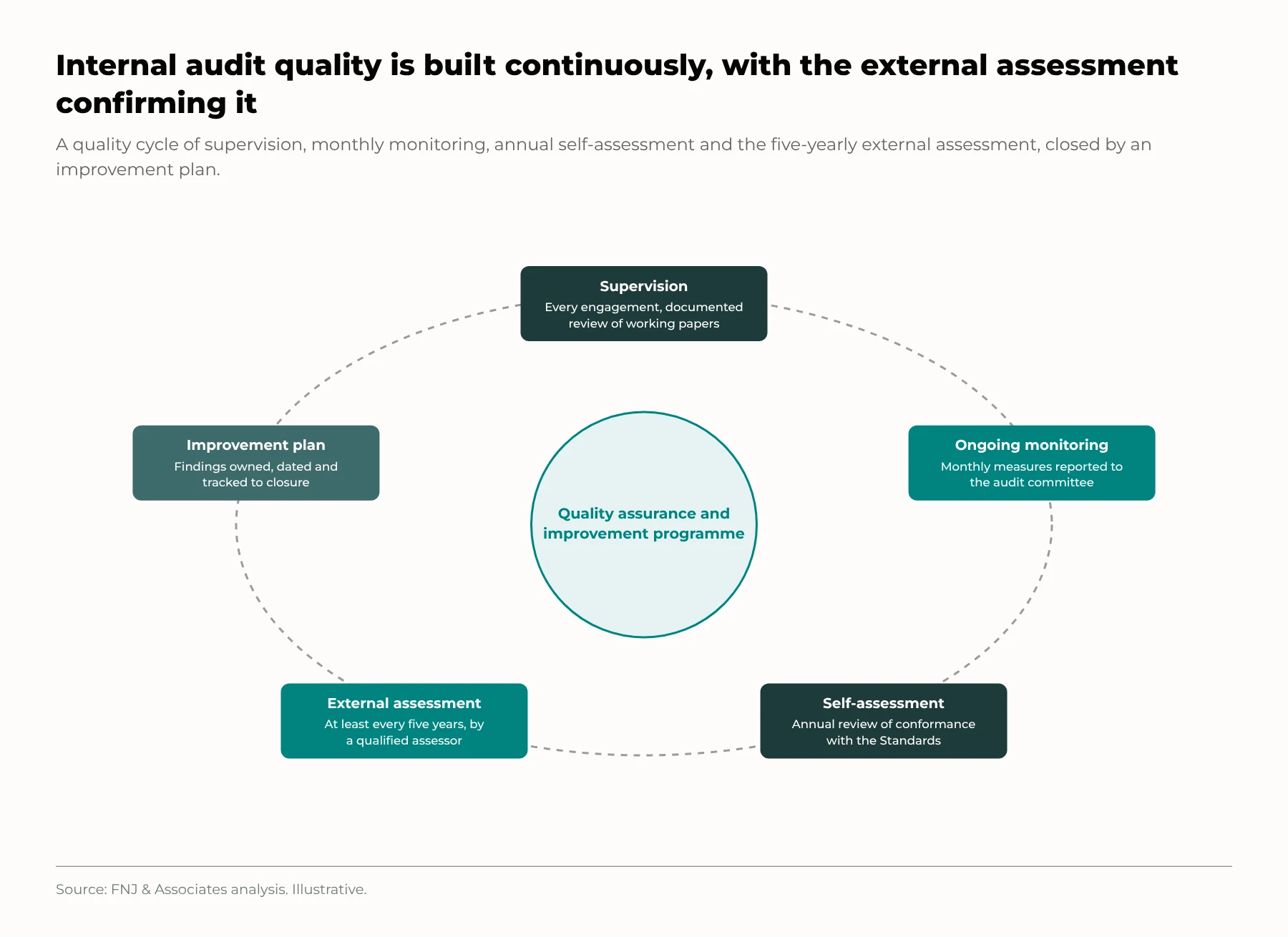
Supervision, ongoing monitoring, periodic self-assessment and a few measures the audit committee watches make the next external assessment a confirmation rather than a surprise.
Internal audit quality describes how well an internal audit function conforms with professional standards, meets the expectations of the board and management, and adds value through its assurance and advice. Banks, SACCOs, insurers, NGOs, state corporations and corporates across Kenya and East Africa rely on their internal audit functions for assurance, which makes the quality of that assurance a governance concern.
Many functions think about quality only when an external quality assessment falls due. They then find that working papers are inconsistent, supervision is undocumented, the charter is out of date and the audit committee has no measures of the function’s performance. These issues take far longer to correct than the few weeks the assessment itself requires.
A quality programme that runs continuously, through supervision, ongoing monitoring, periodic self-assessment, measures and an improvement plan, avoids that position. This article sets out each element, as part of our internal audit services in Kenya and East Africa.
The standards require a continuous quality programme
For internal audit quality, the Global Internal Audit Standards require the chief audit executive to maintain a quality assurance and improvement programme covering all aspects of the function. The programme includes internal assessments, made up of ongoing monitoring and periodic self-assessments, and an external quality assessment performed at least once every five years by a qualified, independent assessor.
The external assessment is therefore only one part of the programme. The internal elements are what keep internal audit quality consistent from year to year, and an assessor will look for evidence that they have operated throughout the period, not only in the months before the visit.
Supervision is the first line of quality control
Every engagement should be supervised in a way that ensures objectives are met, work is performed to the required standard and conclusions are supported by evidence. In practice, this means review of the engagement plan before fieldwork begins, review of working papers during the engagement, clearance of review notes before the draft report and sign-off by the chief audit executive or a delegate on significant findings and conclusions.
Supervision must be documented to count towards internal audit quality. Our article on audit working papers explains how review notes, clearance and sign-off should be recorded so that a reviewer can see that supervision took place and what it changed.
Ongoing monitoring tracks performance every month
Ongoing monitoring is the routine checking of the function’s work and performance, built into its management processes. It includes tracking engagement progress against the plan, monitoring budgets and timelines, reviewing a sample of completed files against a short checklist, collecting feedback from auditees after each engagement and reviewing the status of agreed actions.
| Measure (illustrative) | What it shows |
|---|---|
| Plan completion against schedule | Whether the function delivers the assurance the audit committee approved |
| Days from fieldwork end to final report | Timeliness of reporting |
| Share of files passing the internal quality checklist | Consistency of working papers and supervision |
| Auditee satisfaction score | How engagements are experienced by the business |
| Share of agreed actions closed on time and validated | Whether audit work leads to change |
| Training hours and certifications per auditor | Investment in competence |
Periodic self-assessment tests conformance with the standards
At least annually, or on a cycle that covers every element of the standards within a defined period, the function should assess itself against the Global Internal Audit Standards. A self-assessment usually combines a review of the charter, methodology and policies, a detailed review of a sample of completed engagements, a survey of the audit committee and senior management, and a review of staff competence and training.
The self-assessment is most credible when performed by someone who did not lead the engagements reviewed, such as a quality lead within the function, an auditor from another part of the group or an external reviewer engaged to validate the self-assessment.
The charter and methodology need regular review
Internal audit quality depends on the function’s foundations as well as its engagements. The internal audit charter should be reviewed and approved by the board periodically, the audit methodology should reflect current standards and any applicable topical requirements, and templates should be updated when the methodology changes, so that every engagement starts from a sound base.
The audit committee should see internal audit quality measures
The audit committee approves the internal audit plan and relies on the function’s conclusions, so it should know how well the function performs. A short quality section in the chief audit executive’s regular report, showing the measures above, the results of the latest self-assessment and progress on the improvement plan, gives the committee that view and supports its annual evaluation of the function.
Our article on questions every audit committee should ask includes several on internal audit performance that these measures help answer.
An improvement plan turns findings into change
Each self-assessment, file review and survey will identify areas where internal audit quality can improve. These should be recorded in a single improvement plan with owners and dates, reported to the audit committee and tracked to completion, so that the next external assessment finds that weaknesses identified internally have already been addressed.
External assessment should confirm what the function already knows
When the internal elements of the programme work well, the external quality assessment becomes a confirmation of the function’s own view rather than a source of unexpected findings. The assessor will review the charter, methodology, a sample of engagements and the quality programme itself, interview stakeholders and form an opinion on conformance with the standards.
Functions can choose a full external assessment or a self-assessment with independent external validation, where the standards allow. Either way, choosing an assessor early, agreeing the scope and preparing the documents the assessor will request make the process efficient.
Five weaknesses recur in internal audit quality programmes
- Quality considered only in the year of the external assessment.
- Supervision performed but not documented, so it cannot be demonstrated.
- No measures of performance reported to the audit committee.
- Self-assessments that review policies but not completed engagements.
- Findings from earlier reviews never tracked to completion.
Sector context shapes expectations
Bank and insurance supervisors expect internal audit functions to follow recognised standards and may review their work during inspections, so internal audit quality has a direct regulatory dimension. State corporations face oversight from public sector bodies that expect conformance with professional standards, while listed companies follow governance codes that refer to internal audit effectiveness.
NGO internal audit functions are often small and may be reviewed by donors who rely on their work, which makes a proportionate but documented quality programme particularly valuable. The same elements apply in every case, scaled to the size of the function.
Competence and development underpin internal audit quality
The quality of internal audit work depends ultimately on the people who perform it. The chief audit executive should assess the skills the audit plan requires, such as information technology, data analytics, fraud, credit or programme expertise, compare them with the skills in the team, and close gaps through recruitment, training, certification or co-sourcing.
A training plan for each auditor, linked to the skills assessment and to professional certification where relevant, should be reviewed annually. Recording training hours and certifications also supports the measures reported to the audit committee and the evidence an external assessor will request.
Stakeholder feedback adds an outside view
Internal measures show whether the function follows its methodology, but they do not show how the function is experienced by those it serves. A short survey after each engagement, asking auditees whether the scope was clear, the work professional and the findings fair and useful. An annual survey of audit committee members and senior executives, give the chief audit executive a direct view of how the function is perceived.
Feedback should be read with care, since an auditee who received difficult findings may rate the engagement poorly even when the work was sound. Patterns across many engagements, rather than individual scores, are what matter.
Co-sourced and outsourced work must meet the same standard
Where specialists or external firms perform part of the audit plan, their work is still the function’s work, and it must meet the same standards. The chief audit executive should agree the methodology and documentation standards in advance, review the work before relying on it, and include co-sourced and outsourced engagements in file reviews and self-assessments.
Conformance statements should be honest
The standards allow internal audit functions to state that they conform with the standards only when the results of the quality programme support that statement. Where the latest assessment identified significant gaps, the chief audit executive should disclose them to the board and senior management, together with the plan to address them, rather than using a general statement of conformance that the evidence does not support.
Technology makes internal audit quality easier to evidence
Audit management systems that record supervision, review notes, sign-offs and action follow-up against each engagement make internal audit quality far easier to demonstrate. Rather than searching through folders for evidence of review, the chief audit executive and the external assessor can see at once which engagements were fully reviewed, how long reporting took and how many review notes remain open.
Technology does not create quality on its own, but it removes much of the effort of evidencing it and allows the quality lead to spend time on the substance of the work rather than on assembling records.
Smaller functions can apply a proportionate programme
A function with two or three auditors in a SACCO, an NGO or a mid-sized company can still run an effective quality programme. A one-page file review checklist applied to every engagement, an annual self-assessment validated externally every few years, four or five measures reported to the audit committee and an improvement plan with a handful of actions give the audit committee confidence and prepare the function well for its external assessment.
Three moves for the next quarter
- Introduce a short internal quality checklist and review a sample of completed engagement files against it each quarter.
- Add a quality section to the audit committee report, with four or five measures and progress on the improvement plan.
- Schedule the next self-assessment and confirm the date of the next external assessment, with the scope agreed in advance.
How we support your institution
FNJ & Associates performs external quality assessments and independent validation of self-assessments, facilitates internal quality reviews, designs quality measures and improvement plans, and supports functions preparing for their first external assessment.
Trigarc Audit, implemented by FNJ, covers audit planning, execution, reporting and follow-up, recording supervision, review notes and sign-offs against each engagement and producing the performance measures the audit committee needs.
Questions about internal audit quality
What is a quality assurance and improvement programme?
It is the programme the Global Internal Audit Standards require the chief audit executive to maintain, covering ongoing monitoring, periodic self-assessments and an external quality assessment at least once every five years.
How often must internal audit have an external quality assessment?
The standards require an external quality assessment at least once every five years by a qualified, independent assessor or assessment team.
What should a self-assessment cover?
A self-assessment should review the charter, methodology and policies, a sample of completed engagements, stakeholder feedback and staff competence against the standards.
Which internal audit quality measures should the audit committee see?
Useful measures include plan completion, reporting timeliness, file review results, auditee feedback, the share of actions closed and validated, and training and certification levels.
Can small functions run a quality programme?
Yes, small functions can apply a proportionate programme with a short checklist, an annual self-assessment and a few measures, and can engage external support to validate their self-assessment.
Can internal audit state that it conforms with the standards?
Only when the results of the quality programme, including internal and external assessments, support that statement, and any significant gaps should be disclosed to the board with a plan to address them.
What does an external quality assessor review?
The assessor usually reviews the charter, methodology, a sample of completed engagements and the quality programme itself, and interviews the audit committee, senior management and audit staff before forming an opinion on conformance.
Can FNJ & Associates perform our external quality assessment?
Yes, FNJ & Associates performs external quality assessments and independent validations and supports functions preparing for them, and the firm can be reached through fnjassociates.co.ke to request a proposal.
Request a proposal for a quality assessment
FNJ & Associates helps internal audit functions across Kenya and East Africa build quality between external assessments and demonstrate it when the assessment comes.
About FNJ & Associates
FNJ & Associates is an ICPAK-registered CPA firm and a multidisciplinary team of 20+ professionals holding CPA(K), ACCA, CIA, CISA, CFE, CEH, CAMS and CIPP/E credentials, serving more than 100 organisations across Kenya and East Africa. The firm provides audit and assurance, internal audit, and IT and cybersecurity audits, and implements Trigarc Audit for audit planning, execution, reporting and follow-up. Visit fnjassociates.co.ke to learn more.