

A current register, independent approval, evidence of fair terms and complete disclosure protect both the organisation and the people connected to it.
Related party transactions are dealings between an organisation and people or entities that can influence it, such as directors, senior executives, major shareholders, their close family members and the companies they own or control. Banks, SACCOs, insurers, listed companies, family businesses and NGOs across Kenya and East Africa all enter into such transactions, and many of them, from leases of premises owned by a founder to supplies from a group company, are entirely proper.
The risk is that the related party’s influence shapes the terms. An organisation may pay more than the market price, lend on easier conditions, accept lower quality or forgo an opportunity because someone on the other side of the transaction can affect the decision. The problem is often invisible because related parties are not identified, approvals are given by people who share the interest, and disclosures in the financial statements are incomplete.
Six practices bring related party transactions under control: a clear definition, a current register, independent approval, evidence of fair terms, monitoring after approval and complete disclosure. This article sets out each, drawing on our governance, internal audit and risk management work.
Several frameworks set expectations for related party transactions
Company law requires directors to declare their interests in proposed transactions with the company, and accounting standards, including IAS 24 and the corresponding section of the IFRS for SMEs, require disclosure of related party relationships and transactions in the financial statements. Banking and SACCO rules restrict lending to insiders and their associates, and capital markets rules require listed companies to disclose and, in some cases, seek shareholder approval for significant related party transactions.
NGOs face similar expectations from donors and the PBO regulator, which look closely at payments to board members, staff and their connected entities. In every sector, the underlying concern is the same: that the organisation’s resources are used for its purposes rather than for the benefit of those who influence it.
A clear definition decides who counts as a related party
The organisation’s policy should define related parties in terms consistent with the accounting standards and any sector rules. Typically, this includes directors and their alternates, members of senior management, shareholders above a set threshold, close family members of each, entities controlled or significantly influenced by any of them, and subsidiaries, associates and other group companies.
| Related party (illustrative) | Examples of related party transactions |
|---|---|
| Director or senior executive | Consultancy fees, loans, purchase or lease of assets from or to the individual |
| Close family member | Employment, supply contracts, loans to a spouse or child |
| Entity owned or controlled by a director | Supply of goods or services, property leases, joint ventures |
| Major shareholder | Management fees, loans, guarantees, shared services |
| Group company | Intercompany sales, cost recharges, guarantees, cash pooling |
A current register makes identification possible
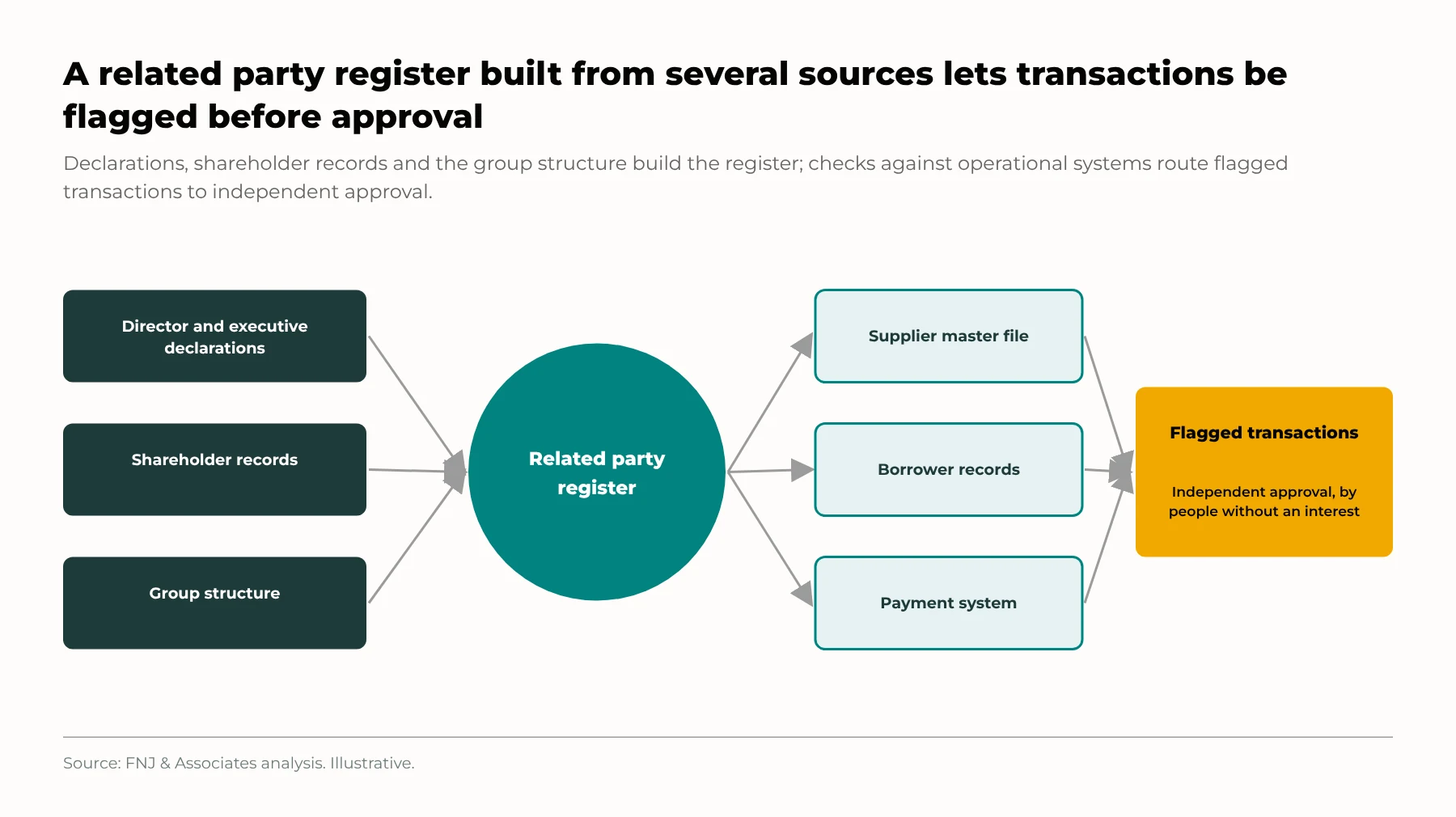
Related party transactions cannot be controlled if the related parties are unknown. The company secretary or compliance function should maintain a register of related parties, built from directors’ and executives’ declarations of interests, shareholder records and group structure charts, and updated whenever an interest changes and at least annually.
The register should be shared with the people who can spot a related party transaction before it happens, including procurement, credit, finance and legal teams. Comparing the register with the supplier master file, the customer and borrower database and the list of payees allows the organisation to flag related party transactions automatically, and our article on the conflict of interest declaration describes how declarations feed this process.
Approval must come from people without an interest
The central safeguard for related party transactions is that they are approved by people who have no interest in them. The interested director or executive should declare the interest, take no part in the discussion or decision and leave the meeting for the item, and the minutes should record each of these steps.
The policy should set thresholds for who approves which transactions, consistent with the delegation of authority. Small, routine transactions on standard terms may be approved by management with notice to the audit committee, while larger or unusual transactions should go to the audit committee or the board, and some may require shareholder approval under company or capital markets rules.
Evidence should show that terms are fair
Approvers need evidence that the terms are at least as favourable as the organisation could obtain from an unrelated party. Depending on the transaction, that evidence may be competitive quotations, an independent valuation, a comparison with market rates or the organisation’s standard pricing, and the approval record should state which evidence was considered.
Where no comparable market exists, for example for a specialised service only the related party can provide, the board should record why the transaction is in the organisation’s interest and how the price was assessed. That record protects the directors who approved it as much as the organisation.
Monitoring continues after approval
Approval is not the end of the process for related party transactions, because related party contracts should be monitored to confirm that goods and services are delivered as agreed, that payments match the approved terms. That renewals and price changes return for approval rather than continuing automatically, since a contract approved on fair terms can drift away from them over several years.
Loans to related parties need particular attention, since banks and SACCOs must monitor insider loans against regulatory limits and ensure that they are serviced on the same terms as other loans, and any arrears on such loans should be reported promptly to the board.
Disclosure should be complete and consistent
The financial statements must disclose related party relationships and transactions as the applicable accounting standard requires. The finance team should reconcile the disclosure with the register and the approvals given during the year, and the external auditor will usually test whether all significant related party transactions have been identified and disclosed.
Internal audit should test the process
Internal audit can provide valuable assurance by testing related party transactions periodically. Data analytics comparing the related party register with supplier, borrower and payroll records can identify transactions that were not flagged, while a review of approvals can confirm that interested parties did not take part and that evidence of fair terms was considered.
Five weaknesses recur in related party controls
- No register of related parties, or one that is rarely updated.
- Interested directors or executives taking part in the decisions that affect them.
- Approvals given without evidence that terms are at market rates.
- Contracts renewed or prices changed without returning for approval.
- Disclosures that omit transactions known to management.
Sector context shapes the main risks
Banks and SACCOs face their most significant related party risk in insider lending, which supervisors examine closely and which has contributed to failures in the past. Listed companies face scrutiny from shareholders and the capital markets regulator over transactions with major shareholders and directors.
Family businesses often have many related party transactions by design, which makes clear policy and independent review especially important as they grow or bring in outside investors. NGOs must show donors that payments to board members, staff and their connected entities were properly approved and at fair value.
Group structures need intercompany rules
Organisations that operate through subsidiaries, sister companies or regional offices often have many intercompany transactions, such as shared services, management fees, loans and guarantees. These are related party transactions, and while they are usually less risky than transactions with individuals, they can move value between entities in ways that disadvantage minority shareholders, creditors, donors or regulators in a particular entity.
A group policy that sets out the basis for charging shared costs, the terms of intercompany loans and the approvals required in each entity, applied consistently and documented each year, protects each board and makes the financial statements easier to audit.
Annual declarations should be supplemented by event-driven updates
Directors and executives should confirm their related parties at least annually, but interests change during the year as people take on directorships, acquire businesses or see family members join suppliers. The related party transactions policy should require prompt notification of new interests, and the company secretary should update the register and inform procurement, credit and finance when a change arises.
The audit committee should review the register and the transactions
The audit committee is well placed to oversee related party transactions. A periodic report setting out the register, the transactions entered into during the period, the approvals given, any transactions identified after the event and the results of internal audit testing gives the committee a complete view, and allows it to challenge transactions that appear unusual in value, timing or terms.
Where a related party transaction was entered into without the required approval, the committee should decide whether to ratify it, require it to be renegotiated or terminate it, and should consider whether disciplinary action is warranted for the failure to declare.
Clear policy protects the people involved
Directors and executives with business interests sometimes see related party controls as an implied criticism. In practice, a clear policy protects them, because a transaction that was declared, approved by people without an interest, supported by evidence of fair terms and properly disclosed is far easier to defend if it is later questioned by shareholders, regulators, donors or the media, and the record shows that the individual acted properly throughout.
Training helps directors and staff recognise related parties
Many related party transactions go unflagged simply because the people involved do not recognise them as such, for example when a supplier is owned by a director’s cousin or a property is leased from a company in which an executive holds a minority stake. Short training for directors, executives and procurement, credit and finance staff, with practical examples drawn from the organisation’s own activities, improves declarations and helps the people who process transactions recognise when one needs independent approval.
Three moves for the next quarter
- Update the register of related parties from fresh declarations by every director and senior executive.
- Compare the register with supplier, borrower and payment records, and review any related party transactions not previously identified.
- Confirm that the policy sets approval thresholds and requires interested parties to leave the decision, and present it to the audit committee.
How we support your institution
FNJ & Associates reviews related party policies and registers, tests related party transactions through internal audit and data analytics, and advises boards and audit committees on approval and disclosure. Our forensic team investigates suspected abuse where transactions appear to have been concealed or improperly priced.
Trigarc Governance, implemented by FNJ, records declarations, board resolutions and the recusal of interested directors, while Trigarc Ethics maintains the conflict of interest register from which related parties are identified.
Questions about related party transactions
What are related party transactions?
Related party transactions are dealings between an organisation and people or entities that can influence it, such as directors, senior executives, major shareholders, their close family members and the companies they control.
Are related party transactions prohibited?
No, many are entirely proper, but they should be identified, approved by people without an interest, made on fair terms and disclosed as the accounting standards require.
Who should approve a related party transaction?
Approval should come from people without an interest, with small routine transactions approved by management and larger or unusual ones by the audit committee, the board or, where rules require, the shareholders.
How can we show that terms are fair?
Evidence may include competitive quotations, an independent valuation, a comparison with market rates or the organisation’s standard pricing, recorded with the approval.
How can undisclosed related party transactions be found?
Comparing the related party register with supplier, borrower, payroll and payment records through data analytics can identify transactions that were not flagged.
Are intercompany transactions related party transactions?
Yes, transactions between group companies are related party transactions and should follow a group policy on charging, loans and approvals, with appropriate disclosure in each entity’s financial statements.
Should related party transactions be reported to the audit committee?
Yes, the audit committee should periodically review the register, the transactions entered into, the approvals given and any transactions identified after the event, together with the results of internal audit testing.
Can FNJ & Associates review our related party controls?
Yes, FNJ & Associates reviews related party policies and registers and tests transactions through internal audit and data analytics, and the firm can be reached through fnjassociates.co.ke to request a proposal.
Request a proposal for a related party transactions review
FNJ & Associates helps boards and audit committees across Kenya and East Africa identify, approve and disclose related party transactions with confidence.
About FNJ & Associates
FNJ & Associates is an ICPAK-registered CPA firm and a multidisciplinary team of 20+ professionals holding CPA(K), ACCA, CIA, CISA, CFE, CEH, CAMS and CIPP/E credentials, serving more than 100 organisations across Kenya and East Africa. The firm provides governance, risk and compliance advisory and corporate governance training, and implements Trigarc Governance for board reporting. Visit fnjassociates.co.ke to learn more.