
Accessible channels, a survivor-centred response and routes that bypass the people concerned give safeguarding policies the reach they are meant to have.
Safeguarding reporting is the set of channels and procedures through which children, beneficiaries, patients, staff and community members can raise concerns that someone connected to an organisation has harmed, exploited or abused a person, or put them at risk. NGOs, faith-based organisations, schools, health providers and other organisations that work with people at risk across Kenya and East Africa depend on these channels to detect harm and to act on it.
Most such organisations have a safeguarding policy, but many rely on reporting routes that the people most likely to be harmed cannot easily use, such as an email address, an office telephone line or a reporting line through managers who may be connected to the person concerned. Reports that do arrive are sometimes handled by people without the training to respond safely, and the result is that harm continues unreported or that reporting itself causes further harm.
Safeguarding reporting that is designed around the people it protects addresses these problems through accessible channels, a survivor-centred response, routes that bypass those concerned, timely notification and learning. This article sets out each element, drawing on our forensic and investigation services and our ethics work.
Expectations for safeguarding reporting have risen
Donors, regulators and the public now expect organisations that work with people at risk to have effective safeguarding systems, and they judge those systems by how well they work in practice. The Core Humanitarian Standard commits organisations to safe and responsive mechanisms for handling complaints, and many donors require partners to report safeguarding concerns to them within a short period of becoming aware of them.
In Kenya, the Children Act 2022 sets out duties to protect children, and data protection law governs the handling of the sensitive personal information that safeguarding reports contain. Organisations that fail to detect or respond properly to harm face the loss of funding and partnerships, regulatory action and lasting damage to the trust on which their work depends.
Channels must reach the people most at risk
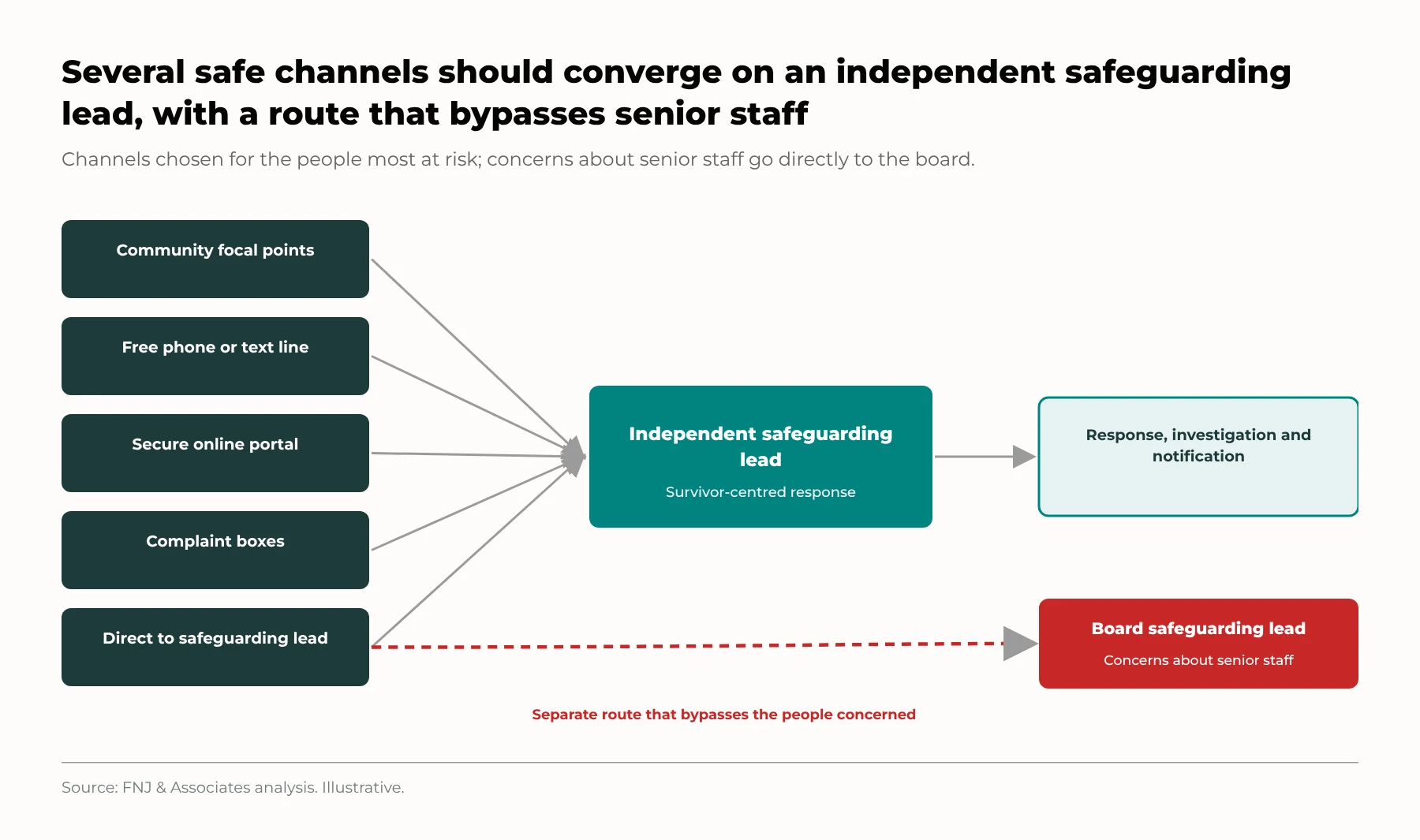
The first test of safeguarding reporting is whether the people most likely to be harmed can use it. That usually means offering several channels, designed with the community, so that a child, a person who cannot read, a person without a phone or a person who fears being seen can each find a safe way to raise a concern.
| Channel (illustrative) | Who it reaches | Considerations |
|---|---|---|
| Trained community focal points | People who prefer to speak face to face in their own language | Focal points must be trusted, trained and independent of programme staff |
| Free telephone line or text service | People with access to a phone | Must be staffed or monitored at times people can call |
| Secure online reporting portal | Staff, partners and literate community members | Allows anonymous reports and follow-up through a case reference |
| Suggestion or complaint boxes | People who cannot use phones or prefer anonymity | Must be emptied regularly by someone independent of the programme |
| Direct reporting to a safeguarding lead | Staff and volunteers | Lead must be independent of line management for the matter |
Channels should be explained in community meetings, on posters and in the languages people use, with a clear message that reporting is safe, that the organisation will act and that aid or services will not be withdrawn because someone has reported a concern.
A survivor-centred response puts safety and choice first
When a concern involves harm to a person, the first priority is that person’s safety and wellbeing. A survivor-centred approach means listening without judgement, taking immediate steps to protect the person from further harm, connecting them with medical, psychosocial and legal support where they want it, and respecting their choices about how the matter proceeds as far as the law and the safety of others allow.
Staff who receive a disclosure should know exactly what to do and what not to do. They should not question the person in detail, promise confidentiality they cannot guarantee or confront the alleged perpetrator, but should record what was said in the person’s own words, ensure immediate safety and pass the report to the safeguarding lead without delay.
Routes must bypass the people concerned
A reporting route that passes through the alleged perpetrator, their manager or their close colleagues will deter reports and may expose the person who raised the concern. Safeguarding reporting should go to a safeguarding lead who is independent of line management for the matter, and concerns about the country director, senior managers or board members should go directly to a designated board member or an external provider.
The same principles that protect whistleblowers apply here, and our article on the whistleblowing procedure explains how independent routes and service levels work together.
Notification duties start the clock
Many safeguarding concerns trigger duties to notify others, sometimes within hours or days. Donors usually require prompt notification of credible concerns involving their funding, the police or children’s services may need to be informed of suspected crimes or children at risk, and partner organisations may need to know if their staff are involved, all while protecting the survivor’s identity and wishes as far as possible.
The safeguarding procedure should list each notification duty, the person responsible and the deadline, so that the safeguarding lead can act quickly and consistently when a report arrives.
Investigations need specialist skills
Safeguarding investigations involve vulnerable people, sensitive evidence and serious consequences, so they should be conducted by investigators trained in safeguarding and interviewing people who have experienced harm. The general principles of triage, predication, terms of reference and evidence preservation set out in our article on workplace investigation apply, together with additional care to avoid causing further harm to survivors and witnesses.
Where an allegation may amount to a crime, the organisation should take advice on whether its own investigation could interfere with a police inquiry, and it should coordinate with the authorities rather than proceeding independently.
Confidentiality protects survivors, reporters and the process
Information about safeguarding reports should be shared only with those who need it to protect people, investigate or meet notification duties. Records should be held securely, separate from general personnel and programme files, with access restricted to the safeguarding lead and named individuals, and retained in line with policy and the Data Protection Act 2019.
Learning should strengthen the safeguards
Each case reveals something about how harm was possible, whether a gap in recruitment checks, a lack of supervision in a particular setting or a channel that was not reaching part of the community. Reviewing cases for these lessons, and reporting themes and actions to the board without identifying individuals, turns safeguarding reporting into a source of prevention.
Five weaknesses recur in safeguarding reporting
- Channels that rely on email, office telephones or managers, which communities cannot easily use.
- Staff unsure how to respond to a disclosure, so survivors are questioned or exposed.
- No route that bypasses senior managers when they are the subject of a concern.
- Notification duties to donors and authorities not mapped, so deadlines are missed.
- Cases closed without lessons being drawn or reported to the board.
Sector context shapes the channels and risks
Humanitarian and development NGOs face the risk of sexual exploitation and abuse by staff, partners and contractors in settings where power imbalances are greatest, and community-based channels are essential. Schools and children’s organisations must focus on child safeguarding and safe recruitment, while health providers must protect patients during care.
Faith-based organisations and community groups often rely heavily on volunteers, which makes training, vetting and clear reporting routes particularly important. In each case, safeguarding reporting succeeds when it is designed with and for the people it is meant to protect.
Partners and contractors must be covered by safeguarding reporting
Much of the work of NGOs is delivered through implementing partners, contractors and volunteers, and harm can occur at any point in that chain. Safeguarding reporting channels should be open to concerns about anyone delivering the organisation’s work, partners should be required to operate their own channels and to report concerns to the organisation, and grant agreements should set out those duties clearly.
Monitoring visits should check that partners’ channels exist, are known to communities and are working, rather than relying on the existence of a partner policy. Where partners lack capacity, the organisation should support them in building it, since a weak link anywhere in the chain weakens the protection of everyone the programme serves.
The board must own safeguarding
Safeguarding is a board responsibility that cannot be delegated entirely to management. The board should appoint a safeguarding lead among its members, approve the policy and procedures, receive regular reports on cases, themes and actions without identifying individuals, and satisfy itself that safeguarding reporting reaches the people it is meant to protect, for example through periodic independent review.
The designated board member should also be the route for concerns about senior management, with clear arrangements for receiving such concerns confidentially and commissioning an independent response.
Safe recruitment and induction prevent harm
Effective safeguarding reporting detects harm, but prevention begins much earlier, at recruitment. Thorough reference checks, criminal record checks where the law allows, inter-agency misconduct disclosure schemes and clear codes of conduct signed on joining reduce the chance that a person who has caused harm elsewhere joins the organisation. Safeguarding induction for every staff member and volunteer ensures that they know both the standards expected and how to report concerns.
Together, these preventive measures and accessible safeguarding reporting give the people an organisation serves the protection its policy promises.
Feedback to communities builds trust in the channels
People are more likely to report when they believe reports lead to action. Without identifying anyone, organisations should tell communities how concerns are handled, what kinds of action have followed past reports and how safeguarding reporting has been improved as a result, using community meetings and the same languages and formats as the channels themselves, so that trust in the system grows over time.
Three moves for the next quarter
- Ask communities and staff which reporting channels they would trust and use, and close the gaps they identify.
- Train every staff member and volunteer on how to receive a disclosure and whom to tell.
- Map every notification duty to donors, authorities and partners, with an owner and a deadline for each.
How we support your institution
FNJ & Associates reviews safeguarding reporting systems, maps notification duties, designs independent reporting routes, conducts safeguarding-sensitive investigations and reports themes to boards. We work alongside organisations’ own safeguarding specialists and the support services survivors need.
Trigarc Ethics, implemented by FNJ, provides a secure online reporting portal with anonymous follow-up, configurable categories for safeguarding concerns, restricted case files and reporting to the board, complementing the community channels an organisation operates.
Questions about safeguarding reporting
What is safeguarding reporting?
Safeguarding reporting is the set of channels and procedures through which children, beneficiaries, staff and community members can raise concerns that someone connected to an organisation has harmed, exploited or abused a person or put them at risk.
Which reporting channels work best in communities?
Most organisations need several channels designed with the community, such as trained focal points, a free phone or text line, an online portal and complaint boxes, so that everyone can find a safe way to report.
What is a survivor-centred approach?
A survivor-centred approach puts the safety, wellbeing and choices of the person harmed first, ensuring immediate protection, access to support and respect for their wishes as far as the law and others’ safety allow.
Who should receive reports about senior managers?
Concerns about the country director, senior managers or board members should go directly to a designated board member or an external provider, bypassing normal management lines.
Do safeguarding concerns have to be reported to donors?
Many donors require prompt notification of credible safeguarding concerns involving their funding, so each organisation should map its donor obligations and deadlines in its procedure.
Should partners operate their own safeguarding channels?
Yes, implementing partners should operate accessible channels and report concerns to the organisation, with these duties set out in grant agreements and checked during monitoring visits.
Can FNJ & Associates review our safeguarding reporting?
Yes, FNJ & Associates reviews safeguarding reporting systems, designs independent routes and conducts safeguarding-sensitive investigations, and the firm can be reached through fnjassociates.co.ke to request a proposal.
Request a proposal for a safeguarding reporting review
FNJ & Associates helps organisations across Kenya and East Africa build safeguarding reporting that reaches the people most at risk and responds with care.
About FNJ & Associates
FNJ & Associates is an ICPAK-registered CPA firm and a multidisciplinary team of 20+ professionals holding CPA(K), ACCA, CIA, CISA, CFE, CEH, CAMS and CIPP/E credentials, serving more than 100 organisations across Kenya and East Africa. The firm provides forensic audit and investigation services and governance, risk and compliance advisory, and implements Trigarc Ethics for speak-up reporting, investigations and ethics registers. Visit fnjassociates.co.ke to learn more.