
Triage criteria, predication, terms of reference and early preservation of evidence decide whether an investigation reaches a fair and defensible conclusion.
A workplace investigation is the structured process an organisation follows to establish the facts when a concern about misconduct is raised, whether fraud, harassment, a conflict of interest, a safeguarding concern or a breach of policy. Corporates, financial institutions, NGOs and public bodies across Kenya and East Africa conduct such investigations regularly, often under pressure and with incomplete information.
The first decisions in a case are frequently made quickly and informally. In many cases a manager begins asking questions before anyone has decided whether an investigation is justified, the scope is never written down, the person investigating is too close to the matter, or documents and devices are left in the hands of the people concerned. These early mistakes can undermine the conclusion however careful the later work.
Five early steps give an investigation a sound footing: written triage criteria, a clear statement of predication, terms of reference, the choice of an independent and competent investigator, and prompt preservation of evidence. This article sets out each step, drawing on our forensic and investigation services.
Triage decides which concerns warrant a workplace investigation
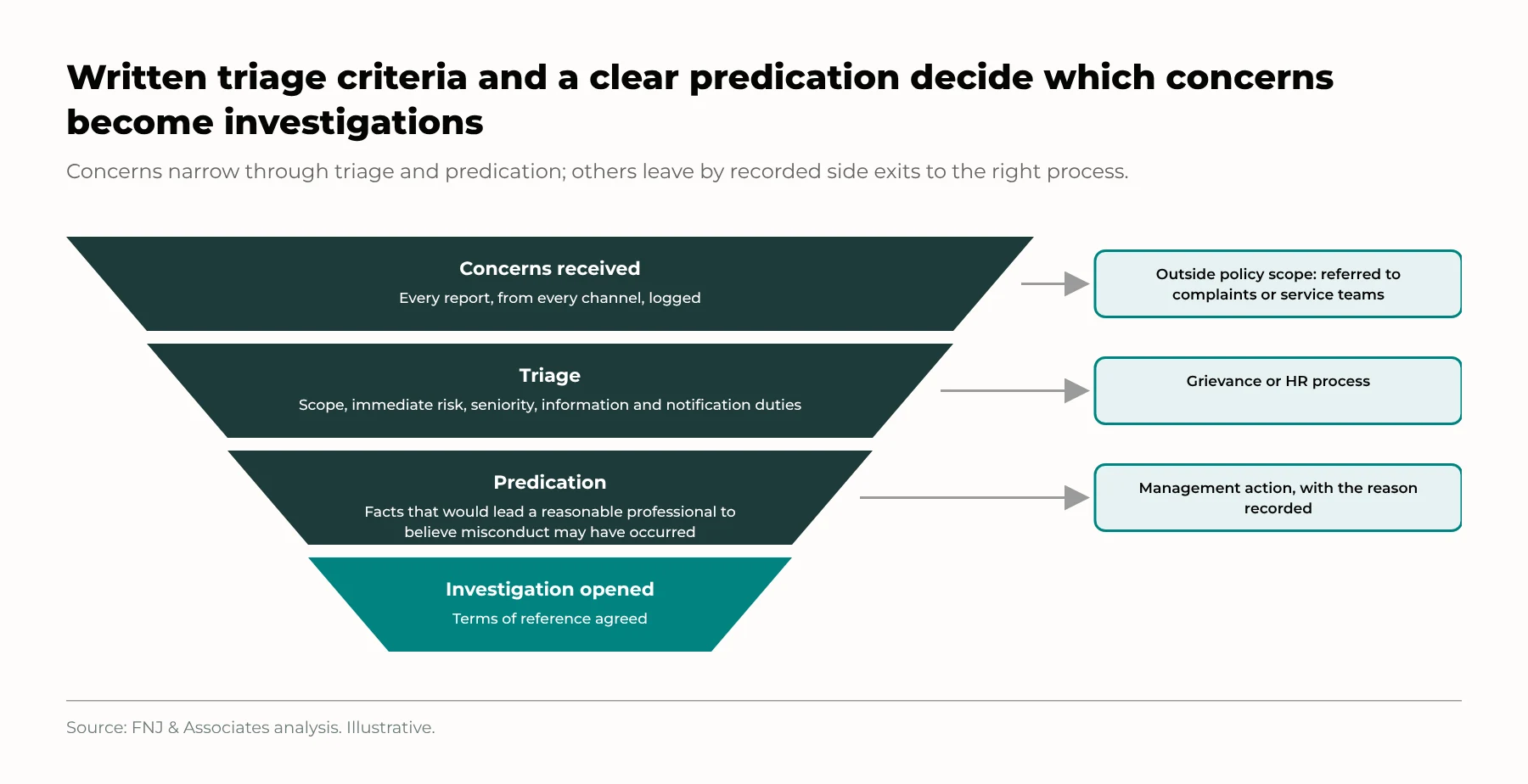
Not every concern requires a full workplace investigation, since some are better handled through a grievance process, a management conversation, a control review or a customer complaints procedure. Some lack enough information to act on without first asking the reporter for more detail.
Written triage criteria help the person screening each concern make consistent decisions. Our article on the whistleblowing procedure describes the screening questions in more detail, and the triage decision should always be recorded with its reasons.
| Triage question | Possible outcome |
|---|---|
| Does the concern allege misconduct within the scope of the policy? | If not, refer to the appropriate process |
| Is there an immediate risk to people, assets or evidence? | If so, take protective steps before the assessment is complete |
| Who is named, and how senior are they? | Route to an independent handler or the audit committee where needed |
| Is there enough information to proceed? | If not, seek more detail from the reporter where possible |
| Are there regulatory, donor or law enforcement notification duties? | If so, start the clock and notify as required |
Predication is the basis for opening a workplace investigation
Predication is the set of facts that would lead a reasonable, professionally trained person to believe that misconduct may have occurred. It is the threshold for opening an investigation, and it protects both the organisation and the people concerned, since investigating without a reasonable basis can be unfair to the subject and difficult to justify later.
The predication should be written down in a short statement that sets out what is alleged, what information supports it and why it justifies an investigation. If the investigation later finds nothing, the record shows that the organisation acted reasonably in looking.
Terms of reference define the scope and authority
Every workplace investigation should have written terms of reference, approved by the person who commissioned it, before work begins. The terms of reference keep the investigation focused, protect the investigator from accusations of overreach and give the commissioning authority a basis for judging whether the work is complete.
- The allegations to be investigated, stated precisely.
- The period and the business areas within scope.
- The investigator and any supporting specialists.
- The authority granted, such as access to records, systems and people.
- The person to whom the investigator reports, and how often.
- The expected output and the target date, recognising that dates may need to change as evidence emerges.
The investigator must be independent and competent
The investigator should have no involvement in the matter, no reporting relationship with the people concerned and no personal interest in the outcome. Where the concern involves senior management, or where the organisation lacks the necessary skills, an external investigator commissioned by the audit committee or the board is usually the right choice.
Competence matters as much as independence, because a workplace investigation involving financial transactions, digital evidence or complex procurement requires skills in forensic accounting, data analysis or digital forensics. An investigator without them may miss evidence or draw conclusions that will not withstand challenge.
Evidence should be preserved before anyone is alerted
Documents, emails, system records and devices can be altered or deleted once the people involved learn that an investigation is under way. Before any interview or obvious enquiry, the investigator should arrange for relevant records to be secured, which may include suspending routine deletion, taking forensic images of devices and copying system logs.
Every item of evidence should be recorded with its source, the date it was obtained and who has held it since, so that the chain of custody can be shown if the matter reaches a disciplinary hearing, a court or a regulator.
Interviews follow the documents, not the other way round
Interviewing the subject before examining the documentary evidence gives them the opportunity to explain away facts the investigator does not yet know. Most experienced investigators review documents and data first, interview witnesses next and interview the subject last, when they can put specific evidence to them and assess the explanation.
Interviews should be planned, conducted by two people where possible, recorded in notes that the interviewee is invited to review, and conducted with respect for the interviewee’s rights, including any entitlement to be accompanied under the organisation’s policies.
Fairness and data protection apply throughout
Kenyan employment law requires a fair procedure before disciplinary action for misconduct, including informing the employee of the allegations and giving them an opportunity to respond. The workplace investigation is the foundation for that procedure, so its findings must rest on evidence and be presented in a way that allows a fair response.
Investigations also involve personal data about the subject, witnesses and the reporter, and the Data Protection Act 2019 applies to how that data is collected, used, stored and retained. Access to investigation files should be restricted, and the organisation should set a retention period for case records.
Findings should rest on evidence and lead to action
The investigation report should state each allegation, the evidence obtained, the investigator’s finding on whether the allegation is substantiated and the basis for that finding. It should not make disciplinary decisions, which belong to management or a disciplinary panel, but it should identify control weaknesses that allowed the misconduct, so that they can be fixed.
Five weaknesses recur in workplace investigations
- Investigations opened without recorded triage or predication.
- No written terms of reference, so scope drifts and the conclusion is contested.
- Investigators who report to, or work closely with, the people concerned.
- Evidence left with the subject until after the first interview.
- Reports that reach conclusions without tying each one to evidence.
Protective steps may be needed before the facts are known
Some concerns require immediate action to protect people, assets or evidence, even before the workplace investigation has established the facts. Examples include suspending system access where data theft is alleged, separating the parties where harassment or a safeguarding concern is reported, and freezing payments to a supplier suspected of fraud.
These steps should be proportionate, recorded with their reasons and described as precautionary rather than disciplinary, so that they do not prejudge the outcome. Where an employee is suspended, the decision should follow the organisation’s policy and employment law, and the suspension should be reviewed if the investigation takes longer than expected.
Confidentiality protects everyone involved
Information about a workplace investigation should be shared only with people who need it, which usually means the investigator, the commissioning authority and specialists supporting the work. Witnesses should be asked to keep the matter confidential, and the identity of the reporter should be protected in line with the whistleblowing policy.
Confidentiality protects the subject as well as the reporter, since a person who is investigated and later cleared can suffer lasting damage if the allegation became widely known, and careless disclosure can also expose the organisation to claims and undermine the evidence.
External notifications may be required
Some matters must be reported outside the organisation, sometimes within short periods. Financial institutions may need to file a suspicious transaction report with the Financial Reporting Centre, and regulators may expect notification of significant fraud. Donors usually require prompt notice of suspected misuse of funds, and serious offences may need to be reported to the police or other authorities.
The triage record should identify these duties at the outset, and the commissioning authority should decide, with legal advice where needed, when and how to notify, so that a workplace investigation does not inadvertently breach a reporting obligation or alert a suspect through an external enquiry.
Timeliness matters for fairness and for evidence
Investigations that drag on for months harm everyone involved: the subject remains under suspicion, the reporter loses confidence, witnesses forget details and the opportunity to recover losses may pass. Setting a target date in the terms of reference, reporting progress to the commissioning authority and recording the reasons for any delay keep the workplace investigation moving without sacrificing thoroughness.
Lessons from each workplace investigation should strengthen controls
Every substantiated case reveals something about how the misconduct was possible, whether a missing segregation of duties, an override that went unchallenged or a policy that staff did not understand. The investigation report should set out these control weaknesses, management should agree actions to address them, and internal audit should confirm in due course that the actions have worked.
Over time, a summary of cases by type, business area and root cause shows the audit committee where misconduct risk is concentrated. That analysis is one of the most valuable outputs of an investigation framework, because it turns individual cases into prevention.
Three moves for the next quarter
- Adopt written triage criteria and a short predication template, and apply them to every new concern.
- Prepare a terms of reference template and require approval before any investigation begins.
- Agree an evidence preservation protocol with information technology and human resources, so that records can be secured quickly when needed.
How we support your institution
FNJ & Associates conducts independent investigations led by Certified Fraud Examiners, provides forensic accounting, data analytics and digital forensic support, and designs investigation frameworks, triage criteria and templates for organisations that run their own investigations. Our article on whistleblower retaliation covers how to protect reporters while an investigation proceeds.
Trigarc Ethics, implemented by FNJ, records triage and predication decisions, holds investigation case files with evidence and findings, and tracks corrective actions, with restricted access and reporting to the audit committee.
Questions about workplace investigation
What is a workplace investigation?
A workplace investigation is a structured process to establish the facts when a concern about misconduct, such as fraud, harassment or a policy breach, is raised within an organisation.
What is predication in an investigation?
Predication is the set of facts that would lead a reasonable, professionally trained person to believe that misconduct may have occurred, and it is the threshold for opening an investigation.
Who should conduct a workplace investigation?
The investigator should be independent of the matter and the people involved and have the skills the case requires, which may mean using an external investigator for senior or complex matters.
Why should documents be reviewed before interviews?
Reviewing documents first allows the investigator to put specific evidence to witnesses and the subject and prevents the subject from explaining away facts the investigator does not yet know.
Does data protection law apply to investigations?
Yes, investigations involve personal data, so the Data Protection Act 2019 applies to how that data is collected, used, stored and retained, and access to case files should be restricted.
When should an employee be suspended during an investigation?
Suspension may be appropriate where the employee’s presence could put people, assets or evidence at risk, and it should be precautionary, proportionate, consistent with policy and employment law, and reviewed if the investigation is prolonged.
What should a workplace investigation report contain?
The report should state each allegation, the evidence obtained, the finding on whether the allegation is substantiated and its basis, and the control weaknesses that allowed the misconduct, leaving disciplinary decisions to management or a disciplinary panel.
Can FNJ & Associates conduct an investigation for us?
Yes, FNJ & Associates conducts independent investigations and designs investigation frameworks, and the firm can be reached through fnjassociates.co.ke to request a proposal.
Request a proposal for investigation support
FNJ & Associates helps organisations across Kenya and East Africa start investigations well and reach fair, defensible conclusions, from triage and predication to evidence and reporting.
About FNJ & Associates
FNJ & Associates is an ICPAK-registered CPA firm and a multidisciplinary team of 20+ professionals holding CPA(K), ACCA, CIA, CISA, CFE, CEH, CAMS and CIPP/E credentials, serving more than 100 organisations across Kenya and East Africa. The firm provides forensic audit and investigation services and governance, risk and compliance advisory, and implements Trigarc Ethics for speak-up reporting, investigations and ethics registers. Visit fnjassociates.co.ke to learn more.