
A single count of reports tells the board little, while a balanced set of measures read together shows whether the programme is working.
An ethics programme brings together the code of conduct, speak-up channels, investigations, registers of interests and gifts, training and the leadership behaviours that shape how people act when no rule tells them what to do. NGOs, financial institutions, public bodies and corporates across Kenya and East Africa invest in these programmes to prevent misconduct, detect it early and respond fairly, and their boards need to know whether the investment is working.
Too often, the board receives a single figure, such as the number of whistleblowing reports in the year, and little else. That figure is hard to interpret on its own, since a rise may reflect more misconduct or greater trust in the channels. A fall may reflect less misconduct or greater fear, so directors cannot tell whether the programme is succeeding.
A balanced set of measures across awareness, trust, response, outcomes and culture, read together and compared over time, gives the board a meaningful view. This article sets out those measures and how to present them, drawing on our compliance services in Kenya and our ethics work.
A single count of reports misleads more than it informs
Report volumes depend on many factors besides the level of misconduct, including how well people know the channels, whether they trust them, whether they believe reports lead to action and whether they fear retaliation. An organisation with few reports may have a healthy culture or a silent one, and only other measures can tell the difference.
ISO 37002, the international guideline on whistleblowing management systems, encourages organisations to evaluate the performance of their arrangements rather than simply counting reports, and the same principle applies to the ethics programme as a whole.
Five groups of measures give a balanced view of the ethics programme
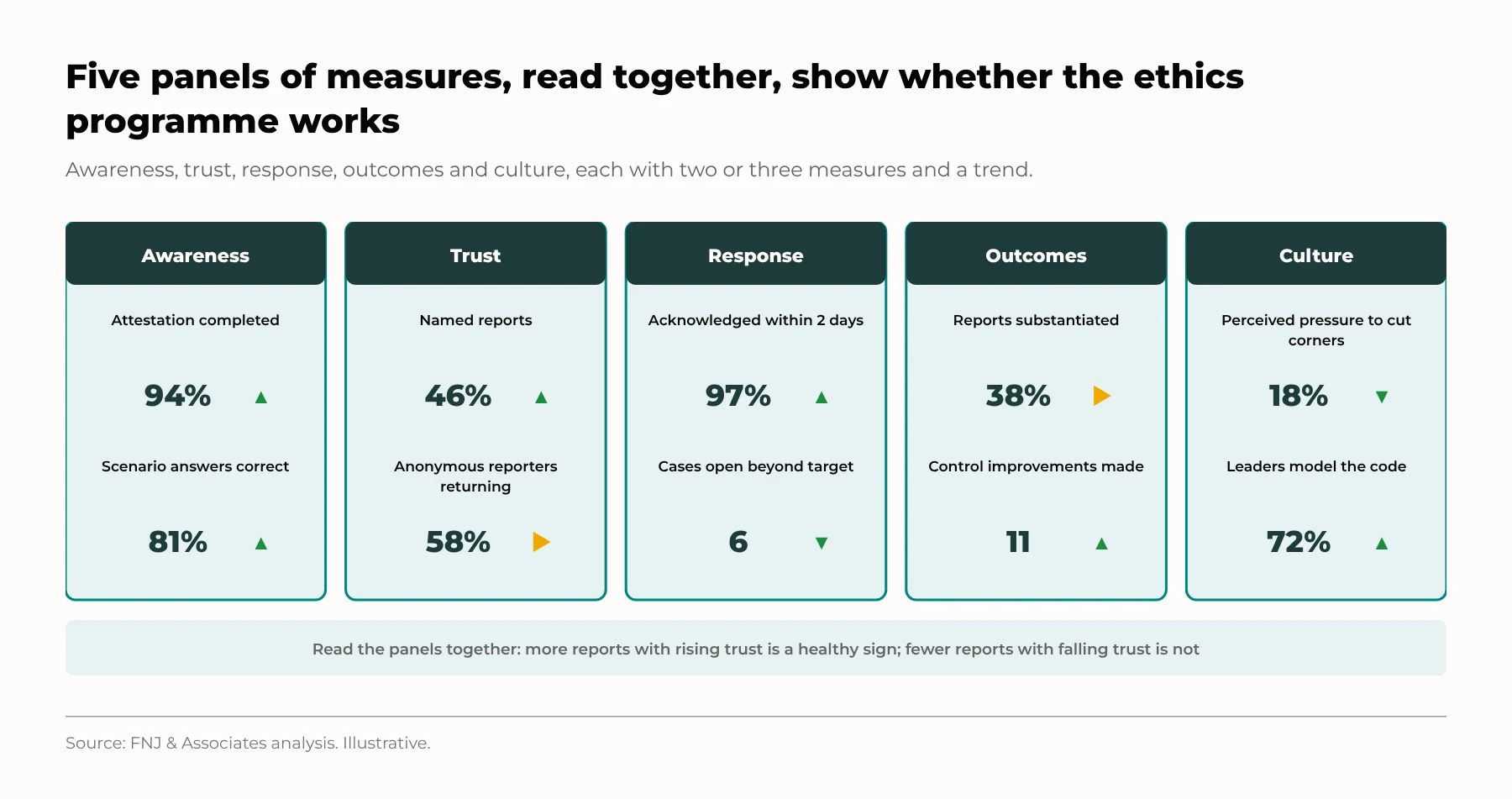
| Group | Illustrative measures | What they show |
|---|---|---|
| Awareness | Code of conduct attestation completion and scenario results; training completion; awareness of speak-up channels in surveys | Whether people know the standards and how to raise concerns |
| Trust | Share of reports made by named reporters; anonymous reporters returning for follow-up; survey confidence in non-retaliation | Whether people feel safe to speak up |
| Response | Time to acknowledge, triage and close reports; cases open beyond target; share of reporters given feedback | Whether the organisation acts promptly and fairly |
| Outcomes | Share of reports substantiated; actions taken; control improvements made; losses recovered | Whether reports lead to change |
| Culture | Survey measures of perceived pressure, leadership example and fairness; retaliation complaints; exit interview themes | Whether behaviour matches the code |
Awareness measures show whether people know the standards
Completion rates for training and attestation show that the ethics programme has reached people, but they say little about understanding. Results on scenario questions in the annual attestation, as our article on code of conduct attestation describes, and survey questions on whether staff know how to raise a concern, give a better indication of whether the standards have been understood.
Trust measures show whether people feel safe to speak
The share of reports made by named rather than anonymous reporters, the share of anonymous reporters who return to answer follow-up questions and staff survey results on confidence that they would not suffer retaliation all indicate trust. A rising share of named reports usually suggests that people are more confident, while a high and persistent share of anonymous reports may point to fear.
Retaliation complaints deserve separate attention, and our article on whistleblower retaliation explains how to monitor reporters after a case closes.
Response measures show whether the organisation acts
Time taken to acknowledge reports, complete triage and close cases, measured against the service levels in the speak-up procedure, shows whether the organisation responds promptly. Cases open beyond their target date, and the share of reporters who received feedback, show whether reporters are being kept informed, which affects whether they and their colleagues will report again.
Outcome measures show whether reports lead to change
The share of reports that are substantiated, the actions taken in response, the control weaknesses fixed and the losses recovered show whether the ethics programme produces results. A very low substantiation rate may suggest poor triage or weak investigations, while a very high rate may suggest that only the most serious concerns are being reported.
Outcomes should also be analysed by type, business unit and seniority of the people involved, which shows the board where misconduct risk is concentrated and whether senior people are held to the same standards as others.
Culture measures reveal what other measures miss
Periodic surveys asking staff whether they feel pressure to compromise standards, whether leaders set a good example and whether misconduct is dealt with fairly provide a direct view of culture. Exit interviews and grievance themes add to that view, and trends over several years are more meaningful than any single result.
Measures should be read together
The value of a balanced set lies in reading the measures together. A rise in reports combined with rising trust and steady substantiation rates is usually positive, while a fall in reports combined with falling trust and rising retaliation complaints is a warning. The ethics function should explain these combinations to the board rather than presenting each measure in isolation.
The board report should be short and comparative
A two-page ethics programme report each quarter or half year, with a dashboard of the five groups, trends over at least four periods, significant cases summarised without identifying individuals and the actions taken, gives the audit or ethics committee what it needs. An annual report can add survey results, benchmarking where reliable data exists and a review of the programme’s priorities for the coming year.
Five weaknesses recur in ethics reporting
- A single count of reports presented without context.
- No measures of trust, so the board cannot tell whether silence means health or fear.
- Response times not compared with service levels.
- Outcomes not analysed by business unit or seniority.
- No trends, so each report stands alone and patterns are missed.
Sector context shapes the emphasis
NGOs often emphasise safeguarding, fraud and community feedback measures, which donors increasingly request, while financial institutions link ethics measures to conduct risk and customer outcomes that supervisors examine. Public bodies relate ethics measures to statutory codes for public officers and to anti-corruption expectations.
Corporates often combine ethics measures with anti-bribery, supplier conduct and health and safety indicators. In every sector, the five groups of measures provide a common structure that can be adapted to the organisation’s main risks.
Leading and lagging measures serve different purposes
Some ethics programme measures describe what has already happened, such as substantiated cases and losses recovered, while others give early warning of what may happen, such as falling survey confidence, rising perceived pressure or a decline in training completion in a particular unit. The board needs both, since lagging measures confirm whether the programme has worked and leading measures show where it may be about to fail.
Presenting the two together, with the leading measures given prominence, helps directors focus on prevention rather than on the cases that have already reached the investigation stage.
Data quality and confidentiality need attention
Ethics measures draw on sensitive data, including reports, investigations and survey responses. The ethics function should define each measure precisely, draw the data from one system wherever possible, protect the identity of reporters, subjects and survey respondents, and avoid presenting results for groups so small that individuals could be identified.
Consistency over time matters as much as accuracy at a point in time. Changing the definition of a measure from one year to the next makes trends meaningless, so definitions should be documented, and any change should be explained when the next report is presented.
Benchmarking should be used cautiously
Boards often ask how their organisation compares with others in the same sector. Published benchmarks for report volumes and substantiation rates exist, but they vary widely by sector, country and the way organisations count reports, so comparisons should be treated as indicative. The organisation’s own trends over several years are usually a more reliable guide than an external comparison.
Metrics should drive decisions about the ethics programme
The purpose of measuring the ethics programme is to improve it. Each report to the board should end with the actions the ethics function proposes in response to the measures, such as targeted training where awareness is low, a review of channels where trust is falling or additional investigation resources where response times are lengthening, so that the dashboard leads to decisions rather than simply being noted.
Over time, the board should see whether those actions moved the measures in the intended direction, which closes the loop between measurement and management.
Smaller organisations can start with a few measures
A small NGO, a SACCO or a mid-sized company does not need a complex dashboard to benefit. Two measures from each of the five groups, drawn from the speak-up log, attestation results and a short annual survey, reported to the board twice a year with a brief commentary, give directors a far better view of the ethics programme than a single count of reports, and they can be extended as the programme matures.
What matters most is consistency, so that the same measures are reported in the same way each time and directors can see how the organisation’s ethical health is changing.
The ethics function should explain, not only report
Measures alone rarely tell the full story of how an ethics programme is performing. The head of ethics or compliance should accompany each dashboard with a short narrative explaining the most significant movements, the likely causes, the cases or events behind them and the actions proposed, so that directors can engage with the substance rather than debating the meaning of individual figures.
Directors should also be invited to ask which measures they find most useful and what is missing, so that the report develops with the board’s needs and the ethics programme’s maturity.
Three moves for the next quarter
- Select two measures from each of the five groups that can be produced from existing data.
- Present the first dashboard to the audit or ethics committee, with an explanation of how to read the measures together.
- Add three culture questions to the next staff survey to establish a baseline.
How we support your institution
FNJ & Associates reviews ethics programmes, designs ethics measures and board reporting, conducts culture surveys and analyses speak-up and investigation data. Our whistleblowing procedure work sets the service levels against which response measures are reported.
Trigarc Ethics, implemented by FNJ, records reports, triage, investigations, outcomes and registers in one place, and produces programme measures and board packs for the audit or ethics committee.
Questions about ethics programme metrics
What is an ethics programme?
An ethics programme brings together the code of conduct, speak-up channels, investigations, registers of interests and gifts, training and leadership behaviours that help an organisation prevent, detect and respond to misconduct.
Why is the number of reports not enough?
Report volumes depend on awareness, trust and fear as well as on misconduct, so a rise or fall cannot be interpreted without other measures.
Which ethics programme measures should the board see?
A balanced set covers awareness, trust, response, outcomes and culture, such as attestation results, the share of named reports, response times, substantiation rates and survey measures.
What does a high share of anonymous reports mean?
A persistently high share of anonymous reports may indicate that people fear retaliation, especially when combined with low survey confidence or retaliation complaints.
How often should ethics measures be reported?
Many organisations report a short dashboard quarterly or half-yearly and a fuller annual report including survey results and programme priorities.
What are leading and lagging ethics measures?
Lagging measures, such as substantiated cases, show what has already happened, while leading measures, such as falling survey confidence or training gaps, give early warning of where the programme may fail.
How can a small organisation measure its ethics programme?
It can start with two measures from each of the five groups, drawn from the speak-up log, attestation results and a short survey, reported twice a year with a brief commentary.
Can FNJ & Associates design our ethics reporting?
Yes, FNJ & Associates designs ethics measures and board reporting, conducts culture surveys and analyses speak-up data, and the firm can be reached through fnjassociates.co.ke to request a proposal.
Request a proposal for an ethics programme review
FNJ & Associates helps organisations across Kenya and East Africa measure whether their ethics programme works and report it to the board with clarity.
About FNJ & Associates
FNJ & Associates is an ICPAK-registered CPA firm and a multidisciplinary team of 20+ professionals holding CPA(K), ACCA, CIA, CISA, CFE, CEH, CAMS and CIPP/E credentials, serving more than 100 organisations across Kenya and East Africa. The firm provides forensic audit and investigation services and governance, risk and compliance advisory, and implements Trigarc Ethics for speak-up reporting, investigations and ethics registers. Visit fnjassociates.co.ke to learn more.