

A readable code, scenario questions, specific disclosures and analysis of the results turn an annual click into evidence of an ethical culture.
A code of conduct sets out the standards of behaviour an organisation expects from its staff, directors and others acting on its behalf. An annual attestation asks each person to confirm that they have read the code, understood it and complied with it. NGOs, financial institutions, public bodies and corporates across Kenya and East Africa use attestation to reinforce their standards and to show regulators, donors and auditors that the code has been communicated, an expectation reflected in compliance standards such as ISO 37301.
For many employees, the attestation is a box clicked in seconds. The code itself is often long and written in abstract language, the attestation asks only a single yes or no question, and any disclosures or questions raised in the process are never read or followed up, so the exercise produces a high completion rate and very little assurance.
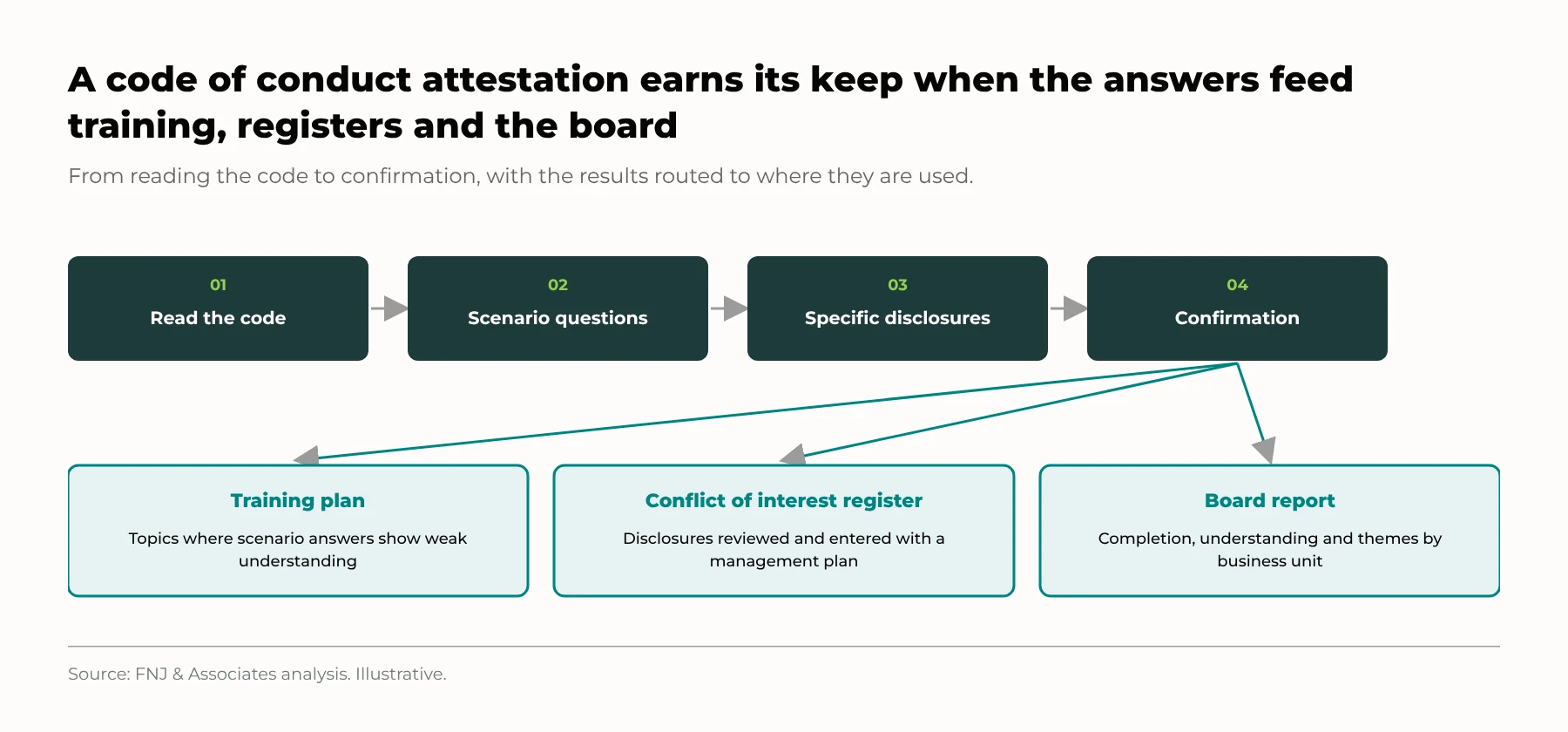
Five changes make attestation meaningful: a code written for the people who use it, questions that test understanding, specific disclosures linked to the organisation’s registers, training targeted at the gaps the results reveal, and analysis reported to the board. This article sets out each change, drawing on our compliance services in Kenya.
The code of conduct must be written for the people who use it
A code that runs to forty pages of legal language will not be read, however often staff are asked to confirm that they have read it. An effective code of conduct is short enough to read in one sitting, written in plain language, organised around the situations staff actually face, and illustrated with examples and questions that help people apply its principles to their own work.
Most effective codes cover a familiar set of topics, including integrity and honesty, conflicts of interest, gifts and hospitality, fraud and corruption, fair treatment of colleagues and customers, safeguarding where relevant, confidentiality and data protection, use of assets, and how to raise concerns. Each section should point to the detailed policy for those who need more, rather than reproducing it.
A single yes or no question proves very little
An attestation that asks only whether the employee has read and complied with the code gives the organisation a record of communication, but little evidence of understanding. Most employees will answer yes, whether or not they have read the code, and the organisation learns nothing about where its standards are unclear or where pressures to depart from them exist.
Scenario questions test understanding
Adding a small number of short scenarios to the attestation, each asking the employee to choose the right response to a realistic situation, turns the exercise from a confirmation into a check of understanding. The scenarios should change each year and reflect the risks most relevant to the organisation and to each group of staff.
| Scenario (illustrative) | What it tests |
|---|---|
| A supplier offers to pay for your family’s holiday after a contract is renewed | Gifts and hospitality rules and conflicts of interest |
| A manager asks you to backdate a document before an audit | Integrity, record keeping and the duty to raise concerns |
| A colleague shares customer data in a personal messaging group | Confidentiality and data protection |
| A community leader asks for a favour in return for access to beneficiaries | Fraud, corruption and safeguarding |
Results for each scenario show where understanding is weak, so if many staff in one function choose the wrong answer on gifts, the organisation knows where to direct training, which is far more useful than a completion rate.
Specific disclosures connect attestation to the registers
The attestation is a natural moment to ask for specific disclosures: interests that could create a conflict, gifts or hospitality received and not yet recorded, outside employment, relationships with suppliers or customers, and any breach of the code of conduct the employee has observed but not reported. Each disclosure should flow into the relevant register, such as the conflict of interest declaration register or the gifts and hospitality register, and be reviewed in the same way as any other declaration.
Asking staff to confirm that they are not aware of any unreported breach gives them a clear prompt to speak up. Where they are aware of one, the attestation should direct them to the speak-up channel rather than asking them to describe the concern in a form that many people may see.
Someone must read and act on the answers
Disclosures and concerns raised through attestation are only valuable if someone reviews them promptly. The ethics or compliance function should review every disclosure, decide what action is needed, record the decision and follow up incomplete attestations, while human resources should address persistent failure to complete the attestation through normal management channels.
Training should follow the results
Annual code of conduct training often repeats the same content for everyone. Using the attestation results to identify which topics are least understood, and in which groups, allows training to focus where it is needed, such as a session on conflicts for procurement staff or on safeguarding for field teams, and the next year’s results show whether the training worked.
The board should see what the attestation reveals
The audit committee or the board ethics committee should receive a short annual report on the code of conduct attestation, covering completion by function and level, scenario results, the number and type of disclosures, any breaches reported and the actions taken. Comparing results year on year gives directors an indication of how the ethical culture is developing, which few other measures provide.
Directors should complete the attestation themselves, because a board that attests to the same code as staff, and whose disclosures are reviewed in the same way, demonstrates that the standards apply at every level of the organisation.
Five weaknesses recur in code of conduct attestation
- A long, legalistic code that staff confirm they have read but never do.
- A single yes or no question that gives no evidence of understanding.
- Disclosures collected but never reviewed or transferred to the registers.
- The same training every year, regardless of what the results show.
- No report to the board on completion, understanding or disclosures.
Sector context shapes the code and the scenarios
NGOs give particular weight to safeguarding, fraud and conduct in communities, and donors often require evidence that staff and partners have attested to an appropriate code. Financial institutions emphasise conduct towards customers, market integrity, confidentiality and anti-money laundering, which supervisors increasingly link to conduct risk.
Public bodies must reflect statutory codes for public officers, while corporates focus on anti-bribery, fair competition, health and safety and supplier relationships. The five changes described here apply in each case, with scenarios tailored to the risks each organisation faces.
Attestation should reach everyone who acts for the organisation
Employees are not the only people whose conduct affects the organisation. Directors, contract staff, consultants, volunteers and, in many cases, implementing partners and key suppliers act in the organisation’s name. The code of conduct or a shorter supplier code should apply to them, with attestation proportionate to their role and the risks involved.
NGOs in particular are often expected by donors to show that partners and sub-grantees have adopted an equivalent code and that their staff have attested to it. Including a partner attestation in grant agreements, and checking it during monitoring visits, extends the organisation’s standards to the people delivering its programmes.
Timing and frequency should match the risk
Most organisations require attestation on joining and annually thereafter, but some roles justify more frequent confirmation. Staff in procurement, finance, treasury, credit and programme management, where pressures to depart from the code of conduct are greatest, may benefit from a short additional attestation before major decisions or at the start of high-risk activities, such as a large tender or a new grant cycle.
Timing the annual attestation to follow, rather than precede, the annual ethics training helps staff answer the scenario questions with the content fresh in their minds, and it allows the results to measure what the training achieved.
Leadership behaviour gives the attestation its credibility
Staff take the code of conduct seriously when they see leaders apply it, including to themselves. Executives who declare their own interests, decline inappropriate hospitality, raise concerns and act on misconduct regardless of seniority give the annual attestation its credibility, while a single visible exception at senior level can undo years of training.
Some organisations ask senior leaders to describe, in their own words, how they have promoted the code within their teams during the year. Those statements, reviewed by the ethics function and summarised for the board, add a qualitative layer to the attestation results.
Data protection applies to attestation records
Attestation records and disclosures contain personal data, including information about family members, outside interests and concerns about colleagues. Access should be limited to those who need to review them, retention should follow the organisation’s records policy, and staff should be told how their information will be used, in line with the Data Protection Act 2019.
Completion rates are a starting point, not the goal
Many organisations report a completion rate of ninety per cent or more and treat that as success. Completion shows that the code of conduct has been communicated, but the more useful measures are the share of staff who answer the scenarios correctly, the number and quality of disclosures and the follow-up of concerns raised. The change in these measures from one year to the next says far more about the ethical culture than completion alone.
Reporting these measures alongside speak-up statistics and investigation outcomes gives the board a rounded view of how standards are understood and applied across the organisation.
Over several cycles, those combined measures also show whether investment in a clearer code of conduct, better scenarios and targeted training is changing behaviour, which is the question boards and donors increasingly ask of ethics programmes.
Three moves for the next quarter
- Review the code of conduct for length and readability, and add practical examples to each section.
- Add four or five scenario questions and specific disclosures to the next annual attestation.
- Agree who reviews disclosures and how the results will be reported to the audit or ethics committee.
How we support your institution
FNJ & Associates reviews and rewrites codes of conduct, designs attestation questions and scenarios, analyses attestation results and delivers targeted ethics training. Our article on the whistleblowing procedure explains how attestation and speak-up channels work together.
Trigarc Ethics, implemented by FNJ, manages code of conduct attestations alongside the conflict of interest and gifts and hospitality registers, so that disclosures flow into the right register and results can be reported to the board.
Questions about code of conduct attestation
What is a code of conduct attestation?
A code of conduct attestation is a confirmation by staff, directors and others that they have read, understood and complied with the organisation’s code of conduct, usually completed on joining and annually thereafter.
How can attestation be made more meaningful?
Attestation becomes more meaningful when the code is readable, the attestation includes scenario questions that test understanding, specific disclosures flow into the registers and the results are analysed and acted on.
What disclosures should the attestation include?
Useful disclosures include conflicts of interest, unrecorded gifts and hospitality, outside employment, relationships with suppliers or customers and awareness of any unreported breach of the code.
Should directors complete the attestation?
Yes, directors should attest to the same code as staff, with their disclosures reviewed in the same way, to show that the standards apply at every level.
What should the board receive about attestation?
The board or audit committee should receive an annual report on completion, scenario results, disclosures, breaches reported and actions taken, compared with previous years.
Should suppliers and partners attest to the code of conduct?
Where suppliers, consultants or implementing partners act in the organisation’s name, they should attest to the code of conduct or a shorter supplier code, with the requirement written into contracts or grant agreements.
Is a high completion rate enough?
No, completion shows that the code has been communicated, but scenario results, disclosures, follow-up of concerns and year-on-year trends say far more about understanding and culture.
Can FNJ & Associates help us improve our code of conduct?
Yes, FNJ & Associates reviews codes of conduct, designs attestation questions and analyses results, and the firm can be reached through fnjassociates.co.ke to request a proposal.
Request a proposal for a code of conduct review
FNJ & Associates helps organisations across Kenya and East Africa turn annual attestation into real evidence of understanding and an ethical culture.
About FNJ & Associates
FNJ & Associates is an ICPAK-registered CPA firm and a multidisciplinary team of 20+ professionals holding CPA(K), ACCA, CIA, CISA, CFE, CEH, CAMS and CIPP/E credentials, serving more than 100 organisations across Kenya and East Africa. The firm provides forensic audit and investigation services and governance, risk and compliance advisory, and implements Trigarc Ethics for speak-up reporting, investigations and ethics registers. Visit fnjassociates.co.ke to learn more.