

Status as of 19 November 2026. Excise duty in force since 01 July 2025; information return in force since 01 July 2026. Sources are listed at the end.
Kenya taxes what virtual asset platforms charge, not what their users trade. Excise duty on VASP fees has applied at 10% since 01 July 2025, and from 01 July 2026 providers also file a calendar-year information return on reportable users.
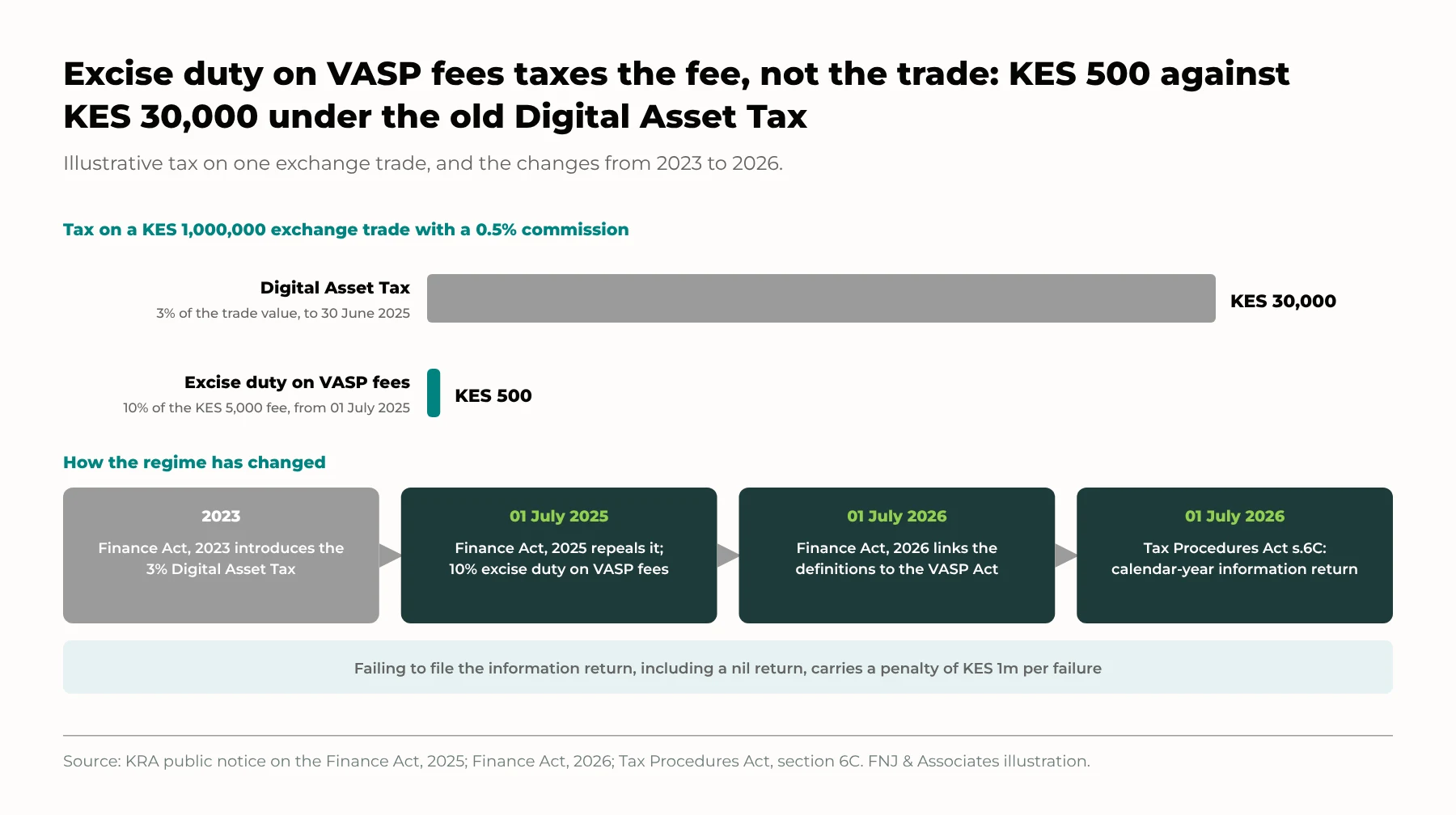
Excise duty on VASP fees replaced Kenya’s Digital Asset Tax in July 2025. The Finance Act, 2025 repealed the 3% tax on the value of virtual asset transfers and made fees charged on virtual asset transactions an excisable service, taxed at 10% of the excisable value. The Finance Act, 2026 then linked the charge to the definitions in the Virtual Asset Service Providers Act, 2025 and added a reporting duty under the Tax Procedures Act.
This guide explains the charge, how to compute it, the new information return and the steps platforms serving Kenyan users should take. It forms part of FNJ & Associates’ work as a tax consultant in Nairobi, and it complements our guide to the VASP licence in Kenya.
Excise duty on VASP fees replaced the 3% Digital Asset Tax in July 2025
The Finance Act, 2023 introduced the Digital Asset Tax at 3% of the value of a transfer or exchange of digital assets. Because it fell on the gross value traded, it bore heavily on low-margin trading, and the Finance Act, 2025 repealed it. In its place, the Kenya Revenue Authority (KRA) listed “fees charged on virtual assets transactions by virtual asset providers” as an excisable service at 10% of the excisable value, effective 01 July 2025.
| Feature | Digital Asset Tax (to 30 June 2025) | Excise duty on VASP fees (from 01 July 2025) |
|---|---|---|
| Law | Income Tax Act | Excise Duty Act, First Schedule |
| Tax base | Value of the transfer or exchange | Fees charged on the transaction |
| Rate | 3% | 10% of the excisable value |
| Accounted for by | Platform owner or facilitator | Virtual asset service provider charging the fee |
Source: KRA public notice on excise duty introduced by the Finance Act, 2025; KRA iTax enhancements, July and August 2025.
KRA added a new excise service category on iTax, “excise duty on fees charged on virtual asset transactions by virtual asset providers”, so taxpayers can register, file and pay.
The Finance Act, 2026 tied the charge to the VASP Act’s definitions
The Finance Act, 2026 left the 10% rate unchanged but, through section 36, inserted definitions of “virtual asset” and “virtual asset service provider” into Part III of the First Schedule to the Excise Duty Act. Both definitions take their meaning from section 2 of the Virtual Asset Service Providers Act, 2025, with effect from 01 July 2026.
The effect is to align the tax perimeter with the licensing perimeter. Exchanges, brokers, wallet providers, payment processors, virtual asset managers and offering platforms that fall within the VASP Act now sit within the same definition for excise duty on VASP fees. A provider that has mapped its services for the licence can reuse that map for tax.
Open questions worth a documented position
Two questions are not settled by the text, and the first is whether spreads and margins built into a quoted price count as “fees” when no separate charge is shown. The second is how foreign platforms that serve Kenyan users without a local entity should register. We advise providers to document their pricing model, take a written position with professional advice and revisit it when KRA issues guidance.
How to compute and account for excise duty on VASP fees
The base is the fee rather than the value of the trade, as the illustrative examples below show.
| Service | Transaction | Fee charged | Excise duty at 10% |
|---|---|---|---|
| Exchange | KES 1,000,000 trade at a 0.5% commission | KES 5,000 | KES 500 |
| Wallet provider | Withdrawal to an external wallet | KES 300 | KES 30 |
| Payment processor | Merchant settlement at 1% on KES 200,000 | KES 2,000 | KES 200 |
Source: FNJ illustration at 10% of the excisable value under the Excise Duty Act, First Schedule.
Under the old Digital Asset Tax, the exchange trade above would have carried KES 30,000 of tax, whereas under excise duty on VASP fees it carries KES 500. Whether the provider shows the duty separately to customers or absorbs it is a commercial choice, but the fee schedule and customer terms should say which.
The compliance cycle has four parts, and a provider that runs them monthly will have little to correct at year end:
- Register: add the excise service on iTax and obtain the excise licence or certificate of registration that applies, as KRA’s notice requires.
- Compute: total excisable fees for the month from the fee ledger, by service line.
- File and pay: submit the monthly excise return and pay by the 20th day of the following month.
- Reconcile: agree excisable fees to revenue in the management accounts and, at year end, to the audited financial statements.
The last step matters because a licensed VASP’s external auditor will test revenue completeness. Differences between declared fees and audited revenue also invite questions from KRA. Our guide to VASP audit requirements in Kenya covers that audit, and our tax calendar for Kenya lists the monthly deadlines.
From July 2026, VASPs also file an information return on reportable users
Section 39 of the Finance Act, 2026 inserted sections 6C and 6D into the Tax Procedures Act, effective 01 July 2026. Section 6C requires a virtual asset service provider to file an information return with the Commissioner for a calendar year. The return covers users with whom the provider maintains a relationship and who are reportable users or have controlling persons who are reportable persons. The duty applies to providers that carry out exchange transactions or run a trading platform for customers, including as a counterparty or intermediary.
| Failure | Consequence under section 6C |
|---|---|
| Failing to file a return, including a nil return | Penalty of KES 1m per failure |
| Omitting required information | Penalty of KES 100,000 per omission |
| Making a false statement in a return | Fine of KES 100,000 per statement, imprisonment of up to three years, or both |
Source: section 6C, Tax Procedures Act, as inserted by section 39 of the Finance Act, 2026.
Section 6D allows Kenya to agree the automatic exchange of virtual asset transaction information with other countries, subject to data protection safeguards. The design follows the reportable user and controlling person model used in international crypto-asset reporting. KRA’s guidance on the Finance Act, 2026 notes the requirement and refers taxpayers to further guidance. The filing date and the due diligence rules are therefore still to be published.
Providers should not wait for that guidance to start collecting data. Tax residence and controlling person details are easiest to capture at onboarding, alongside the due diligence described in our guide to VASP AML compliance in Kenya.
Five steps for VASPs and platforms serving Kenyan users
- Map fee lines to the excise base: list trading commissions, withdrawal, custody, conversion and settlement fees, and take a documented position on spreads.
- Confirm registration: check that the excise service is active on iTax and that returns have been filed since 01 July 2025.
- Update pricing and terms: show customers how excise duty on VASP fees is treated in the fee schedule.
- Capture reportable user data now: add tax residence self-certification and controlling person fields to onboarding for new and existing users.
- Reconcile monthly: agree excise returns to the fee ledger and revenue before the external audit does it for you.
A provider that has traded since July 2025 without registering should quantify the exposure and take advice on regularising it before applying for a licence. The application requires a tax compliance certificate, so unresolved arrears can delay the file.
Disclaimer: this summary of excise duty on VASP fees reflects the Excise Duty Act, the Tax Procedures Act and KRA notices as of 19 November 2026. It is not tax advice. Confirm your position with KRA or a tax adviser before you file.
Frequently asked questions
Is crypto taxed in Kenya?
Yes: since 01 July 2025, excise duty applies at 10% to fees charged on virtual asset transactions by virtual asset service providers. The Digital Asset Tax on the value of transfers was repealed from the same date, while profits remain within the general income tax rules.
What is the rate of excise duty on VASP fees in Kenya?
10% of the excisable value, which is the fee charged on the virtual asset transaction. The Finance Act, 2026 kept the rate and linked the definitions to the Virtual Asset Service Providers Act, 2025.
Is the Digital Asset Tax still in force?
No. The Finance Act, 2025 repealed the 3% Digital Asset Tax and replaced it with excise duty on VASP fees from 01 July 2025.
When is excise duty on VASP fees paid?
The provider pays monthly, filing an excise return on iTax and paying by the 20th day of the month after the fees were charged.
What is the VASP information return?
Section 6C of the Tax Procedures Act, in force from 01 July 2026, requires a VASP to file a calendar-year information return on reportable users. Failing to file, including a nil return, carries a penalty of KES 1m per failure, although KRA has yet to publish the filing date.
Can FNJ & Associates help with VASP tax compliance?
Yes: FNJ & Associates registers providers for excise duty, reviews fee structures, prepares and files monthly returns, quantifies past exposure and prepares for the information return.
Further reading
Check your VASP tax position before you apply
FNJ & Associates reviews fee structures, registers providers for excise duty, files monthly returns and quantifies any exposure since July 2025, so the tax compliance certificate in your licence file is not delayed.
About this research. The rate, scope and effective dates are from KRA’s public notice on the Finance Act, 2025, KRA’s iTax notice of July and August 2025, the Finance Act, 2026 and the Tax Procedures Act as amended, read on 19 November 2026. The examples, open questions and steps are FNJ analysis.
Sources. KRA public notice: excise duty introduced by the Finance Act, 2025; KRA iTax enhancements, July and August 2025; Finance Act, 2026 (KRA copy); Tax Procedures Act, as amended to 2026 (KRA copy); KRA: Finance Act 2026, what it means for you; Virtual Asset Service Providers Act, 2025 (Kenya Law).
Disclaimer. This article is general information as of 19 November 2026. It is not tax, legal or financial advice. Confirm your position with KRA or a tax adviser before you act.
About FNJ & Associates
FNJ & Associates is an ICPAK-registered CPA firm and a multidisciplinary team of 20+ professionals holding CPA(K), ACCA, CIA, CISA, CFE, CEH, CAMS and CIPP/E credentials, serving more than 100 organisations across Kenya and East Africa. The firm provides tax advisory and compliance, external audit, AML/CFT audits and licence application support for financial institutions and fintechs, and implements Trigarc Compliance to track regulatory obligations and filing deadlines. Visit fnjassociates.co.ke to learn more.