

Status as of 19 November 2026. In force; no provider licensed yet. Sources are listed at the end.
Virtual asset service providers have been reporting institutions under Kenya’s anti-money laundering law since 04 November 2025, before any licence was issued. A programme built on Prevent, Detect and Respond meets the Financial Reporting Centre’s expectations and the licensing file at the same time.
VASP AML compliance in Kenya starts earlier than many providers expect, because the Virtual Asset Service Providers Act, 2025 amended the Proceeds of Crime and Anti-Money Laundering Act (POCAMLA) so that a “reporting institution” now includes a virtual asset service provider. That amendment took effect when the Act commenced on 04 November 2025. Providers that meet the Act’s definition therefore carry reporting duties today, whether or not they have applied for a licence.
The licensing regime then adds its own layer, as the Virtual Asset Service Providers Regulations, 2026 require anti-money laundering, counter-terrorist financing and counter-proliferation financing (AML/CFT/CPF) policies in the application, due diligence before onboarding and records that capture wallet addresses. This guide organises those duties under FNJ & Associates’ compliance model, Prevent, Detect and Respond, and forms part of our work on GRC advisory in Kenya. Our guide to the VASP licence in Kenya covers the wider application.
VASP AML compliance in Kenya rests on three laws and two kinds of authority
The Financial Reporting Centre (FRC) is Kenya’s financial intelligence unit: it registers reporting institutions and receives their reports. The Central Bank of Kenya (CBK) or the Capital Markets Authority (CMA) licenses and supervises the provider, and a sound programme satisfies both.
| Law | What it requires of a VASP |
|---|---|
| Proceeds of Crime and Anti-Money Laundering Act and its 2023 Regulations | Registration with the FRC, a risk assessment, customer due diligence, a money laundering reporting officer, suspicious transaction reports within two days, record keeping, an independent audit and annual compliance reporting |
| Virtual Asset Service Providers Act, 2025 | Reporting institution status under POCAMLA, and a prohibition on mixer, tumbler and other anonymity-enhancing services |
| Virtual Asset Service Providers Regulations, 2026 | AML/CFT/CPF policies in the application, due diligence before onboarding, seven-year records including wallet addresses and network identifiers, monitoring for financial crime, and immediate compliance with freezing orders |
Source: section 2 and Second Schedule, Virtual Asset Service Providers Act, 2025; sections 44 and 47A, POCAMLA; regulations 6, 22, 26, 32, 102, 112 and 136, Virtual Asset Service Providers Regulations, 2026.
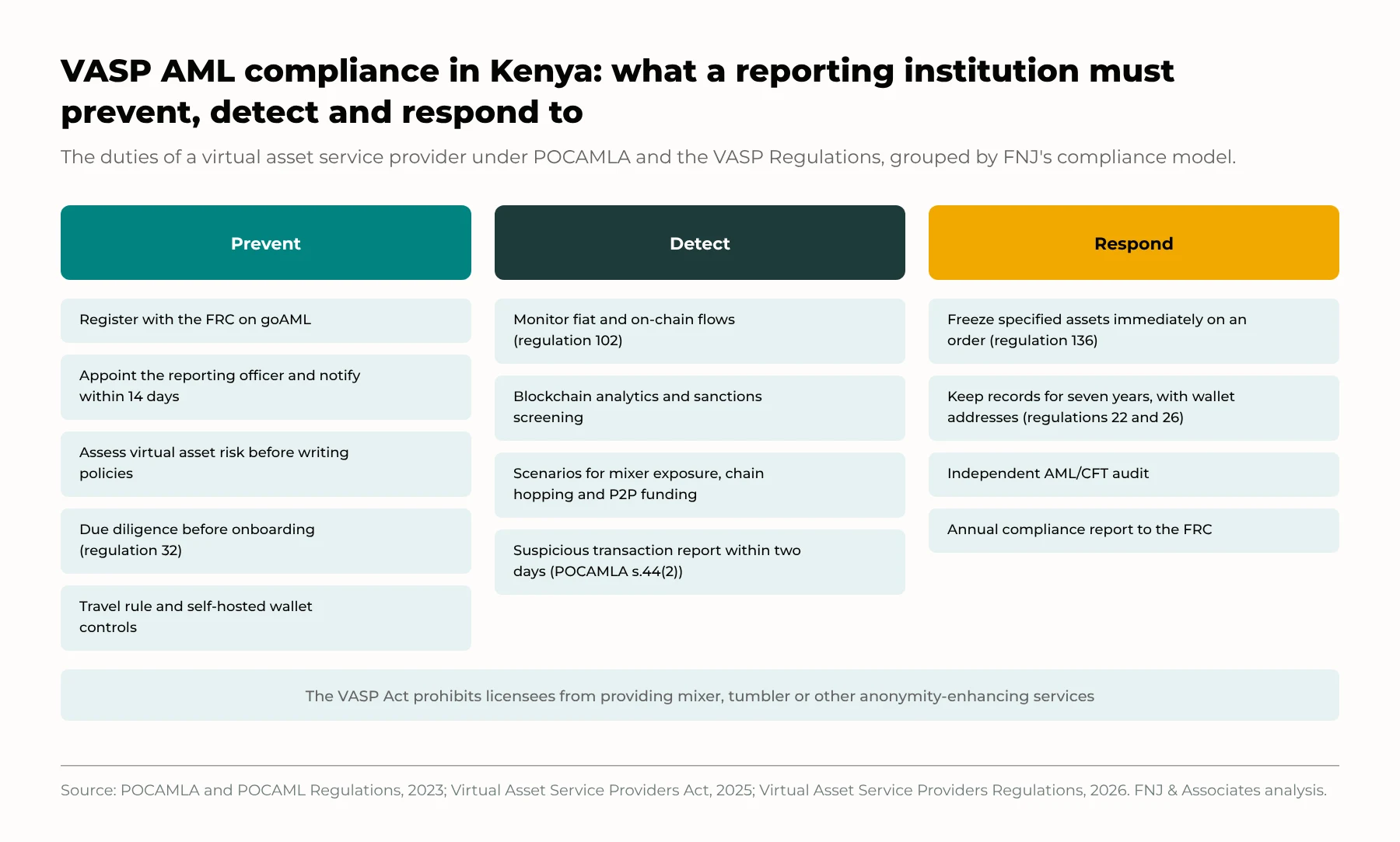
Prevent: registration, risk assessment and due diligence come before the first transaction
Register with the FRC and appoint a reporting officer
The first step in VASP AML compliance in Kenya is registration, because section 47A of POCAMLA requires reporting institutions to register with the FRC, which runs registration and reporting through its goAML system. The institution appoints a money laundering reporting officer at management level and notifies the FRC and its supervisor of the appointment or removal within 14 days. For a VASP, the reporting officer should also be the person who understands how blockchain analytics alerts are generated and closed.
Assess virtual asset risk before writing policies
The 2023 Regulations require a documented and regularly updated money laundering risk assessment. For a VASP, the assessment should cover the services offered (custody, exchange, conversion, payments or offerings), the assets listed, delivery channels, customer types, geographies and counterparty providers. Its conclusions drive the policy set that regulation 6(2) requires in the licence application, so the assessment comes first in any plan for VASP AML compliance in Kenya.
Apply due diligence before onboarding
Regulation 32 requires a licensee to identify and verify consumers before onboarding, in line with POCAMLA. That includes beneficial owners of corporate customers and screening for politically exposed persons, both at onboarding and through the relationship. Our guides to customer due diligence in Kenya and PEP screening after onboarding set out the method.
Build the travel rule now
The Financial Action Task Force (FATF) standard on wire transfers, Recommendation 16, applies to virtual asset transfers. It expects originating and beneficiary providers to obtain, hold and transmit originator and beneficiary information with a transfer. We found no detailed travel rule procedure in the Regulations as gazetted. Even so, foreign counterparties will request travel rule data, and supervisors assess against FATF standards, so we advise providers to build the capability before licensing rather than retrofit it.
Transfers to and from self-hosted wallets need their own controls, so in practice providers verify that the customer owns or controls the wallet and apply higher monitoring to those flows.
Detect: monitoring, screening and a two-day reporting window
Regulation 102 requires a licensee to monitor for market abuse, financial crime, money laundering, terrorism financing and proliferation financing, and regulation 112 adds measures to identify, deter and prevent those risks. For VASP AML compliance in Kenya, monitoring has two halves: fiat flows through the provider’s bank accounts and on-chain flows through its wallets. Blockchain analytics covers the second half, scoring wallet addresses by exposure to illicit sources.
Scenarios that a VASP’s transaction monitoring should run include:
- Deposits traced to mixers, tumblers or other anonymity-enhancing services, which the Act prohibits a licensee from providing.
- Rapid conversion from fiat to virtual assets and out to an external wallet, with no trading activity in between.
- Movement across several chains or assets in quick succession to break the audit trail.
- Wallets linked to sanctioned persons, darknet markets, scams or ransomware, as scored by blockchain analytics.
- Peer-to-peer traders funding accounts from many personal bank accounts or mobile wallets.
- Amounts kept slightly below the provider’s internal review thresholds, repeated across days or linked accounts.
Sanctions screening applies to customers, beneficial owners and, where the data allows, counterparty wallets. When a concern holds after review, section 44(2) of POCAMLA requires a suspicious transaction report to the FRC within two days after the suspicion arose, and tipping off the customer is prohibited.
Respond: freezing orders, seven-year records and an independent audit
Regulations 134 to 141 deal with freezing and seizure orders issued by courts and other lawful authorities. On receiving an order, a licensee immediately freezes the specified virtual assets. That requires the technical ability to block movement from a named wallet or account at short notice, which should be tested before licensing.
Records are the evidence for the other duties, so regulations 22 and 26 require activity and transaction records to be kept for at least seven years, with metadata that includes wallet addresses and network or chain identifiers. The record set should let an investigator rebuild a customer’s full history, both fiat and on-chain.
The programme is then tested, because the 2023 Regulations require an independent audit of the AML/CFT programme and an annual compliance report to the FRC. Our AML/CFT program audit guide covers that work, and our guide to VASP audit requirements in Kenya places it alongside the external and systems audits.
The cost of getting it wrong
Under the VASP Regulations, the regulator may impose administrative fines of up to KES 5m on a company and suspend or revoke its licence. Criminal penalties reach KES 8m for a company, and up to five years’ imprisonment for an individual. POCAMLA carries its own penalties for reporting failures, and weak VASP AML compliance in Kenya also has a commercial cost: banks will review a provider’s programme before opening the accounts the Regulations require.
A 60-day plan for providers preparing their application
The plan below sequences VASP AML compliance in Kenya for a provider that intends to file its licence application within two months.
- Days 1 to 15, register and assess: register with the FRC, appoint the money laundering reporting officer and complete the virtual asset risk assessment.
- Days 16 to 30, write the policies: draft the AML/CFT/CPF policy, due diligence procedures, the travel rule approach and the self-hosted wallet controls.
- Days 31 to 45, build detection: configure monitoring scenarios, sanctions screening and blockchain analytics, and set alert-closure standards.
- Days 46 to 60, train, test and approve: train staff using our AML training for employees, test the freezing process and obtain board approval of the programme.
Licensees can then track the recurring duties in an obligations register, which Trigarc Compliance holds with reminders and evidence in one place. Our guide to AML compliance software in Kenya compares the options.
Disclaimer: this summary of VASP AML compliance in Kenya reflects the law as of 19 November 2026. It is not legal advice. Confirm requirements with the FRC, the CBK or the CMA before you act.
Frequently asked questions
Are VASPs reporting institutions in Kenya?
Yes: the Virtual Asset Service Providers Act, 2025 amended POCAMLA so that a reporting institution includes a virtual asset service provider. The change took effect on 04 November 2025, so VASP AML compliance in Kenya applies now to providers that meet the definition, including registration, due diligence and reporting duties.
Does Kenya have a travel rule for virtual assets?
FATF Recommendation 16 applies the travel rule to virtual asset transfers, and we found no detailed travel rule procedure in the VASP Regulations as gazetted. Counterparties and supervisors still work to the FATF standard, so we advise providers to build the capability before licensing.
How quickly must a VASP report a suspicious transaction?
Within two days after the suspicion arose, under section 44(2) of POCAMLA. The report goes to the Financial Reporting Centre, and the provider must not tip off the customer.
How long must a VASP keep records in Kenya?
At least seven years, and the VASP Regulations require activity and transaction records to include metadata such as wallet addresses and network or chain identifiers.
What does VASP AML compliance in Kenya prohibit?
The Act prohibits a licensee from undertaking mixer, tumbler or other anonymity-enhancing services. Providers should also assess listed assets with privacy features against that prohibition with their regulator.
Can FNJ & Associates help a VASP with AML/CFT?
Yes: FNJ & Associates prepares risk assessments, policies and procedures, trains staff and boards, and performs independent AML/CFT audits. Independence rules mean we do not audit a programme we designed, so we agree the role at the outset.
Further reading
Build an AML/CFT programme the FRC and your regulator will accept
FNJ & Associates helps exchanges, wallet providers, payment processors and token issuers design and test programmes for VASP AML compliance in Kenya, from the risk assessment to the independent audit.
About this research. Requirements are from the Virtual Asset Service Providers Act, 2025, the Virtual Asset Service Providers Regulations, 2026 (Legal Notice No. 134) and the Proceeds of Crime and Anti-Money Laundering Act and Regulations, read on 19 November 2026. The Prevent, Detect and Respond structure, the monitoring scenarios and the 60-day plan are FNJ analysis.
Sources. Virtual Asset Service Providers Act, 2025 (Kenya Law); Virtual Asset Service Providers Regulations, 2026, Legal Notice No. 134 (Kenya Law; CMA copy); Proceeds of Crime and Anti-Money Laundering Regulations, 2023 (National Treasury); CBK and CMA joint public notice, 13 November 2026.
Disclaimer. This article is general information as of 19 November 2026. It is not legal or financial advice. Confirm requirements with the FRC, the CBK, the CMA and your legal counsel before you act.
About FNJ & Associates
FNJ & Associates is an ICPAK-registered CPA firm and a multidisciplinary team of 20+ professionals holding CPA(K), ACCA, CIA, CISA, CFE, CEH, CAMS and CIPP/E credentials, serving more than 100 organisations across Kenya and East Africa. The firm provides AML/CFT risk assessments, programme design, training and independent AML/CFT audits for financial institutions and fintechs, and implements Trigarc Compliance to track regulatory obligations and reporting. Visit fnjassociates.co.ke to learn more.