
Status as of 19 November 2026. In force; no provider licensed yet. Sources are listed at the end.
A licensed virtual asset service provider in Kenya runs five audits across the life of its licence. The Regulations decide who may perform them, how often and when the regulator sees the results.
VASP audit requirements in Kenya begin before the licence is granted and continue for as long as it is held. The Virtual Asset Service Providers Regulations, 2026 (Legal Notice No. 134) require audited financial statements and an independent information systems audit in the application file. After licensing, they add an external auditor approved by the regulator, penetration tests on a fixed cadence and, for stablecoin issuers, quarterly audits of reserve assets.
This guide sets out the five audits, the timetable that follows from them and how a provider can keep its advisory and audit roles separate. It builds on our guide to the VASP licence in Kenya and draws on FNJ & Associates’ practice as an audit firm in Nairobi.
VASP audit requirements in Kenya cover five audits across the licence lifecycle
The five audits differ in purpose, frequency and audience, but they share one feature. The regulator, whether the Central Bank of Kenya (CBK) or the Capital Markets Authority (CMA), decides who is acceptable to perform them.
| Audit | What the Regulations require | When |
|---|---|---|
| External audit of financial statements | An auditor who is a member of the Institute of Certified Public Accountants of Kenya (ICPAK), approved by the regulator, appointed annually and limited to four consecutive financial years | Three years of audited statements at application; annual statements within three months of the year end |
| Independent information systems audit | A report from a suitably qualified person, including a vulnerability assessment and penetration test; later audits by a qualified independent party approved by the regulator | At application, then under the cybersecurity regime |
| Vulnerability assessment and penetration test | Testing of systems that hold or move client assets and data | Twice in the first licensed year, then at least annually |
| Stablecoin reserve audit | An independent audit of reserve assets by an approved auditor, with a summary published on the issuer’s website | Quarterly, with proof to the CBK by the 10th day after the quarter ends |
| Independent AML/CFT audit | A test of the anti-money laundering programme of a reporting institution | Periodically, as the institution’s programme sets |
Source: regulations 6(2), 78, 82, 90 to 92 and 97, Virtual Asset Service Providers Regulations, 2026; Proceeds of Crime and Anti-Money Laundering Regulations, 2023.
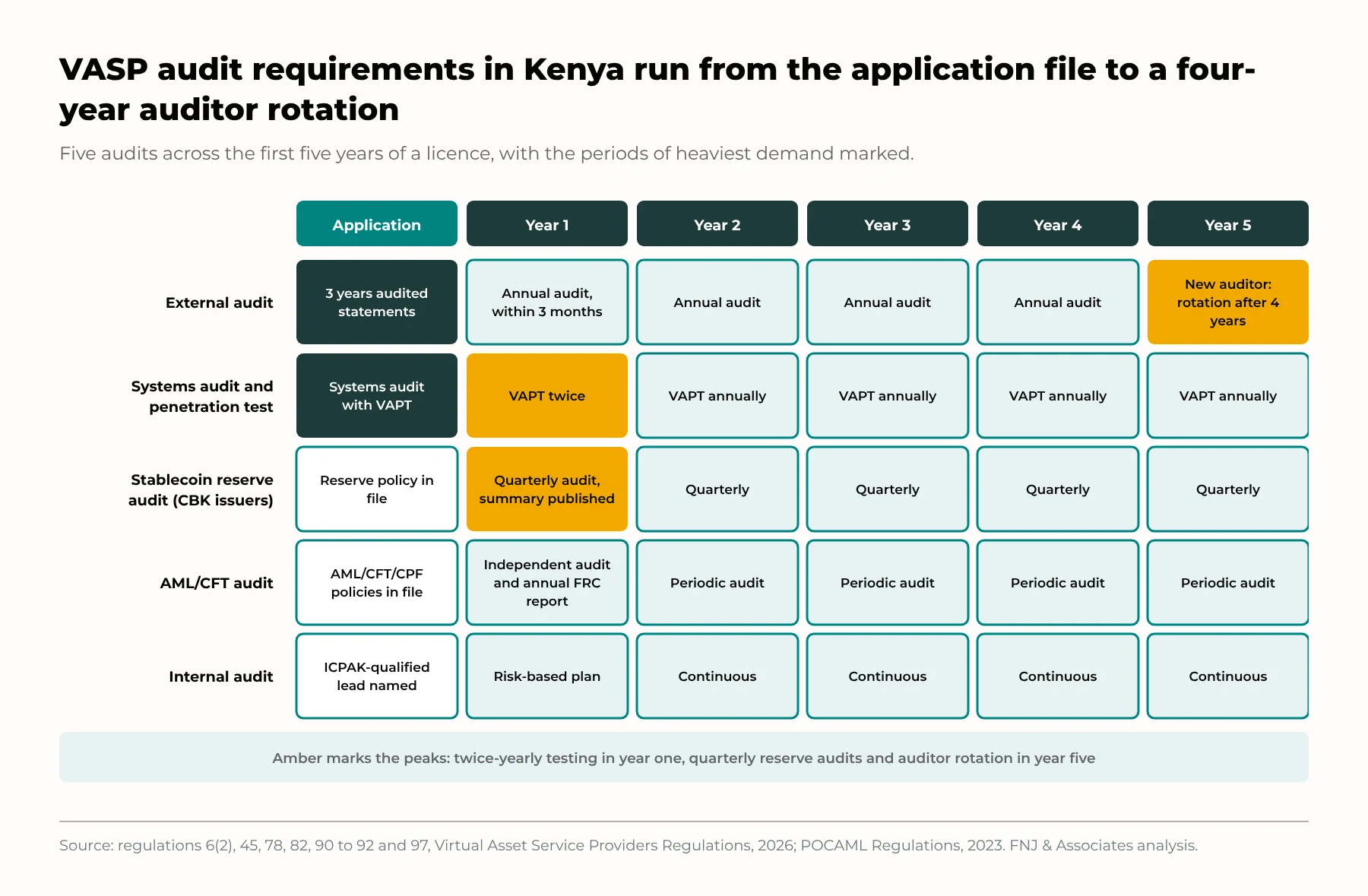
The external auditor is an ICPAK member approved by the regulator, for at most four years
Regulation 90 sets the terms of the external audit, under which a licensee appoints its external auditor with the approval of the relevant regulator. The auditor must be a member in good standing of ICPAK. The appointment is annual, and an auditor may serve for a maximum of four consecutive financial years.
The regulator keeps wide powers over the engagement, since it may require the auditor to submit reports, extend the scope of the audit or carry out specific examinations. It may also decline or revoke an appointment where the auditor has contravened the Act. Where an audit report is qualified because of the licensee’s records, regulation 91 requires the auditor to report in writing to the regulator and the licensee within seven days.
Regulation 92 fixes the reporting rhythm, under which quarterly financial statements reach the regulator by the 10th day of the month after the quarter ends, and capital and liquidity reports follow monthly. Audited annual financial statements are due within three months of the financial year end, so a December year end gives a 31 March deadline.
Two implications for planning
First, four years is shorter than many institutions are used to, and because the regulator approves the incoming auditor, a licensee should begin succession planning in the third year rather than the fourth. Second, applicants need audit history before they apply, because regulation 6(2)(i) requires three years of audited financial statements or, for a new applicant, verified opening statements. Regulation 6(2)(j) adds three years of consolidated statements for a foreign parent.
Where audit effort is likely to concentrate
In our view, five areas will draw most of the external auditor’s time in a first VASP audit:
- Client assets: whether client virtual assets and client money are segregated, reconciled and held at banks licensed in Kenya, as the Regulations require.
- Existence and control of virtual assets: evidence that the licensee controls the keys to the wallets it reports, and that balances agree to the blockchain.
- Capital and liquidity: paid-up and liquid capital tested against the Fifth Schedule, including the extra 50% per additional activity.
- Revenue: completeness of trading, custody and conversion fees, which also drive the excise duty base.
- Related parties: transactions with shareholders, group platforms and market makers, which auditors test for pricing and disclosure.
Systems audits and penetration tests run twice in the first year, then annually
Among the VASP audit requirements in Kenya, the cybersecurity regime turns a one-off application requirement into a recurring audit. Regulation 6(2)(l) requires the application to include an independent information systems audit report, with a vulnerability assessment and penetration test, prepared by a person with relevant qualifications and competence. After licensing, regulation 97(4)(a) requires vulnerability assessments and penetration tests twice in the first year of licensing and at least once a year after that.
Regulation 97 also requires the licensee, subject to the regulator’s approval, to appoint a qualified independent party to audit its systems and controls, and it sets independence criteria for that party. Regulation 100 requires the audit report to be prepared by a fit and proper person responsible for cybersecurity audit. The regulator may also commission its own audit or investigation at any time under regulation 98.
Three related duties shape the scope, starting with the appointment of a chief information security officer or equivalent. The licensee also reports cybersecurity incidents to the regulator within 24 hours of discovery and files a detailed report within five working days. Loss of keys and unauthorised transactions are also reportable within 24 hours. The systems audit should therefore test incident detection and escalation, not only technical controls. Our GRC advisory in Kenya covers the assessment and penetration testing work that sits alongside the audit.
Stablecoin issuers face a quarterly reserve audit and must publish a summary
The strictest of the VASP audit requirements in Kenya falls on CBK-licensed stablecoin issuers. Regulation 82 requires the issuer to appoint an approved auditor and to obtain a quarterly independent audit of its reserve assets. Proof of the audit report reaches the CBK by the 10th day of the month after the quarter ends. The issuer also obtains annual reviews of its systems and controls and of its redemption policies.
Transparency is part of the design, as regulation 78(b) requires the issuer to publish a summary of the audit report on its reserve assets. Quarterly stress tests, with results filed by the same 10th-day deadline, sit alongside the audit. The audit tests the rules that our guide to VASP regulations in Kenya for banks describes. Reserve assets must at least equal the stablecoins in issue, and at least 30% of funds received must sit in trust accounts at commercial banks in Kenya.
Internal audit and the AML/CFT audit complete the assurance picture
VASP audit requirements in Kenya also reach the internal audit function. The Regulations require the persons who manage the finance and internal audit functions to be members in good standing of ICPAK or an equivalent recognised body. The board may establish an audit committee, but delegation does not discharge the board’s own duties. Many smaller licensees will meet the internal audit requirement through outsourced internal audit, which needs the regulator’s approval at least 30 days before an outsourcing arrangement starts.
A licensee is also a reporting institution under the Proceeds of Crime and Anti-Money Laundering Act, so the independent audit duty in the 2023 Regulations applies. Our guide to VASP AML compliance in Kenya sets out the programme that audit tests, and our AML/CFT program audit guide covers the approach.
Independence rules mean a VASP chooses its adviser and its auditors separately
Professional independence standards that apply to ICPAK members limit what an auditor may do for an audit client. A firm that prepares a client’s business plan, projections or policies cannot then audit the statements or controls built on that work without a self-review threat. The Regulations add their own independence criteria for the systems auditor.
For a VASP, this means four roles that should be allocated early and in writing:
- Licence adviser: prepares the business plan, the policy set and the fit and proper documentation.
- External auditor: audits the financial statements, with the regulator’s approval, for up to four years.
- Independent systems auditor: performs the information systems audit and penetration tests, with the regulator’s approval.
- Internal audit provider: tests controls through the year and reports to the board or audit committee.
One firm cannot hold the first role and the second or third for the same client. FNJ & Associates applies this rule: for a given VASP, we either advise on the application or act as an auditor, not both. Meeting VASP audit requirements in Kenya is easier when this split is settled before the file is submitted, because the regulator will review the auditors named in it.
An audit calendar for a licensed VASP
| Frequency | Audit or report | Deadline |
|---|---|---|
| Within 24 hours | Cybersecurity incident, loss of keys or unauthorised transaction | Detailed report within five working days |
| Within seven days | Auditor’s report on a qualified opinion over records | To the regulator and the licensee |
| Monthly | Capital and liquidity report | As the regulator directs |
| Quarterly | Financial statements; for stablecoin issuers, reserve audit proof and stress test results | By the 10th day of the following month |
| Twice in year one, then annually | Vulnerability assessment and penetration test | Under the cybersecurity programme |
| Annually | Audited financial statements; auditor reappointment with approval; stablecoin reviews of systems and redemption | Statements within three months of the year end |
| Four-yearly | External auditor rotation | Approval of the incoming auditor before appointment |
Source: regulations 75, 82, 90 to 92, 97 and 99, Virtual Asset Service Providers Regulations, 2026.
A calendar of VASP audit requirements in Kenya belongs in the compliance obligations register rather than in individual diaries. Our statutory compliance calendar guide shows how to assign owners and evidence, and Trigarc Compliance tracks the deadlines for licensees that prefer a system to a spreadsheet.
Disclaimer: this summary of VASP audit requirements in Kenya reflects the Regulations as of 19 November 2026. It is not legal or audit advice. Confirm requirements with the CBK or the CMA before you appoint auditors.
Frequently asked questions
Who can audit a VASP in Kenya?
An external auditor of a VASP in Kenya is a member in good standing of ICPAK, approved by the CBK or the CMA. The auditor is appointed annually and may serve for a maximum of four consecutive financial years. The regulator may decline or revoke an appointment where the auditor has contravened the Act.
What are the VASP audit requirements in Kenya at the application stage?
The application includes three years of audited financial statements, or verified opening statements for a new applicant, and three years of consolidated statements for a foreign parent. It also includes an independent information systems audit report with a vulnerability assessment and penetration test.
How often must a VASP run penetration tests in Kenya?
Twice in the first year of licensing and at least once a year after that, which makes testing the most frequent of the VASP audit requirements in Kenya after the quarterly reserve audit for stablecoin issuers. The licensee also appoints a qualified independent party, approved by the regulator, to audit its systems and controls.
Do stablecoin issuers need a reserve audit?
Yes: a CBK-licensed stablecoin issuer appoints an approved auditor, obtains a quarterly independent audit of its reserve assets and sends proof to the CBK by the 10th day of the following month. It also publishes a summary of the audit report on its website so that holders can see the result.
Can the same firm prepare the licence application and audit the VASP?
No, because independence standards stop a firm from auditing statements or controls built on its own advisory work. FNJ & Associates either advises on the application or acts as an auditor for a given VASP, and we recommend settling these roles before the file is submitted.
Further reading
Plan your VASP audit and assurance cycle
FNJ & Associates provides external audits, independent information systems audits and AML/CFT audits for virtual asset service providers that use another adviser for their licence file and need to meet VASP audit requirements in Kenya. Where we prepare the application, we work alongside the auditors you appoint.
About this research. Requirements are from the Virtual Asset Service Providers Act, 2025 and the Virtual Asset Service Providers Regulations, 2026 (Legal Notice No. 134), read on 19 November 2026, and from the Proceeds of Crime and Anti-Money Laundering Regulations, 2023. The five-audit grouping, the areas of audit focus and the role allocation are FNJ analysis.
Sources. Virtual Asset Service Providers Act, 2025 (Kenya Law); Virtual Asset Service Providers Regulations, 2026, Legal Notice No. 134 (Kenya Law; CMA copy); Proceeds of Crime and Anti-Money Laundering Regulations, 2023 (National Treasury); CBK and CMA joint public notice, 13 November 2026.
Disclaimer. This article is general information as of 19 November 2026. It is not legal, audit or financial advice. Confirm requirements with the CBK, the CMA and your advisers before you act.
About FNJ & Associates
FNJ & Associates is an ICPAK-registered CPA firm and a multidisciplinary team of 20+ professionals holding CPA(K), ACCA, CIA, CISA, CFE, CEH, CAMS and CIPP/E credentials, serving more than 100 organisations across Kenya and East Africa. The firm provides external and internal audit, information systems audits, AML/CFT audits and licence application support for financial institutions and fintechs, and implements Trigarc Compliance to track regulatory obligations and reporting. Visit fnjassociates.co.ke to learn more.