
Status as of 19 November 2026. In force; no provider licensed yet. Sources are listed at the end.
Licensed VASPs must bank in Kenya, and stablecoin issuers hold at least 30% of the funds they receive in trust accounts at Kenyan banks. VASP banking is now a regulated relationship that needs a risk appetite, onboarding checks and monitoring.
The VASP regulations in Kenya make banks part of the virtual asset market, whether or not a bank offers a virtual asset product. Licensed providers hold their client and company accounts at banks licensed in Kenya. Stablecoin issuers keep at least 30% of the funds they receive in trust accounts at Kenyan commercial banks. In a joint public notice on 13 November 2026, the Central Bank of Kenya (CBK) and the Capital Markets Authority (CMA) directed providers to apply for licences and confirmed that none had yet been licensed. Banks should therefore expect requests for accounts to follow as licences are granted.
In brief, the Virtual Asset Service Providers (VASP) Regulations, 2026 (Legal Notice No. 134, gazetted 22 July 2026) license ten categories of provider under the VASP Act, 2025. They set paid-up capital from nil to KES 300m and require independent boards, qualified control functions and segregated client assets, and our guide to the VASP licence in Kenya covers licensing in detail.
This article covers what the rules mean for VASP banking relationships: where client money will sit, how to onboard providers, which red flags to monitor, what boards should test and what to do in the next 90 days. It forms part of FNJ & Associates’ work on GRC advisory in Kenya.
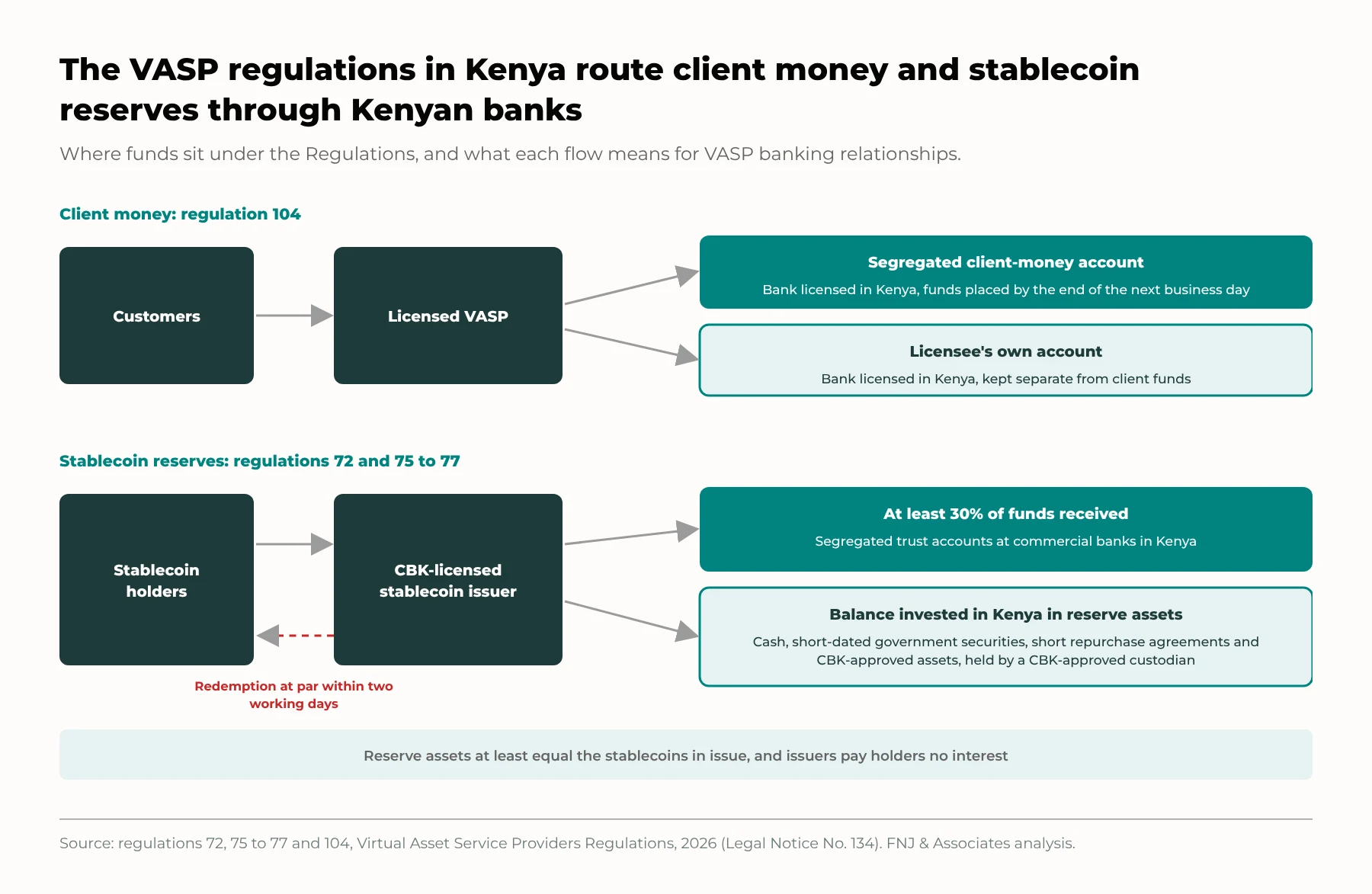
The VASP regulations in Kenya route client funds and reserves through Kenyan banks
Three provisions in the Regulations create direct demand for banking services, and the table below sets out what they mean for a bank.
| Provision | What it requires | What it means for a bank |
|---|---|---|
| Regulation 104 | Client and licensee accounts are held at a bank licensed in Kenya. Consumer funds are placed with a bank or financial institution by the end of the business day after receipt, in accounts separate from the licensee’s own funds. | Segregated client-money accounts, daily inflows and reconciliation support |
| Regulation 77 | A stablecoin issuer holds at least 30% of funds received in segregated trust accounts at commercial banks in Kenya, and invests the balance in Kenya in permitted reserve assets. | Trust account mandates and concentrated, redeemable balances |
| Regulations 75 and 76 | Reserve assets at least equal outstanding stablecoins. They are limited to cash, short-dated government securities, short repurchase agreements and assets the CBK approves, and are held by a CBK-approved custodian. | Deposit, custody and liquidity planning for reserve balances |
Source: Virtual Asset Service Providers Regulations, 2026 (Legal Notice No. 134).
Stablecoin issuers keep 30% of funds at Kenyan banks and pay holders no interest
The stablecoin reserve requirement
Under the VASP regulations in Kenya, reserve assets at least equal the stablecoins in issue, and 30% of the funds received sits in segregated trust accounts at commercial banks in Kenya. Holders may redeem at any time, and the issuer processes redemption at par within two working days. Reserve balances at a bank can therefore fall quickly, which matters for liquidity planning.
The stablecoin interest prohibition
Regulation 72 bars an issuer from paying interest on a stablecoin, so the issuer, not the holder, bears the profits, losses and risks of investing the reserve. A bank that prices trust balances therefore negotiates returns with the issuer alone.
A licensed provider is a regulated customer, but the bank’s own due diligence still applies
A licensed provider is a reporting institution under the Proceeds of Crime and Anti-Money Laundering Act. It runs its own anti-money laundering, counter-terrorist financing and counter-proliferation financing (AML/CFT/CPF) programme, supervised by its regulator. That status supports a risk-based relationship, but it does not replace the bank’s own due diligence. Our guide to VASP AML compliance in Kenya describes the programme a provider should be able to show.
Four checks fit into the bank’s existing onboarding process, and together they show whether a provider is licensed, operating and properly controlled.
- Licence status: confirm the provider on the CBK or CMA register, and record the licence category and conditions, since the Act requires both regulators to publish registers. A licensee starts business within 12 months of the grant, so a licence alone does not show that a provider is operating.
- Scope of services: match the services the provider describes to the categories it is licensed for. Conversion to or from foreign currency needs a separate CBK authorisation that runs to 31 December of the year of issue.
- Governance evidence: request the board composition, the compliance officer’s details and the most recent independent systems audit, which the Regulations require of a licensee.
- Flow of funds: understand which accounts hold client funds, which hold the provider’s own funds and how the provider reconciles them. Licensees file monthly returns with their regulator by the 10th day of the following month, which gives the bank a reference point for those reconciliations.
Ongoing due diligence then follows the bank’s existing approach, including PEP screening after onboarding for the provider’s directors, significant shareholders and beneficial owners.
A bank that offers virtual asset services needs its own licence and capital
Under the VASP regulations in Kenya, a bank or subsidiary that plans custody, payment processing or another virtual asset service applies for the relevant licence like any other company. Where an applicant already operates in a regulated sector, the Act requires a no-objection from its existing regulator. Licence capital for virtual asset services sits outside prudential capital planning; a wallet provider licence, for example, requires paid-up capital of KES 150m.
Red flags in virtual asset flows that bank monitoring should catch
Monitoring is where VASP banking risk shows first. Customers already move money to and from platforms, and the account of a licensed provider concentrates many customers’ flows in one place. FNJ & Associates groups the warning signs into three sets, mapped to scenarios a transaction monitoring system can run.
Customer accounts: flows to platforms that are not licensed
- Regular transfers to platforms, wallets or payment intermediaries that do not appear on the CBK or CMA register once the registers are published.
- Rapid in-and-out movement, such as salary or business receipts sent to a platform on the day they arrive, or platform receipts withdrawn in cash at once.
- Several unrelated customers funding the same platform account, paybill or mobile number, often in similar amounts over a short period.
- Platform turnover out of line with the customer’s declared occupation, income or business, particularly where it appears suddenly.
- Amounts kept slightly below the bank’s internal review or reporting thresholds, repeated across days or linked accounts.
Provider accounts: client money that does not behave like client money
- Client-money balances that move without matching customer receipts or payouts, or that fall sharply against the provider’s usual pattern.
- Transfers from the segregated client account to the provider’s own account, related parties or offshore counterparties without a clear fee or withdrawal basis.
- Cross-border payments to exchanges or custodians outside the services the provider is licensed for, or in jurisdictions it has not disclosed.
- A sudden shift in banking pattern, such as new accounts at other banks or a move to cash.
- For stablecoin issuers, trust balances that fall without matching redemption payments to holders.
Sanctions and anonymity: prohibited services and screening hits
- Payments linked to mixers, tumblers or other anonymity-enhancing services, which the Act prohibits a licensee from providing.
- Counterparties, platforms or wallet addresses linked to persons under targeted financial sanctions, identified through screening or blockchain analytics.
- Customers who decline to explain the source of virtual asset proceeds credited to their accounts, or who give explanations the bank cannot verify.
No single red flag proves wrongdoing, so the bank reviews alerts in the context of the customer’s profile before acting. Where a concern holds after review, the bank files a suspicious transaction report with the Financial Reporting Centre under the Proceeds of Crime and Anti-Money Laundering Act, as it would for any other customer. The board questions below test whether these scenarios exist and work in practice.
Boards can test readiness with six questions
Directors do not need technical knowledge of virtual assets to oversee this risk, because six questions give the board a clear view of the bank’s exposure and readiness.
- What is our risk appetite for banking licensed providers, and who approved it?
- How many existing customers already send funds to virtual asset platforms, and what is the value?
- Has the institutional money laundering risk assessment been updated for the VASP regulations in Kenya?
- If we hold client-money or stablecoin trust accounts, how do we manage concentration and redemption liquidity?
- Can our monitoring systems identify flows to unlicensed platforms?
- Have the money laundering reporting officer, operations and front-line teams been trained on the new regime?
The answers belong in the board risk report, and decisions on risk appetite reach the board through a board pack organised around decisions.
Banks should complete three updates in the next 90 days
Existing customers already send funds to virtual asset platforms, so the VASP regulations in Kenya change a bank’s risk profile before it opens a single provider account. Three updates, completed in this order over 12 weeks, prepare a bank for the first licensed providers and the account requests that will follow.
- Weeks 1 to 4, size the exposure and set appetite: identify customers and flows linked to virtual asset platforms, then seek board approval of a risk appetite for licensed providers, pending applicants and unlicensed platforms.
- Weeks 5 to 8, update the three core documents: add virtual asset segments to the institutional risk assessment, and set acceptance criteria and approval levels in the customer acceptance policy. Then add monitoring scenarios for the red flags above, and include the segment in the compliance monitoring plan.
- Weeks 9 to 12, train and report: train front-line, operations and compliance staff, then report the updated position to the board against the six questions above.
These steps extend an existing AML/CFT programme rather than create a new one, and the same sequence suits microfinance banks, SACCOs and insurers whose customers trade virtual assets.
Frequently asked questions
Do the VASP regulations in Kenya apply to banks?
The VASP regulations in Kenya apply to any company that provides virtual asset services, including a bank or its subsidiary. A bank that only provides accounts to licensed providers is not a virtual asset service provider, but it remains bound by its own AML/CFT obligations for those customers.
Which VASPs are licensed in Kenya?
None yet: in their joint public notice of 13 November 2026, the CBK and the CMA stated that they had not licensed any VASPs under the Act to operate in or from Kenya. Until the registers are published, a bank should treat a platform that claims to be licensed as unverified.
Can a bank open an account for a crypto exchange?
The Regulations expect licensed providers to hold client and company accounts at a bank licensed in Kenya, but the decision to onboard a provider rests with the bank’s risk appetite and due diligence. Confirming licence status on the CBK or CMA register is the first step in that process.
Does a VASP license in Kenya make a provider low risk for a bank?
No: a VASP license in Kenya shows that a regulator has assessed the provider, which supports a risk-based relationship. The bank still applies its own due diligence, sets limits under its risk appetite and monitors the account for red flags such as flows to unlicensed platforms.
What is the difference between the VASP Act and the VASP Regulations?
The Virtual Asset Service Providers Act, 2025 sets the framework: the licence requirement, the two regulators, offences and the one-year transition. The VASP regulations in Kenya, gazetted as Legal Notice No. 134 on 22 July 2026, set the detail: application requirements, capital, governance, AML/CFT/CPF, cybersecurity, client assets and stablecoin reserves.
How should a bank treat customers who trade virtual assets?
A bank applies its risk-based approach under the Proceeds of Crime and Anti-Money Laundering Act, identifying those customers as a risk segment, monitoring flows to and from platforms and checking whether the platforms are licensed. FNJ & Associates supports this work through risk assessment reviews, independent AML/CFT audits and training for staff and boards.
Further reading
Update your AML/CFT risk assessment for virtual assets
FNJ & Associates helps banks, microfinance banks and SACCOs across Kenya prepare for licensed virtual asset providers, with practical support that runs from risk assessment reviews to independent AML/CFT audits and board training.
Request an AML/CFT audit or review Book a Trigarc demo with FNJ
About this research. Requirements, fees and capital are from the Virtual Asset Service Providers Act, 2025 and the Virtual Asset Service Providers Regulations, 2026 (Legal Notice No. 134), read on 13 and 14 November 2026 and reviewed on 19 November 2026, and from the CBK and CMA joint public notice of 13 November 2026. Groupings, sequencing and implications are FNJ analysis.
Sources. Virtual Asset Service Providers Act, 2025 (Kenya Law); Virtual Asset Service Providers Regulations, 2026, Legal Notice No. 134 (Kenya Law; CMA copy); Proceeds of Crime and Anti-Money Laundering Act (Kenya Law); CBK and CMA joint public notice, 13 November 2026.
Disclaimer. This article is general information as of 19 November 2026. It is not legal, tax or financial advice. Confirm requirements with the CBK and your legal counsel before you act.
About FNJ & Associates
FNJ & Associates is an ICPAK-registered CPA firm and a multidisciplinary team of 20+ professionals holding CPA(K), ACCA, CIA, CISA, CFE, CEH, CAMS and CIPP/E credentials, serving more than 100 organisations across Kenya and East Africa. The firm provides licence application support, AML/CFT audits, compliance and risk advisory, and internal audit for financial institutions and fintechs, and implements Trigarc Compliance to track regulatory obligations and reporting. Visit fnjassociates.co.ke to learn more.